USAID DEC
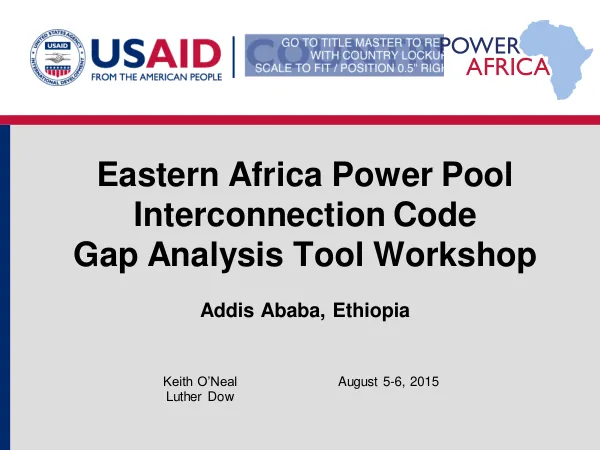
Eastern Africa Power Pool Interconnection Code Gap Analysis Tool Workshop
The Eastern Africa Power Pool Interconnection Code Gap Analysis Tool Workshop was held on August 5-6, 2015, in Addis Ababa, Ethiopia.
2015 · 71 pages
Sign in to readA free account is required to download.
Abstract
The workshop aimed to familiarize participants with the EAPP Interconnection Code Gap Analysis Tool and its application in ensuring compliance with minimum reliability requirements. The tool is designed to help grid operators and planners identify gaps in their systems and take necessary steps to meet EAPP IC and standards. The importance of grid codes and standards was highlighted through a review of historical blackouts in the United States. The 2003 US blackout, which affected 50 million people and resulted in an estimated $10 billion economic loss, led to the passage of the 2005 Federal Power Act. The act authorized the Federal Energy Regulatory Commission (FERC) to implement mandatory reliability standards, which were previously voluntary. FERC selected the North American Electric Reliability Corporation (NERC) to develop standards and monitor compliance, with responsibility delegated to eight regional entities across the US. The US experience has shown that electricity infrastructure is the single most important infrastructure, and its reliability is critical to economic and social stability. The development of mandatory reliability standards has improved grid resilience and reduced the risk of blackouts. The EAPP Interconnection Code Gap Analysis Tool is designed to replicate this success in Eastern Africa, where the increasing number of interconnections, load, and generation pose significant reliability challenges. The workshop focused on the history of blackouts, including the 1977 New York City blackout and the 1965 Northeast US blackout. These events highlighted the need for standards and codes to ensure grid reliability. The importance of infrastructure, including water, gas, communication, sanitation, cyber, and government operations, was also emphasized. The workshop participants were expected to learn how to use the Gap Analysis Tool to identify gaps in their systems and take necessary steps to meet EAPP IC and standards. The workshop included hands-on experience with the Gap Analysis Tool, allowing participants to apply their knowledge in a practical setting. The tool is designed to be user-friendly and accessible to grid operators and planners, enabling them to identify areas for improvement and develop strategies to address them. The workshop concluded with a discussion of future considerations and the potential for the EAPP Interconnection Code Gap Analysis Tool to improve grid reliability in Eastern Africa.