USAID DEC
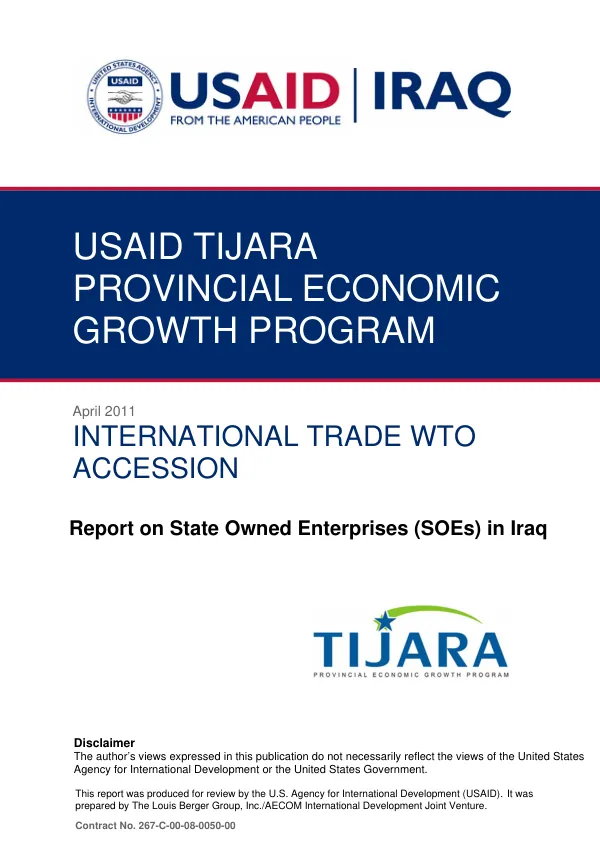
Economic Assessment of Iraqi Agricultural Sector Reforms: State Owned Enterprises (SOEs) in Iraq
Sign inUSAID DEC
Economic Assessment of Iraqi Agricultural Sector Reforms: State Owned Enterprises (SOEs) in Iraq
Iraq's state-owned enterprises (SOEs) have a long history of dominance in the country's economy.
2011 · 37 pages
Sign in to readA free account is required to download.
Abstract
Prior to 2003, the state controlled key sectors of the economy, with public enterprises operating under high protection and input and output prices heavily subsidized. Non-Arab foreign direct investment was forbidden, and the UN sanctions imposed in 1991 effectively closed the economy. Most of Iraq's pre-2003 trade was conducted through the oil-for-food program. A parallel economy managed by Saddam family members flourished during sanctions, with a negative impact on governance and the poor. The state of Iraq's SOEs deteriorated significantly, with de-capitalization of assets, lack of access to modern technology, and no incentives to increase productivity. Many SOEs are now uncompetitive and are expected to bear the brunt of adjustment as Iraq transitions to a more market-oriented global economy. The transition from SOEs to a market economy will inevitably result in significant job losses, which will need to be managed to avoid social crises. Indications are that SOEs are not likely to attract much interest from investors, given their current financial state. The interim Iraq Government in 2004 was not in a position to dispose of SOE assets, and privatization was not a short-term option. However, with the establishment of a new "representative and inclusive" government, privatization may become a more viable option if a legal and regulatory framework for privatization can be implemented. Effective SOE reform is essential for the Iraqi economy to return to its position as one of the leading economies in the region. Reform will be necessary to meet the aspirations and expectations of the Iraqi people to live in a modern, successful economy that creates jobs and wealth, drives growth, and allows open and equitable participation in the world economy. Other countries have faced similar problems and adopted a range of different approaches to SOE reform. The World Bank, USAID, and other international donors and organizations have had extensive dialogue with Iraqi policymakers on SOE reform options, and this dialogue continues. U.S. policymakers have attempted various strategies to bring Iraq's SOEs into a more competitive economic position, including the plan to sell most SOEs to the highest bidder to bring in fresh capital, streamline operations, and boost profits. However, foreign investors were not attracted to the uncertain political and security situation in Iraq, and the plan to sell SOEs was not successful. The current situation with Iraq's SOEs is complex, and a comprehensive approach to reform is necessary to address the challenges facing the sector. This approach should involve a combination of privatization, restructuring, and modernization of SOEs, as well as the development of a legal and regulatory framework for privatization. The World Trade Organization (WTO) accession process has also highlighted the need for Iraq to reform its SOEs and improve its trade policies. The WTO accession process requires Iraq to commit to a set of trade liberalization and reform measures, including the privatization of SOEs and the reduction of trade barriers. The successful implementation of these measures will be critical to Iraq's accession to the WTO and its integration into the global economy. In conclusion, the situation with Iraq's SOEs is complex and challenging, and a comprehensive approach to reform is necessary to address the challenges facing the sector. The World Bank, USAID, and other international donors and organizations have had extensive dialogue with Iraqi policymakers on SOE reform options, and this dialogue continues. The successful implementation of a comprehensive reform program will be critical to Iraq's economic development and its integration into the global economy.
Related documents