USAID DEC
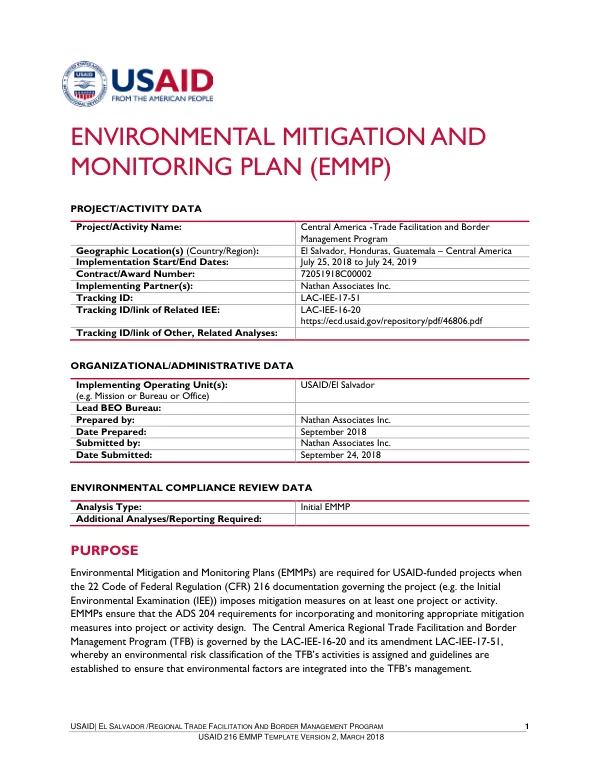
Environmental Mitigation and Monitoring Plan (EMMP) for Central America Regional Trade Facilitation and Border Management Program
Sign inROBERT NATHAN ASSOCIATES
Environmental Mitigation and Monitoring Plan (EMMP) for Central America Regional Trade Facilitation and Border Management Program
The Central America Regional Trade Facilitation and Border Management (TFB) Program is a five-year activity, implemented between July 2018 and July 2023, with the core objective of improving regional trade efficiency in Northern Triangle (NT) Countries, including El Salvador, Guatemala, and Honduras.
2018 · 17 pages
Sign in to readA free account is required to download.
Abstract
The program aims to reduce crossing times at borders and the time and cost for the private sector to import and export. The TFB Program is built upon the work of its predecessors, the Regional Trade and Market Alliances Project (2013-2018) and the Regional Trade Facilitation Expansion Activity (2016 – 2018), and focuses on enhancing economic integration in Central America with emphasis on the NT and supporting comprehensive implementation of the World Trade Organization-Trade Facilitation Agreement. The activities to be implemented under the TFB's Work Plan for Year 1 (Y1) are categorized into two components. Component 1, Central America Economic Integration Enhanced With Emphasis In The Northern Triangle, includes activities such as optimizing border processes, supporting customs union integration, developing an integrated border management certification, improving border control systems and facilities, and improving sanitary registration processes and interconnectivity of systems. These activities are classified as low-risk categorical exclusions. Component 2, Comprehensive Implementation of the WTO Trade Facilitation Agreement Supported, includes activities such as strengthening national trade facilitation committees, implementing and improving Authorized Economic Operator (AEO) programs, and supporting the International Monetary Fund's (IMF) Integrated Regional Risk Management Strategy. These activities are also classified as low-risk categorical exclusions. The Environmental Mitigation and Monitoring Plan (EMMP) describes the actions that will be implemented to avoid, reduce, or mitigate any possible adverse environmental effects associated with activities that include small-scale construction to improve border facilities and fall into a medium-risk category. The TFB team will prepare an amendment to the EMMP for USAID review and approval if any new demand-driven activity, which falls into a Negative Determination with Conditions (NDwC) category, is included as part of the Work Plan for Y1. The EMMP is guided by the following regulations and guidelines: Title 22, CFR 216: Agency Environmental Procedures, Initial Environmental Evaluation (IEE) IIE LAC-IEE-16-20 and LAC-IEE-17-51, and government regulations and guidelines. The implementation of the TFB activities and the definition and execution of mitigation actions established in the EMMP shall be guided by these regulations and guidelines. The TFB Program will also integrate gender and social inclusion (GSI) practices on both categorical exclusion and NDwC activities to foster buy-in and investment to promote women's empowerment in public and private institutions, or relevant groups indirectly or directly associated with trade and customs matters. The EMMP presents the following components: Scope of the TFB Program, Monitoring Tables, and Climate Risk Management Chart (CRM). The CRM presents the risks arising from climatic variability that may impede or affect the implementation of TFB's work plan activities. This assessment allows the identification of measures for an adaptive management of these risks so that they do not affect TFB implementation capacity. The EMMP was prepared by Nathan Associates Inc. and submitted to USAID/El Salvador on September 24, 2018. The EMMP was approved by Lorena Aceto, Activity Manager/A/COR, on September 24, 2018, and cleared by Alexandra Hadzi-Vidanovic, Regional Mission Environmental Officer, on September 24, 2018, and Joe Torres, Regional Environmental Advisor, on September 24, 2018.