INTERNATIONAL ORGANIZATION FOR MIGRATION
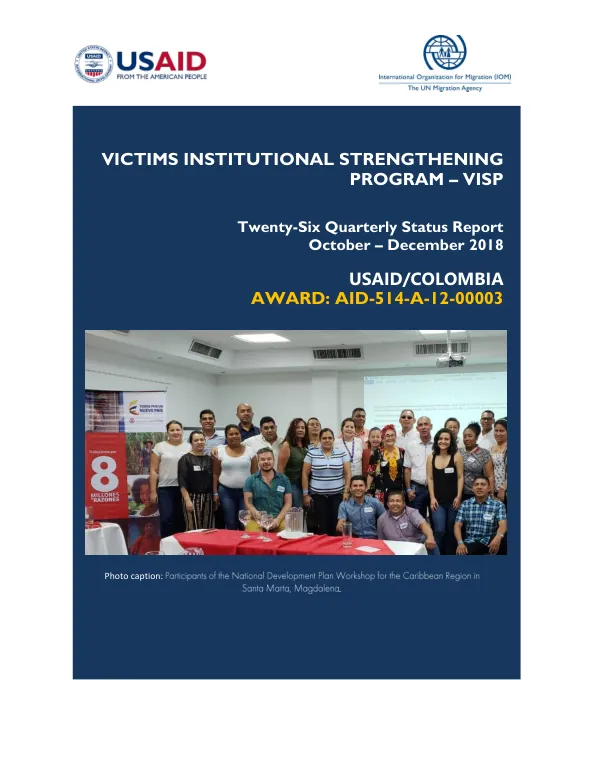
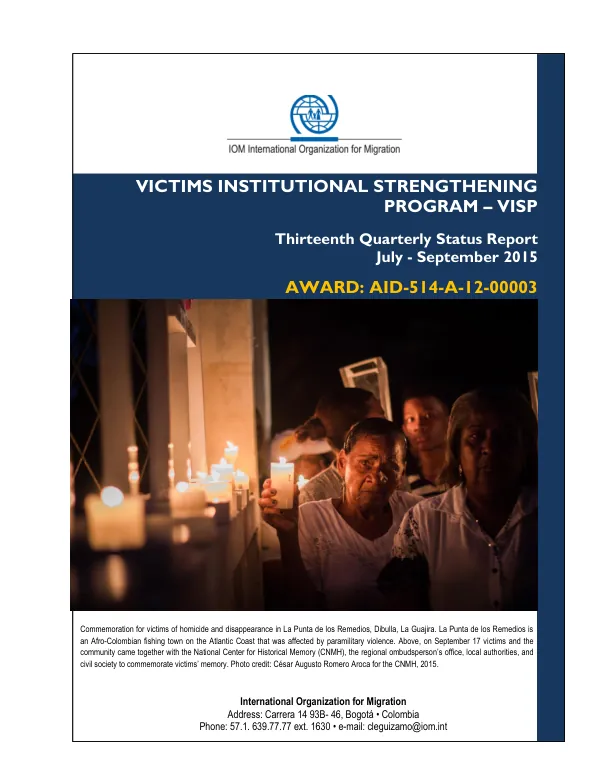
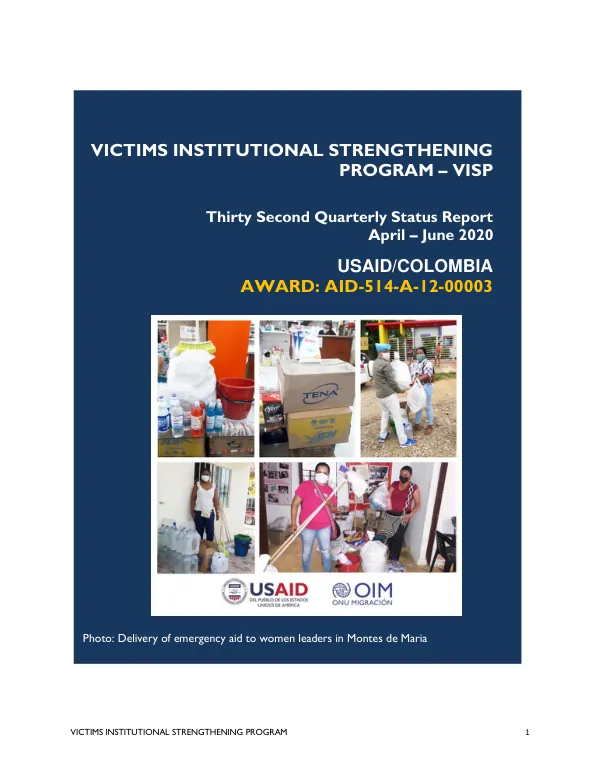
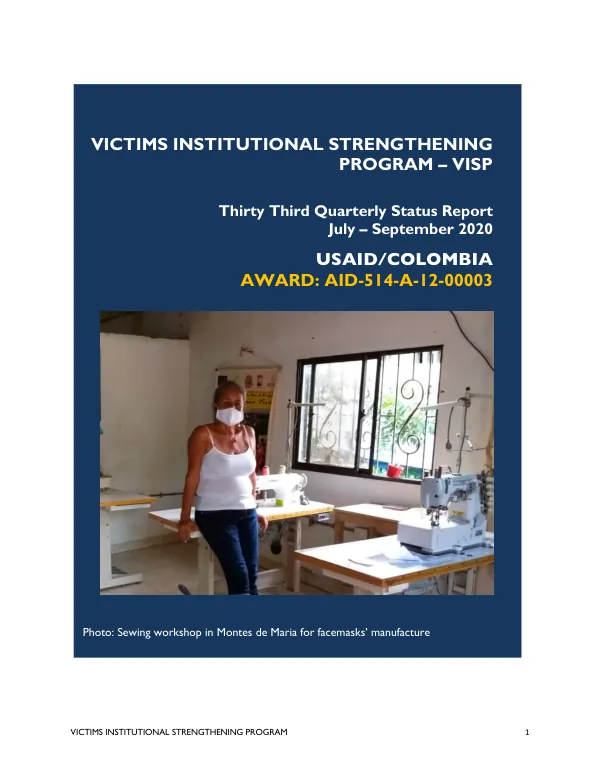
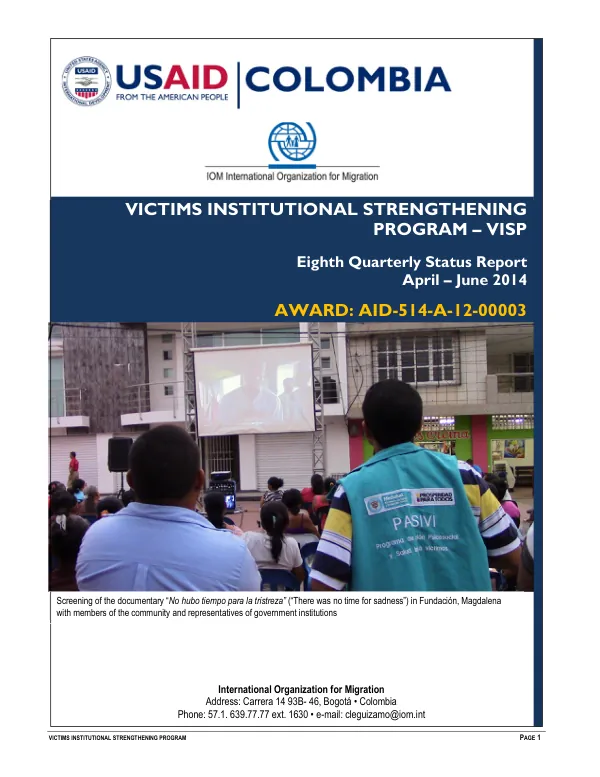
Eighth Quarterly Status Report: Victims Institutional Strengthening Program – VISP
The Victims Institutional Strengthening Program (VISP) is a program aimed at ensuring select Government of Colombia (GoC) institutions, policies, and systems are operationalized for effective implementation of the Victims Law.
2014 · 77 pages
Sign in to readA free account is required to download.
Abstract
The program's strategic objective is to ensure that the GoC institutions, policies, and systems at the national, departmental, and municipal levels are operationalized for effective implementation of the Victims Law. During the second quarter of 2014, the VISP program operated in a context affected by the first and second rounds of presidential elections, and the ensuing environment surrounding the reelection of President Juan Manuel Santos and the reorganization of his cabinet. Victims-related topics gained increased visibility in the news in the context of presidential campaigns, discussions on victims in peace negotiations with the FARC in Havana, and discussions regarding how victims will participate directly in said negotiations, and how an equal and balanced participation of victims of different perpetrators can be guaranteed. Substantive progress was made in each of VISP's four intermediate results (IRs) during this period. Intermediate Result 1 results included holding a Knowledge Fair with the Victims Unit and 13 operating partners funded by USAID on June 27, 2014, to share experiences and lessons learned in the formation of public policies and attention processes for victims of the armed conflict. Advances were also made to renovate and provide resources and equipment to Victims Attention points and centers in Ciénaga (Magdalena), Dibulla (La Guajira), San Juan Nepomuceno (Bolivar), and Riosucio (Chocó) to provide improved and more dignified attention services to victims of the armed conflict. Intermediate Result 2 results included trainings on the Pair Supervision Process with five Victims Psychosocial and Comprehensive Health Program (PAPSIVI) teams, training on psychosocial approaches and "Do No Harm" principles with participants from municipal health secretariats in 11 municipalities, and workshops with GoC institutions to collect information and clarify processes to register victims with disabilities. Additionally, the Rehabilitation Team advanced in the construction of psychosocial response models for complex crises, adjusting the models for Samaniego and Bogotá according to feedback provided and progressing on the completion of models for Apartadó and Medellín and the model with Sisma Mujer for women under protection measures. Intermediate Result 3 results included sharing the historical documentary "No hubo tiempo para la tristeza" ("There was no time for sadness") in screenings in VISP municipalities throughout Colombia, as well as Reparations School training processes held on the individual and collective reparation routes, human rights, and transitional justice with civil servants from the Victims Unit's Office in Bogotá, and advances towards five prioritized collective reparation cases. Intermediate Result 4 results included reviewing the Victims Unit's Diversity Mainstreaming Model's proposal and its presentation to the Diversity Mainstreaming Strategic Committee on June 24th, as well as activities in Pasto, Nariño; Cartagena, Bolivar; Apartadó, Antioquia; Quibdó, Choco to provide feedback for its improvement, train 42 civil servants from the Victims Unit's Regional Offices on diversity mainstreaming concepts, and establish a baseline instrument to identify basic needs for training, human resources, and appropriate relations with victims. The VISP program operated in a context of uncertainty among partner entities of the Colombian government at the central and local levels given the reorganization of government teams following the reelection of President Santos, as well as perspectives towards a new institutionalism to implement agreements including on the topic of victims. The increased visibility of victims-related issues as a center of debate in peace negotiations in Havana and the pressure of victims of the FARC for direct participation with victims of other armed actors also affected the work carried out by the VISP program. The VISP program is executed by the International Organization for Migration (IOM Mission in Colombia) and has a project duration of July 2012 to April 2016. The key program partners are the Victims Assistance and Reparations Unit, National Historical Memory Center, and Ministry of Health. The reporting period is April 1 to June 30, 2014, and the total confirmed funding is USD 42,822,579. The total funds received to date are USD 16,370,000, and the total expenditures are USD 18,595,812.