GOVERNMENT OF COLOMBIA
Fifth Quarter Status Report: Victims Institutional Strengthening Program
The Victims Institutional Strengthening Program (VISP) is a three-year initiative aimed at ensuring select Government of Colombia (GOC) institutions, policies, and systems are operationalized for effective implementation of the Victims Law.
2013 · 36 pages
Sign in to readA free account is required to download.
Abstract
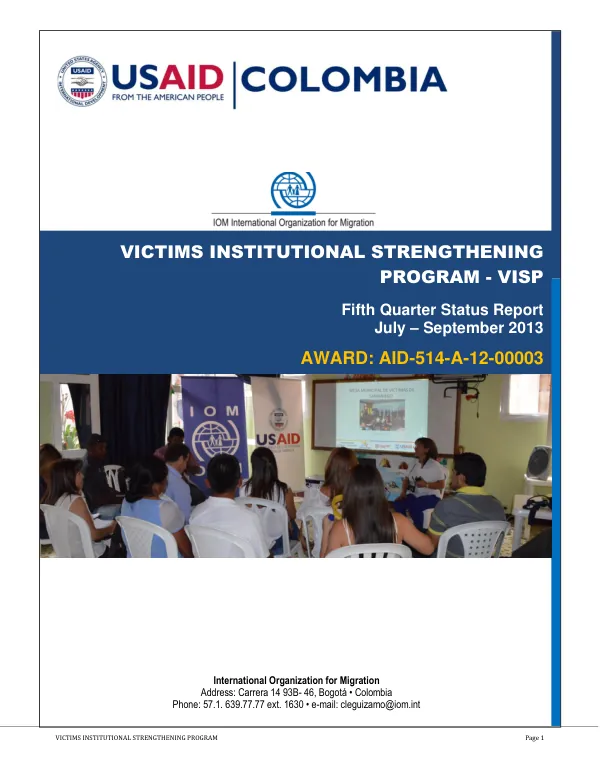
The program is implemented by the International Organization for Migration (IOM) in Colombia, with a total confirmed funding of USD 28,870,064. The program's strategic objective is to improve GOC strategic management for victims law, rehabilitation services, transitional justice processes, and accommodation of specific needs of ethnic groups and women. The program's four intermediate results (IRs) include supporting the Victims Unit to have strategic, financial, and budget planning tools, completing the toolkit for follow-up and monitoring, delivering final print materials to disseminate the collective reparations route, and holding the First National Workshop for LGBTI Victims of Armed Conflict. Substantive progress was made in each of VISP's four IRs during the fifth quarter of the program, which spanned from July 1 to September 30, 2013. IR1 advances include supporting the Victims Unit to have strategic, financial, and budget planning tools, with five departments now having Regional Action Plans (PAT) for their municipalities that align with the Victims Unit's methodology. IR2 advances include completing the toolkit for follow-up and monitoring, with VISP coordinating with the Ministry of Health (MOH), Anti-Personnel Mines Program (PAICMA), and the Victims Unit to raise awareness for the project. IR3 advances include delivering final print materials to disseminate the collective reparations route to the Victims Unit, with more than 50% of the goal to disseminate the General Report during the Semana por la Memoria/Memory Week, November 18-29, 2013, easily met within the established timeframe. IR4 advances include holding the First National Workshop for LGBTI Victims of Armed Conflict in September with the Victims Unit's Women and Gender Group, identifying conditions and needs of LGBTI victims with respect to the Victims Law. The two main challenges faced by VISP during the fifth quarter were coordination difficulties between the national and local levels, due to lengthy local validation processes and unaligned motivations of national and local entities, and obfuscated feedback from entities developing projects and consultant teams. VISP responded by including local needs and priorities in the initial phase of the 2014 VISP work plan and by supporting the alignment of Victims Unit national strategic planning with local action plans. In the upcoming quarter, VISP will focus on developing and implementing the minimal subsistence model, training for a variety of national and local public officials to improve their work, increasing awareness of institutional services at the local level through communication campaigns, and providing support to operationalize the Reparation and Service Model (MAARIV) support and reparations route. The Santos administration has been using victims as a reelection strategy amidst low approval ratings and slow progress in Havana. The administration has been quick to use the work of the Victims Unit and other victims issues in an attempt to bolster ratings, strengthen the reelection platform, and has been pushing for external support for the peace process. Despite this uncertain climate, victims issues continue to be addressed by the government and have achieved greater visibility this quarter. Land restitution for victims has the second highest approval rating (42%), after international affairs (44%) in the September Colombia Opina poll.