USAID DEC
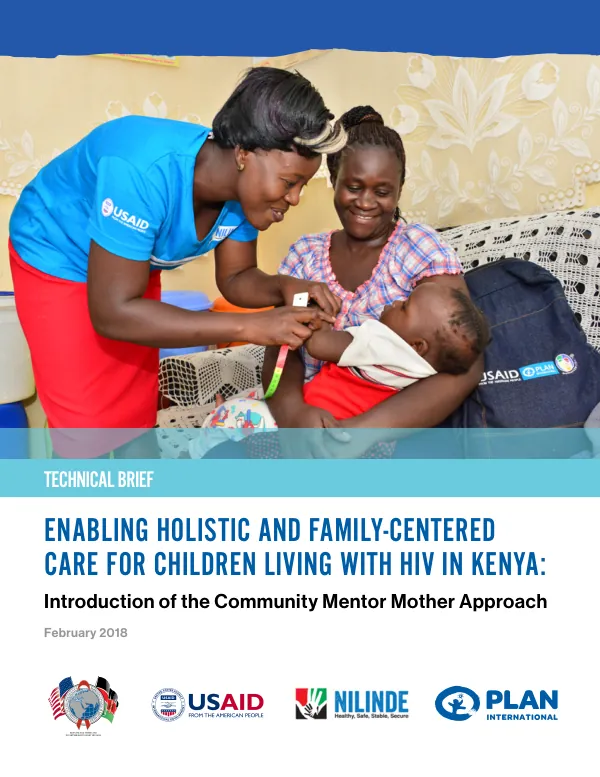
Enabling Holistic and Family-Centered Care for Children Living with HIV in Kenya: Introduction of the Community Mentor Mother Approach
Sign inMOTHERS2MOTHERS
Enabling Holistic and Family-Centered Care for Children Living with HIV in Kenya: Introduction of the Community Mentor Mother Approach
The Nilinde project, a five-year initiative funded by USAID, aimed to improve the welfare and protection of children affected by HIV and AIDS in six counties of Kenya.
2018 · 20 pages
Sign in to readA free account is required to download.
Abstract
Implemented by Plan International in partnership with mothers2mothers, Childline Kenya, and Ananda Marga Universal Relief Team, the project worked to strengthen local capacity to implement proven, evidence-based approaches while prioritizing creativity and innovation to ensure responsiveness to the diverse local needs of the communities it served. In 2015, HIV prevalence in Kenya was 5.9% in the general population, and 6.3% among women aged 15-49. The total population of orphans and vulnerable children (OVC) in critical need was a staggering 3.6 million. Majority of OVC households strained to care for multiple OVC under one roof, and most were doing so while living in the lowest two wealth quintiles in the country. The Government of Kenya had worked to address OVC needs by including OVC as a target population for its national Community Health Volunteer (CHV) cadre members, who each provided support to between 25 to 30 households per month on average. To address the needs of OVC holistically, Nilinde introduced the Community Mentor Mother approach. This approach aimed to provide tailored support to children living with HIV and their caregivers, focusing on building local capacity to respond to OVCs' full range of health and social needs. The project recognized that a significant proportion of its OVC population was now entering adolescence, a critical period when young people's decisions significantly shape the course and stability of their lives. Nilinde placed particular emphasis on strategies to address CLHIVs' full range of social and developmental needs, including providing tailored assistance to help them mature to healthy, safe, stable, schooled, and secure individuals. The Community Mentor Mother approach was based on the Mentor Mother Model, which recruits, trains, and employs mothers living with HIV and adhering to treatment to work as 'Mentors' to support their peers. This approach had been successfully implemented in seven sub-Saharan African countries, including Kenya, where it had shown to increase adherence among those living with HIV. The project focused on leveraging existing national strategies to increase the breadth and coverage of CLHIV support services, with a particular emphasis on addressing the needs of adolescent CLHIV. Implementation of the Community Mentor Mother approach was tailored to the specific needs of each county, with a focus on building local capacity to support OVC. The project worked in six counties, including Nairobi, Mombasa, Kilifi, Kwale, Taita Taveta, and Lamu, and was committed to building local capacity to respond to OVCs' full range of health and social needs. The project recognized that a significant proportion of its OVC population was now entering adolescence, and placed particular emphasis on strategies to address CLHIVs' full range of social and developmental needs. The Community Mentor Mother approach was designed to provide tailored support to children living with HIV and their caregivers, focusing on building local capacity to respond to OVCs' full range of health and social needs. The project worked to strengthen local support networks for adolescent CLHIV, many of whom would exit program support within Nilinde's project lifecycle. The approach was based on the Mentor Mother Model, which had been successfully implemented in seven sub-Saharan African countries, including Kenya, where it had shown to increase adherence among those living with HIV.
Related documents