USAID DEC
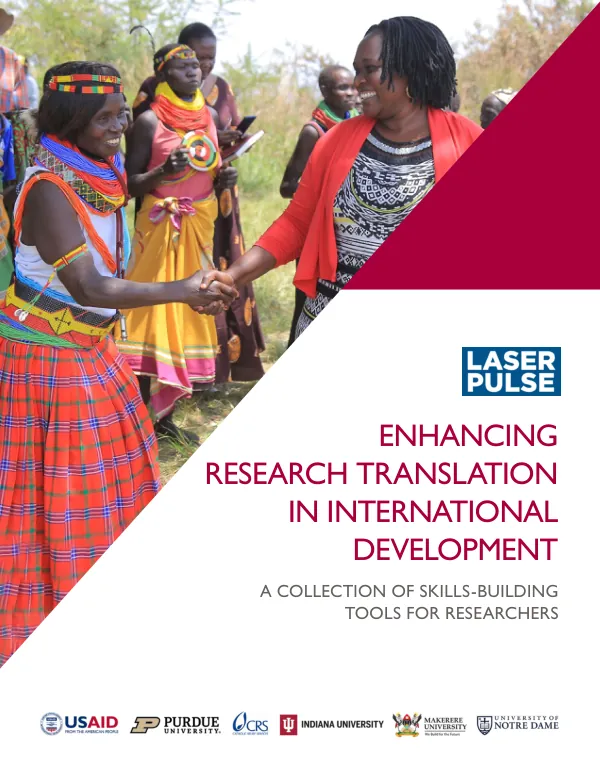
Enhancing Research Translation in International Development: A Collection of Skills-Building Tools for Researchers
Sign inCATHOLIC RELIEF SERVICES ORGANIZATION
Enhancing Research Translation in International Development: A Collection of Skills-Building Tools for Researchers
The LASER PULSE program is a $70 million initiative funded through USAID's Innovation, Technology, and Research Hub.
2023 · 72 pages
Sign in to readA free account is required to download.
Abstract
The program delivers research-driven solutions to field-sourced development challenges in USAID partner countries. A consortium led by Purdue University, in collaboration with Catholic Relief Services, Indiana University, Makerere University, and the University of Notre Dame, implements the LASER PULSE program through a network of over 3,500 researchers and development practitioners in 80 countries. The program collaborates with USAID missions, bureaus, and independent offices, as well as local stakeholders, to identify research needs for critical development challenges. LASER PULSE funds and strengthens the capacity of researcher-practitioner teams to co-design solutions that translate into policy and practice. The program's Embedded Research Translation (ERT) model integrates research translation as an integral component of the entire research cycle, rather than a final phase. The ERT model is built on four pillars: Partnership, Process, Product, and Dissemination. The tools developed by LASER PULSE emphasize key components of this model and can be applied broadly in research translation efforts. The collection of skills-building tools for researchers is designed to aid in planning for and conducting research translation. The tools and templates included in the collection are based on gaps in publicly available research translation tools and guidance, as well as needs expressed by LASER PULSE projects. The primary audience for this collection is researchers in USAID partner countries and higher-income countries who are active in or interested in research for development. However, the materials are also anticipated to be useful for USAID, NGOs, and other government entities as they partner with researchers in development work. The collection includes tools for planning and strategy, specific approaches to research translation, and creating briefs and other written communications. The Embedded Research Translation Stakeholder Analysis was developed by Catholic Relief Services staff at LASER PULSE. The analysis is a tool for identifying and understanding the needs and perspectives of stakeholders in research translation efforts. The analysis is designed to help researchers and practitioners develop effective strategies for engaging stakeholders and translating research into policy and practice. The LASER PULSE program's approach to research translation is reflected in its model of Embedded Research Translation. This model integrates research translation as an integral component of the entire research cycle, rather than a final phase. The ERT model is built on four pillars: Partnership, Process, Product, and Dissemination. The tools developed by LASER PULSE emphasize key components of this model and can be applied broadly in research translation efforts. The collection of skills-building tools for researchers is designed to aid in planning for and conducting research translation. The tools and templates included in the collection are based on gaps in publicly available research translation tools and guidance, as well as needs expressed by LASER PULSE projects. The primary audience for this collection is researchers in USAID partner countries and higher-income countries who are active in or interested in research for development.
Related documents