LA COORDINADORA INDÍGENAS DE LAS ORGANIZACIONES INDÍGENAS DE LA CUENCA AMAZÓNICA
Equidad entre hombres y mujeres indígenas en proyectos de conservación
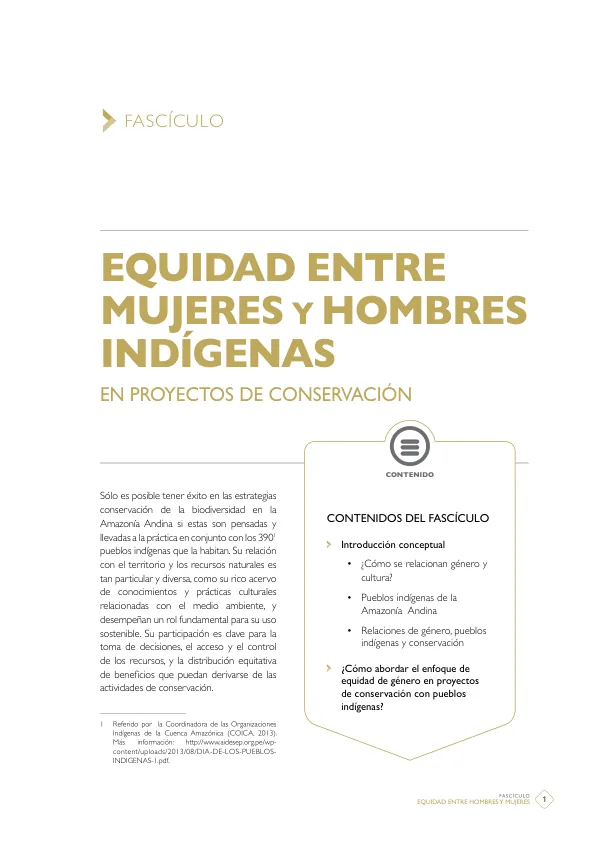
The concept of gender refers to the value and significance assigned to women and men by each society and culture, as well as the expectations held about their characteristics, aptitudes, and behaviors.
2014 · 16 pages
Sign in to readA free account is required to download.
Abstract
Gender systems are constructed by social groups, are dynamic, and are in constant flux, being established in a specific time and place, in relation to a tradition, culture, religion, and so on. Gender is also a relational category, defined by the power relationships established between men and women. Considering the gender approach as a theme exclusive to women is inaccurate. The culture of the Amazonian Andean region conceives the land and its resources as entities with life, linked to their spiritual identities, whereas Western culture predominantly views the land as a commercially exploitable resource. The culture affects the relationships established between men and women, as well as those they maintain with the environment. Culture is dynamic, inherited, used, transformed, and transmitted, and is connected to power relationships. Although culture is dynamic and changes, it is common for it to be perceived as static and immutable over time, and therefore, resistances to change are presented. Certain cultural practices can reproduce, reinforce, or create new situations of gender inequality in communities. This inequality generally characterizes a situation of disadvantage for women, associated with their gender condition. It translates into unequal access to resources, benefits, and rights, such as education, health, political participation, market, financial credits, natural resources, land, technology, and others. The recognition of territory and natural resources is fundamental for the life, identity, and historical and economic continuity of indigenous populations in the Amazonian Andean region. They maintain a link with nature from their spirituality, which transcends the utilitarian logic of use. The nature is an entity with life that sustains their survival and well-being. Each indigenous people has a unique knowledge, cultural practice, and use of natural resources. Despite their diversity and richness of knowledge, indigenous peoples share the fact of having been almost always subjects of discrimination and exclusion. Historically, they have seen their right to make decisions about their territories and access to natural resources limited, and they have suffered the consequences of violence, displacement, expropriation, and even the imposition from outside of their development agendas. Several legal tools at the national and international levels recognize indigenous customary rights, collective rights to their ancestral territory, self-determination (the right to the free determination of peoples), and the right to be consulted beforehand about activities to be carried out in their territory, among others. However, Amazonian indigenous peoples continue to face obstacles in exercising these rights. Frequently, private interests of extractive companies and those of states are privileged for the generation of energy, infrastructure, mining, media, and so on. These activities have impacts on Amazonian ecosystems, such as deforestation due to land use change and degradation of forests for agricultural, mining, petroleum, and forest uses, and the creation of artificial lakes. Since the 1970s, Amazonian indigenous movements have developed, in a sustained and supported manner by national and international allies, the struggle for the respect of their human and collective rights. Although this struggle has not been characterized by a consistent agenda regarding the relationships between men and women, the participation of women has been significant in these movements. Women have played a key role in the development of indigenous organizations and have been instrumental in the struggle for the recognition of indigenous rights. The Iniciativa para la Conservación en la Amazonía Andina (ICAA) works with 27 Amazonian indigenous peoples, seeking to strengthen their populations and organizations to participate in decision-making processes related to territorial rights, prior consultation, territorial management, intellectual property, and access to natural resources. ICAA also contributes to strengthening the capacities of organizations and authorities responsible for indigenous policies, promoting participation in the design and implementation of public policies. Additionally, ICAA disseminates information about indigenous peoples and the value of their traditional knowledge. The concept of equity between men and women is essential for the success of conservation strategies in the Amazonian Andean region. The participation of indigenous women is crucial for the decision-making process, access to and control of resources, and the equitable distribution of benefits that may arise from conservation activities. The Iniciativa para la Conservación en la Amazonía Andina (ICAA) recognizes the importance of working with indigenous men and women to develop long-term conservation strategies in the region.
Related documents
Documents in this collection
 2013
2013USAID DEC
Análisis cualitativo del uso histórico del territorio en el ámbito del área de influencia del proyecto Pucallpa– Cruzeiro do Sul
Open record 2013
2013USAID DEC