USAID DEC
Evaluation of the Land for Prosperity (LFP) Activity in Colombia: Evaluation Design Report
Sign inGOVERNMENT OF COLOMBIA
Evaluation of the Land for Prosperity (LFP) Activity in Colombia: Evaluation Design Report
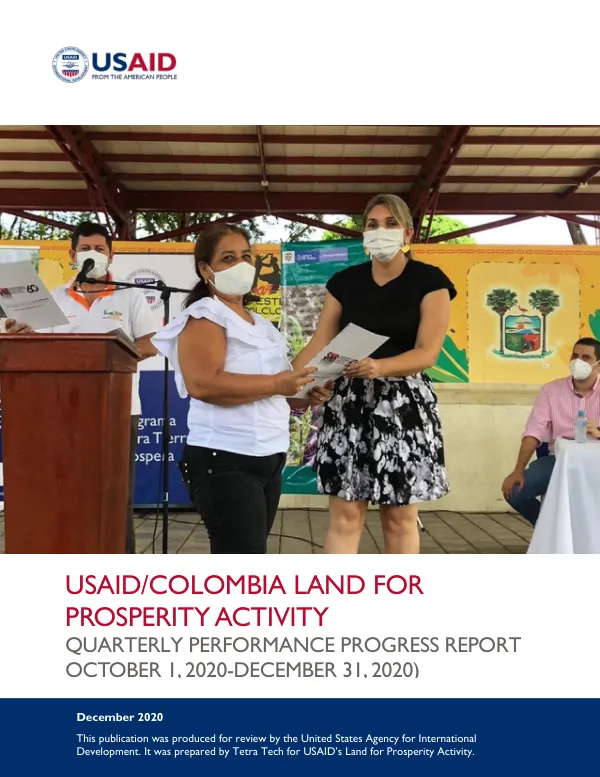
The Land for Prosperity (LfP) activity in Colombia is a United States Agency for International Development (USAID) initiative aimed at improving land tenure security and promoting economic growth in rural areas.
2020 · 80 pages
Sign in to readA free account is required to download.
Abstract
The activity is being implemented across seven micro-regions of Colombia, with a focus on ten pilot municipalities that will receive all three LfP components: massive land titling, strengthening local government capacity, and promoting public-private partnerships (PPPs). The LfP activity is being implemented in a context of significant rural land inequality and social conflict. Colombia's national agrarian structure is characterized by a large number of smallholders and a smaller number of large landowners, with historical social conflicts raised around issues of land tenure and land usage. The country's land ownership has been concentrated in few hands and territories, with as much as 75% of the national territory under public domain by 1850. The evaluation of the LfP activity is being led by NORC at the University of Chicago, under the Communications, Evidence and Learning (CEL) Project. The evaluation design report (EDR) describes the proposed design, research methodology, work plan, team composition, and estimated budget for a mixed-methods impact evaluation (IE) of the LfP activity. The evaluation will use a matched-comparison group Difference-in-Difference (DID) IE design to collect qualitative and quantitative data at baseline and endline from 3,000 households across 200 communities in the ten LfP pilot municipalities and in ten comparison municipalities. The evaluation will assess the effects of the LfP activity on individual households, heterogeneity of impacts on household-level outcomes, land administration and governance, private-sector engagement and illicit crop substitution, implementation effectiveness, and overarching lessons. The evaluation will also examine the gender aspects of the evaluation questions and use indicators and outcome measures to assess the impact of the LfP activity. The LfP activity comprises three main intervention components: massive land titling, strengthening local government capacity, and promoting public-private partnerships (PPPs). The massive land titling component aims to provide secure land tenure to smallholders and rural communities, while the strengthening local government capacity component aims to improve the capacity of local governments to manage land and provide services to rural communities. The promoting public-private partnerships (PPPs) component aims to promote partnerships between the public and private sectors to support economic growth and development in rural areas. The evaluation will use a mixed-methods approach, combining quantitative and qualitative data and analytic approaches, to assess the effects of the LfP activity. The evaluation will collect data from 3,000 households across 200 communities in the ten LfP pilot municipalities and in ten comparison municipalities. The data will be collected at baseline and endline, and will include both quantitative and qualitative data. The evaluation will also examine the implementation effectiveness of the LfP activity, including the extent to which the activity is being implemented as planned, and the challenges and barriers to implementation. The evaluation will also identify overarching lessons from the LfP activity, including the effectiveness of the activity in achieving its objectives, and the lessons that can be learned from the activity for future land reform initiatives. Overall, the evaluation of the LfP activity in Colombia is an important step in assessing the effectiveness of the activity in improving land tenure security and promoting economic growth in rural areas. The evaluation will provide valuable insights into the impact of the LfP activity, and will inform future land reform initiatives in Colombia and other countries.