USAID
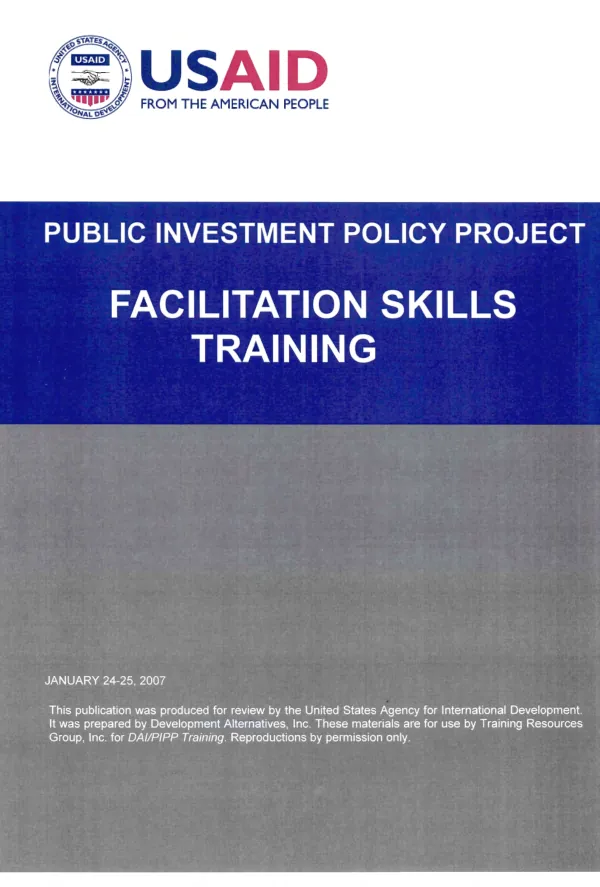
Facilitation Skills Training
The facilitation skills training course is designed to enhance the capacity of ERSRI staff to deliver economic training.
2016 · 29 pages
Sign in to readA free account is required to download.
Abstract
The course objectives are to provide training design and delivery skills, with a focus on experiential learning cycles. Participants will be able to describe the 8 design components of an experiential learning cycle and define facilitation skills to conduct effective interactive meetings and sessions. The 8 design components of an experiential session include Climate Setting, Objective Clarification, Interactive Presentation, Experience, Processing, Generalizing, Applying, and Closure. Climate Setting stimulates interest and curiosity, while Objective Clarification presents the intent and purpose of the training activity. Interactive Presentation provides a framework for the experience, and Experience provides opportunities for participants to simulate real-life situations. Processing causes participants to reflect on the experience, think critically, and share their reactions in a structured way. Generalizing extracts conclusions and generalizations derived from the previous phases of the cycle, linked to the objectives of the session. Applying draws upon insights and conclusions to incorporate into their lives for more effective behavior in the future. Closure briefly summarizes the events of the training session, links back to objectives, and seeks to determine if they have been met. The facilitation skills training agenda includes a welcome and getting started activity, which helps participants make the transition from their daily routine and behaviors into a positive learning environment. The course also covers effective adult learning, which makes explicit links between real-world and content, is participatory, and includes practice in the use of skills or frameworks. The training program emphasizes the importance of creating a positive learning environment, providing opportunities for participants to share and contribute ideas, and using a mix of methodologies to match the content and learning objectives. The program also highlights the need to challenge participants to be analytical, help them identify the relevance and importance of the content, and balance individual and group context for learning. Throughout the training program, participants will have opportunities to practice and apply their facilitation skills, including conducting interactive meetings and sessions, eliciting participation, and generating interaction among participants. The program will also provide a chance for participants to reflect on their experiences, share their reactions, and explore alternative approaches to the tasks and challenges they face.