FINTRAC
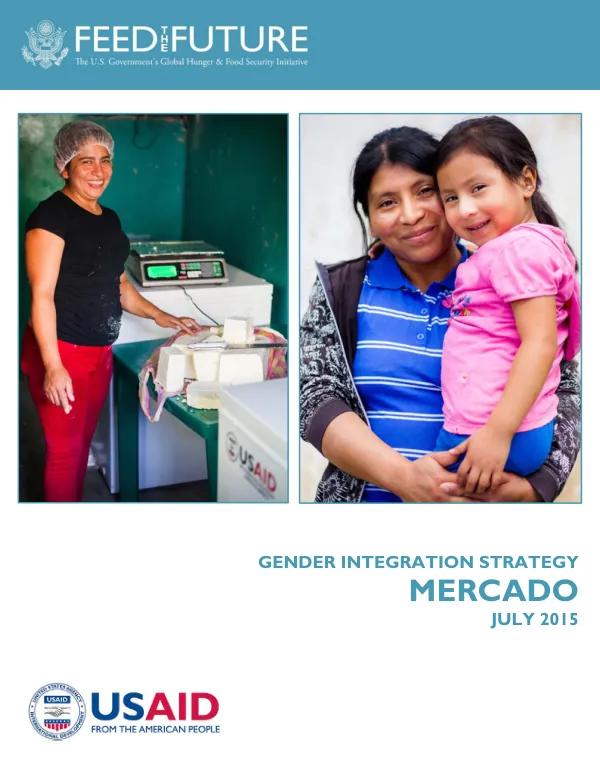
Feed the Future MERCADO Gender Integration Strategy
The Feed the Future MERCADO Gender Integration Strategy aims to increase incomes, expand markets, and improve health and nutrition for 15,000 rural households in the target area.
2015 · 25 pages
Sign in to readA free account is required to download.
Abstract
The strategy focuses on engaging the whole household in activities that prioritize income generation and food security. MERCADO will target both men and women, conducting household-friendly activities that ensure equitable participation. Key activities include introducing technologies that save households time and energy, transferring knowledge related to agriculture, health, and business practices, increasing household access to key inputs and assets, and increasing incomes for the whole household. The strategy targets women for engagement in agriculture-related activities in which they are typically marginalized, targeting men for engagement in health-related activities in which they are typically less involved, and promoting household decision making. MERCADO will introduce technologies that save households time and energy, increase yields, and incomes. The strategy also focuses on transferring knowledge related to agriculture, health, and business practices to beneficiary farmers through trainings designed to target the whole household. The Feed the Future MERCADO Gender Integration Strategy emphasizes the importance of targeting and encouraging whole household involvement in training and technical assistance to further ensure male and female engagement. The strategy also aims to economically empower household entrepreneurs, especially women, in processing and value addition enterprises. Additionally, MERCADO will expand access to credit for all producers and micro, small, and medium-size enterprises (MSMEs), promote gender integration strategies and priorities to partners and counterparts through workshops and trainings, and address perceptions related to gender-based violence. The strategy defines key terms, including data disaggregated by sex, discrimination, female empowerment, gender equity, gender, and sex. Data disaggregated by sex refers to data collected according to the physical characteristics of people, allowing for comparison between countries, regions, departments, municipalities, and communities. Discrimination is defined as the special treatment of individuals or groups who violate the justice principles in which all persons should be treated as equals. Female empowerment is achieved when women and girls acquire the power to act freely, exercise their rights, and fulfill their potential as full and equal members of society. The Feed the Future MERCADO Gender Integration Strategy aims to create conditions that facilitate empowerment and address historical and social disadvantages preventing men and women from acting on equal terms. The strategy emphasizes the importance of understanding gender as a social attribute that is learned or acquired during socialization as a member of a given community. Gender is therefore an acquired identity that is context and time-specific and changeable. The strategy also defines gender-based violence as violence directed at an individual based on their biological sex, gender identity, or perceived adherence to socially defined norms of masculinity and femininity. The strategy's focus on targeting and encouraging whole household involvement in training and technical assistance, economically empowering household entrepreneurs, expanding access to credit, promoting gender integration strategies, and addressing perceptions related to gender-based violence aims to address challenges to full family participation in MERCADO initiatives and ensure whole households benefit from activity support leading to increased incomes, expanded markets, and improved health and nutrition.
Related documents