USAID DEC
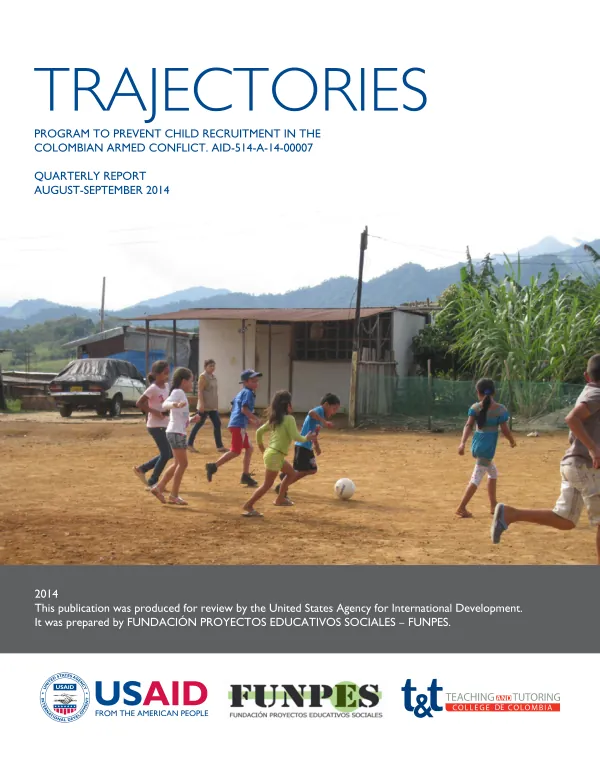
Final Report: Trajectories. Program to Prevent Child Recruitment in the Colombian Armed Conflict
Sign inUSAID
Final Report: Trajectories. Program to Prevent Child Recruitment in the Colombian Armed Conflict
The Trajectories program to prevent child recruitment in the Colombian armed conflict began on August 4, 2014, and concluded on August 3, 2015.
2015 · 15 pages
Sign in to readA free account is required to download.
Abstract
Fundación Proyectos Educativos Sociales – FUNPES served as the prime implementing partner, with a subcontractor, DA, supporting the initiative. The program focused on four Colombian departments: Caquetá, Meta, Nariño, and Putumayo, where serious abuses of boys, girls, and adolescents (BGAs) were prevalent. The main goal of Trajectories was to achieve that BGAs and their families develop behaviors, skills, and capacities within safe and friendly environments to become less vulnerable to recruitment and participation in the armed conflict. The program was based on the Theory of Change and focused on the People to People approach. Five main changes were identified as necessary, and a component-activity was proposed for each of them: school inclusion activities, welfare and psycho-social attention, social, sporting, and cultural schools, community and institutional networks and support, and sensitizing the IAOs. During the first quarterly period, the program focused on getting ready for the implementation of the five component-activities. Key achievements included the construction of planning documents, such as the Work Plan, the M&E Plan, and the Branding and Marking Waiver. The program budget was revised and adjusted to make spending more efficient. Technical and administrative materials and protocols were reviewed and adapted to respond to the characteristics of Trajectories. The staff selection and hiring process for the basic team was completed, and initial approaches were made with local authorities in the four departments. In Caquetá, initial meetings were held with the Education Secretaries of Caquetá and Florencia to socialize the program. The Secretary of Education of Florencia expressed interest in participating in the activities, and agreements were established to ensure the sustainability of the activities. In Meta, initial meetings were held with the Education Secretaries of Meta and Villavicencio, resulting in agreements to ensure the sustainability of the activities. In Nariño, the initial meeting with the Education Secretary of Ipiales recognized the importance of the program, but expressed concerns about the Municipality's ability to gather enough BGAs. As a result, the program decided to conduct a meeting with the Education Secretary of Pasto to socialize the program and develop activities in this Municipality. In Putumayo, the initial meeting with the Education Secretary of Putumayo resulted in agreements to ensure the sustainability of the activities, with the Secretary presenting requirements for endorsing the program. The program's implementation in the four departments was crucial in addressing the problem of child recruitment in the Colombian armed conflict. The establishment of agreements with local authorities ensured the sustainability of the activities and paved the way for the program's success. The program's focus on safe and friendly environments for BGAs and their families was essential in making them less vulnerable to recruitment and participation in the armed conflict.