USAID DEC
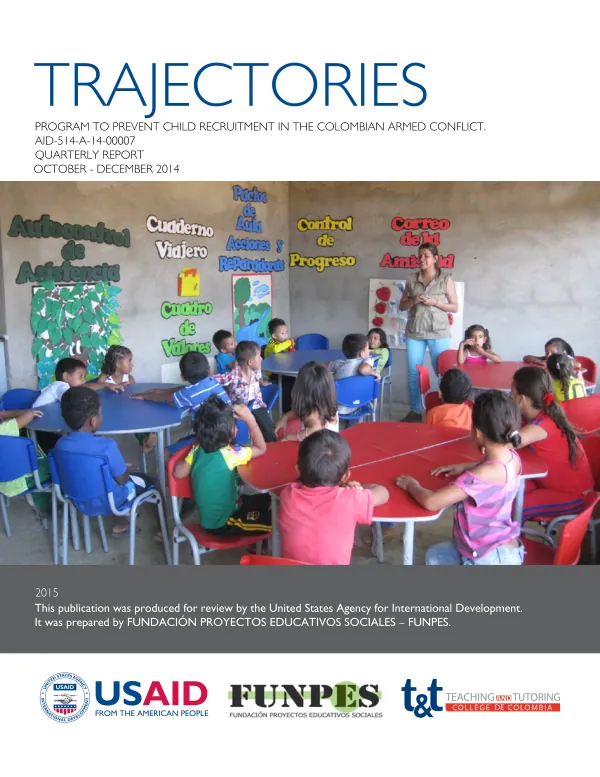
Final Report: Trajectories, Program to Prevent Child Recruitment in the Colombian Armed Conflict
Sign inUSAID DEC
Final Report: Trajectories, Program to Prevent Child Recruitment in the Colombian Armed Conflict
The Trajectories program to prevent child recruitment in the Colombian armed conflict began in August 2014 and aimed to restore the rights of Boys, Girls, and Adolescents (BGAs) by mitigating the effects of the conflict on them.
2014 · 47 pages
Sign in to readA free account is required to download.
Abstract
The program's main goal is to achieve that BGAs and their families develop behaviors, skills, and capacities within safe and friendly environments to become less vulnerable to recruitment and participation in the armed conflict. The program is based on the Theory of Change and focuses on the People to People approach. Five main changes have been identified as necessary to accomplish the main goal of the program: school inclusion activities, welfare and psycho-social attention, social, sporting, and cultural schools (SSCS), community and institutional networks and support, and sensitizing the Illegal Armed Organizations (IAOs). The program will be implemented in four Colombian Departments of intense armed confrontation: Caquetá, Putumayo, Nariño, and Meta. During the second quarter, the program focused on the team's training and enlistment process to start the activities of the five components. Key achievements during this period included the training of the team that will carry out the five components in the four regions, preparation of the physical spaces and delivery of the school baskets, selecting of the BGAs who will take part in the program, meetings with local authorities and private entities to build alliances, initiation of activities of the five components with the target population, and approval of the M&E Plan and beginning of actions in MONITOR. The program's implementation is divided into five components, each with a component-activity linked to a conceptual and result framework. The key learnings (NERI) of this period include the necessity of having a team of well-trained and well-paid people interested in the program's themes to guarantee the success of the activities, the importance of taking into account local characteristics when developing programs within a context of continuing violence, and the relevance of enjoying the support of the communities to start the activities. The program's progress in the implementation of activities is shown below. The activities developed during the second quarter included documents approval, review and adjustment of the program budget, staff selection and hiring process of the basic team, training process for the local teams, and pedagogical activity with the local teams. The trained local teams replicated the training process in each of the regions to teach the school tutors and those of the SSCS. The tutors evaluated this process in a positive way and recognized its usefulness to develop their activities. The program's focus on the People to People approach and the Theory of Change aims to transform attitudes and behaviors in order to accomplish the main goal of the program. The program's implementation in four Colombian Departments of intense armed confrontation aims to benefit 500 BGAs, 500 families, and 1,000 BGAs through school inclusion activities, welfare and psycho-social attention, SSCS, community and institutional networks and support, and sensitizing the IAOs. The program's geographic coverage includes Caquetá, Meta, Nariño, and Putumayo, with a focus on the four regions where the program is being implemented. The program's reporting period is August-September 2014, with a focus on the second quarter of the program. The program's key achievements and learnings during this period provide insights into the program's progress and challenges. The program's implementation is ongoing, with a focus on the five components and the activities developed during the second quarter. The program's progress and challenges will continue to be monitored and evaluated to ensure the success of the program and the achievement of its main goal.
Related documents