USAID DEC
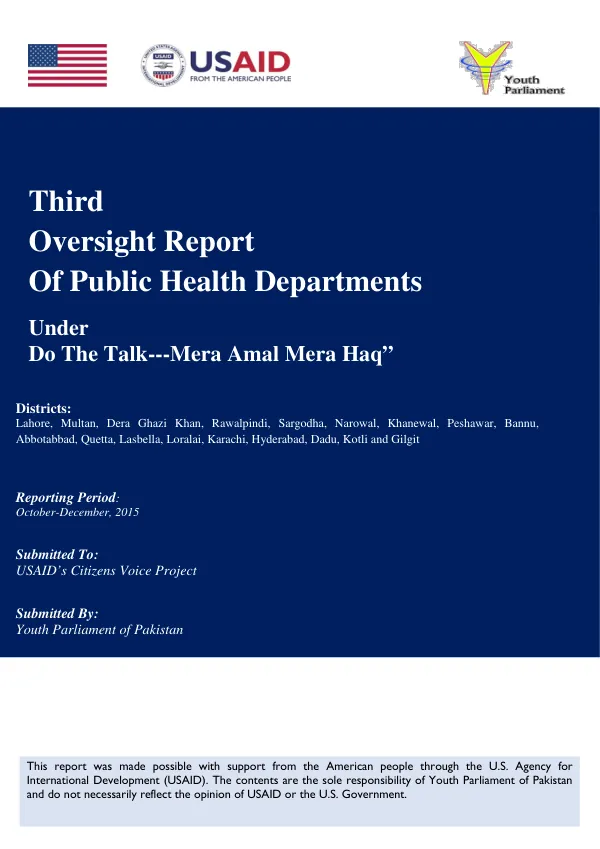
First Oversight Report: Do The Talk---Mera Amal Mera Haq” Third Oversight Report Of Public Health Departments Under Do The Talk---Mera Amal Mera Haq”
Sign inUSAID
First Oversight Report: Do The Talk---Mera Amal Mera Haq” Third Oversight Report Of Public Health Departments Under Do The Talk---Mera Amal Mera Haq”
Pakistan is one of the most youthful countries of the world with about 67% of its population under 30 years of age.
2015 · 60 pages
Sign in to readA free account is required to download.
Abstract
The country's population is projected to exceed 260 million by 2030 and 335 million by 2050. Almost two-thirds (67%) of Pakistan's population comprises youth between the ages of 15-35 years. The need of the hour is to encourage the youth through various engagement tools within their own local communities so that they can fulfill their responsibility as citizens towards the social, economic, and political transformation of their country. The project "Do The Talk---Mera Amal Mera Haq” aims to organize youth in twenty target districts of all four provinces and AJK. The project intends to empower the youth of Pakistan in their own constituencies. The specific objectives of the project are to oversee the performance of district health departments in youth development initiatives, develop a National Youth development Manifesto related to health issues to guide policymaking processes in provinces including GB and AJK, raise awareness and train the youth to actively and effectively participate in debate and discussion over policies/decisions relating to health that affect them, and establish linkages between youth (District Youth Assemblies) and policymakers at different levels through different catalysts. The project team has formed district youth council (DYC) at district level and Tehsil Youth Councils (TYCs) in 20 districts. DYC has 10 members with equal men and women representation. These 20 districts are divided into 80 Tehsils. A detailed questionnaire was developed in the first oversight before visits of health institutes, and all DYC members were oriented during training sessions of TYCs. The questionnaire was used to collect information from respective health facilities. Data was analyzed using appropriate statistical tools including SPSS. A consolidated oversight report was prepared, which includes information on five facilities being visited. The project team visited a total of 340 health units during the reporting period. The health units visited included DHQ hospitals, THQ hospitals, rural health centers, basic health units, and dispensaries. The project team collected data from these health units through questionnaires and individual interviews with health department officials and community members. The data was analyzed to identify the strengths and weaknesses of the health departments in the target districts. The project team found that the health situation in the target districts is not good. The health facilities are understaffed, and the equipment is outdated. The project team also found that the health departments are not transparent in their functioning, and there is a lack of accountability. The project team recommended that the health departments should be made more transparent, and there should be more accountability in their functioning. The project team also recommended that the health facilities should be equipped with modern equipment, and the staff should be trained to provide better healthcare services. The project team also found that the youth in the target districts are not aware of their health rights. The project team recommended that the health departments should educate the youth about their health rights and provide them with information about the health services available to them. The project team also recommended that the health departments should involve the youth in the decision-making process and provide them with opportunities to participate in the planning and implementation of health programs. The project team concluded that the health departments in the target districts need to be strengthened to provide better healthcare services to the people. The project team recommended that the health departments should be made more transparent, and there should be more accountability in their functioning. The project team also recommended that the health facilities should be equipped with modern equipment, and the staff should be trained to provide better healthcare services.
Related documents