WATER FOR PEOPLE
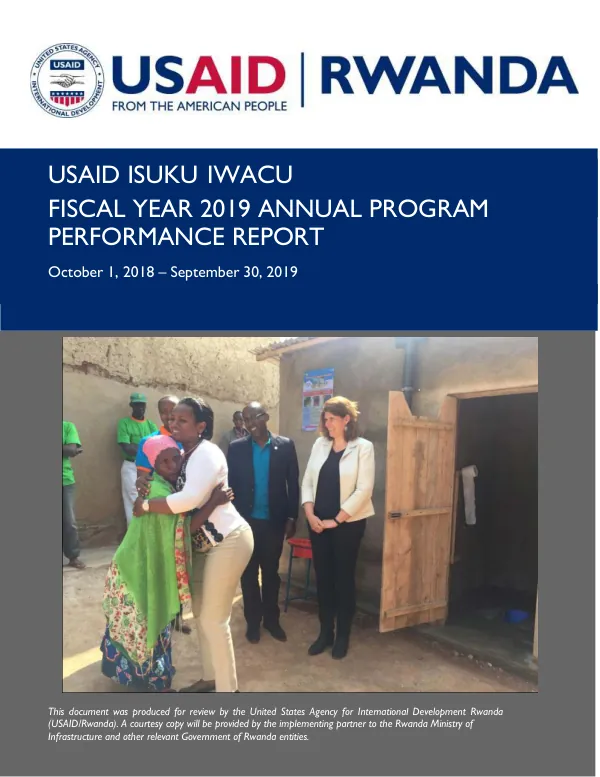
Fiscal Year 2019 Annual Program Performance Report
The Isuku Iwacu – Rwanda Rural Sanitation Activity is a cooperative agreement between the United States Agency for International Development (USAID) and SNV USA, with the goal of improving access to basic sanitation for poor and vulnerable households in Rwanda.
2019 · 35 pages
Sign in to readA free account is required to download.
Abstract
The activity began on September 2, 2016, and is set to end on November 9, 2020. During fiscal year 2019, the activity achieved several major milestones. One of the key accomplishments was the facilitation of access to basic sanitation for 8,443 poor and vulnerable households through vouchers. By the end of the reporting period, Isuku Iwacu had provided 15,635 households, or over 67,230 people, with access to basic sanitation. This represents a significant increase in the number of households with access to basic sanitation. In addition to the voucher program, the activity also focused on rehabilitating district sanitation centers. During fiscal year 2019, the centers in Nyarugenge, Nyanza, Ruhango, Nyabihu, and Ngoma districts were completed, with four of the centers starting operations. The Nyabihu district sanitation center is expected to start operating in the first quarter of fiscal year 2020. The activity also made progress in promoting open defecation free (ODF) practices. Training was provided to 61 villages across the eight target districts, with the goal of promoting ODF practices and improving access to sanitation. Furthermore, the construction of 16 public latrines was completed, with each latrine serving an average of 100 individuals on a daily basis. To accelerate implementation and enable broader access to grassroots communities, Isuku Iwacu recruited five local civil society organizations (LCSOs) to partner with the activity. These LCSOs include the African Evangelistic Enterprise (AEE) Rwanda, Duharanira Amajambere y’icyaro-Action Pour Le Development Rural intégré (DUHAMIC-ADRI), Faith Victory Association (FVA), Rwanda Development Organization (RDO), and the Young Women’s Christian Association of Rwanda (YWCA). The activity also collaborated with the Association of Microfinance Institutions in Rwanda (AMIR) to provide access to sanitation loan products through its 347 licensed member microfinance institutions and SACCOs. The goal of this partnership is to target at least 40,000 households with access to sanitation loan products. In addition to these achievements, the activity also made progress in disseminating water supply and sanitation policies in collaboration with the Ministry of Infrastructure. The overall objective of this effort is to ensure awareness and ownership of the National Water Supply and Sanitation policies and related framework among local leaders, stakeholders, technicians, and communities. Despite these achievements, the activity faced several challenges during fiscal year 2019. One of the key challenges was the delay in completing voucher latrines due to poor weather conditions, delayed contributions from the community, difficulty digging due to soil conditions, and an acute shortage of Satopans in the market. Additionally, Omnium de Construction et de Bâtiments, Ltd (OCB Ltd) unexpectedly terminated its contract before completing the construction of all voucher latrines in Nyabihu district. As a result, Isuku Iwacu had to rebid for the remaining works to be completed by another contractor in the first quarter of fiscal year 2020. The activity also experienced significant delays in scaling up sanitation loans with Amasezerano Community Banking (ACB) due to the bank's failure to meet deliverables under its agreement. As a result, the agreement was cancelled, and all the targets were included into AMIR's agreement as the umbrella organization. Overall, the Isuku Iwacu – Rwanda Rural Sanitation Activity made significant progress in improving access to basic sanitation for poor and vulnerable households in Rwanda during fiscal year 2019. Despite the challenges faced, the activity remains committed to its goal of improving access to sanitation and promoting ODF practices in the target districts.