ADRA
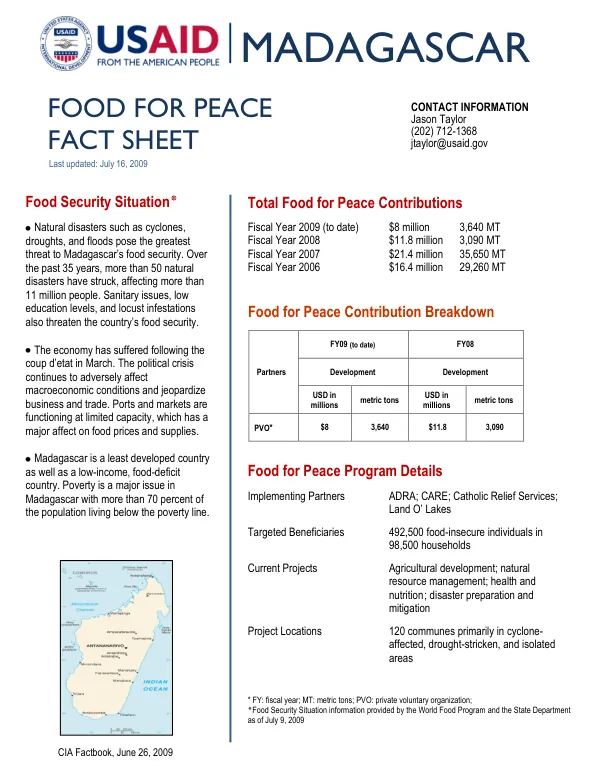
Food for Peace FACT SHEET MADAGASCAR
The Food for Peace program in Madagascar is a critical initiative aimed at addressing the country's food security challenges.
2009 · 1 pages
Sign in to readA free account is required to download.
Abstract
Madagascar is a least developed country and a low-income, food-deficit country, with more than 70 percent of the population living below the poverty line. The country's food security situation is further exacerbated by natural disasters such as cyclones, droughts, and floods, which have affected more than 11 million people over the past 35 years. Sanitary issues, low education levels, and locust infestations also pose significant threats to the country's food security. The economy has suffered significantly following the coup d'etat in March, with the political crisis continuing to adversely affect macroeconomic conditions and jeopardize business and trade. Ports and markets are functioning at limited capacity, which has a major impact on food prices and supplies. The Food for Peace program is working to address these challenges through a range of interventions, including agricultural development, natural resource management, health and nutrition, and disaster preparation and mitigation. The program is implemented by a range of partners, including ADRA, CARE, Catholic Relief Services, and Land O'Lakes. The targeted beneficiaries of the program are 492,500 food-insecure individuals in 98,500 households. The program is focused on 120 communes primarily in cyclone-affected, drought-stricken, and isolated areas. The program's goal is to improve food security and reduce poverty in these areas. The Food for Peace program has made significant contributions to Madagascar's food security situation. In FY09, the program contributed $8 million and 3,640 metric tons of food assistance. In FY08, the program contributed $11.8 million and 3,090 metric tons of food assistance. The program has also made significant contributions in previous years, including $21.4 million and 35,650 metric tons in FY07, and $16.4 million and 29,260 metric tons in FY06. The program's impact is evident in the improvements in food security indicators in the target areas. The program has helped to increase household income and improve food security among the targeted beneficiaries. The program's focus on agricultural development and natural resource management has also helped to improve crop yields and reduce poverty in the target areas. Overall, the Food for Peace program is a critical initiative that is making a significant contribution to improving food security and reducing poverty in Madagascar.
Related documents