USAID DEC
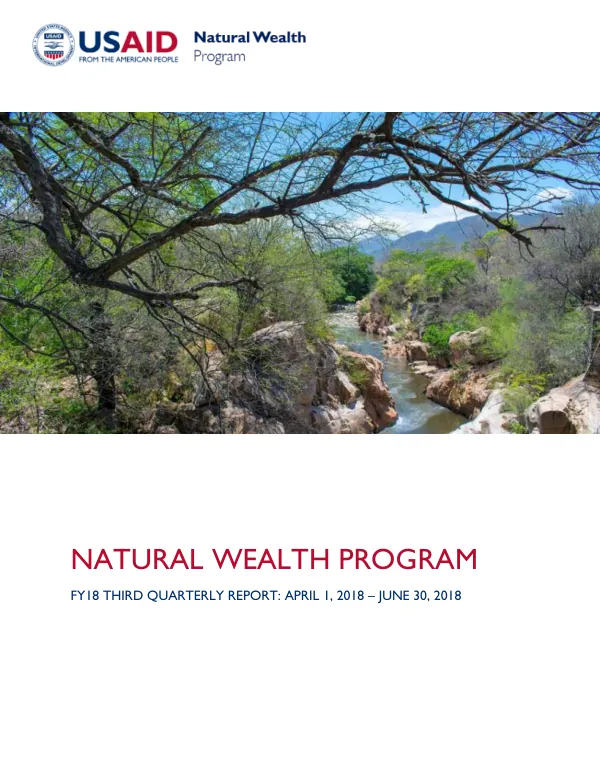
FY18 Third Quarterly Report: April 1, 2018 – June 30, 2018 for the Natural Wealth Program
Sign inCHEMONICS
FY18 Third Quarterly Report: April 1, 2018 – June 30, 2018 for the Natural Wealth Program
The Natural Wealth Program supports the Government of Colombia in conserving the country's biodiversity in strategic landscapes, including the tropical dry forest in Montes de Maria and the Sierra Nevada de Santa Marta – Piedmont of Perijá, and the grasslands and freshwater ecosystems in the Orinoquía region.
2018 · 60 pages
Sign in to readA free account is required to download.
Abstract
Through conservation measures and promoting sustainable land uses in these critical ecosystems, local populations benefit from the ecosystem services preserved to achieve social and economic progress for a sustainable and lasting peace. The Program supports the Government of Colombia's conservation goals and social and economic well-being of local communities by increasing the area of land under legal protection, demonstrating the economic and social benefits that can be obtained by conserving biodiversity, and integrating biodiversity criteria into national, regional, and local land use planning and management tools to support protected area and conservation corridor initiatives. During the reporting period, Natural Wealth implemented activities and made progress towards key targets in conservation corridors that reflect this strategic approach to conservation. The Program's fiscal year 18 Third Quarterly Report presents progress and activities from April 1, 2018 – June 30, 2018, as related to the implementation of its approved fiscal year 18 annual work plan. The main achievements from the third quarter of fiscal year 18 include the Colombian Academy of Science's approval for the National Integrated Management District Cinaruco, which aims to place under legal protection 331,800 hectares of critical habitat. Natural Wealth was engaged as part of the declaration process and supported the development of Caño Mochuelo's community outreach strategy, which formed a critical part of the proposal requesting declaration of the DNMI in Cinaruco. The Program worked with the National Natural Parks and the Biodiversity, Culture, and Land Conservation Alliance to advance in the registration of 34 Civil Society Nature Reserves in Montes de Maria and Orinoquía, totaling 24,200 hectares of land dedicated to conservation, restoration/rehabilitation, and sustainable production. The Program also signed a grant agreement with the Tayrona Indigenous Confederation for COP 1.314 million to work on tropical dry forest conservation and management, as well as assisting the Confederation to identify legal instruments to expand protected areas to traditional lands owned by the Arhuaco community. Natural Wealth carried out activities to identify sacred lands, recover traditional knowledge, and develop biological maps of the indigenous territory, with the goal of improving land management of at least 40,000 hectares. In addition, the Program progressed towards improving protected areas management plans in Montes de Maria, SNSM-PP, and Orinoquía, focusing on the Serranía de Coraza Protected Forest Reserve and Los Besotes Natural Regional Park. Natural Wealth updated technical documents and developed cartography for land use planning, providing key information for updating management plans and specifying the protected land reach in terms of area. The Program also continued to work in SNSM-PP's along the Arhuaco community, regional entities, and departmental governments on the Sierra Nevada de Santa Marta National Park expansion proposal. The Program continued exploring opportunities to work with the cocoa and avocado sectors in Montes de Maria and the dairy sector in Orinoquía to establish financial incentives for populations living in conservation corridors, linked to their commitment to conservation activities. Natural Wealth also advanced in the development of the Piedmont of Perijá conservation strategy, working with Corporación Paisajes Rurales to conduct an analysis of ecosystem services and degradation drivers of previously prioritized conservation areas. The Program's progress towards key targets in conservation corridors reflects a strategic approach to conservation, supporting the Government of Colombia's conservation goals and social and economic well-being of local communities. The Program's activities and achievements during the third quarter of fiscal year 18 demonstrate the economic and social benefits that can be obtained by conserving biodiversity and integrating biodiversity criteria into national, regional, and local land use planning and management tools.
Related documents