USAID
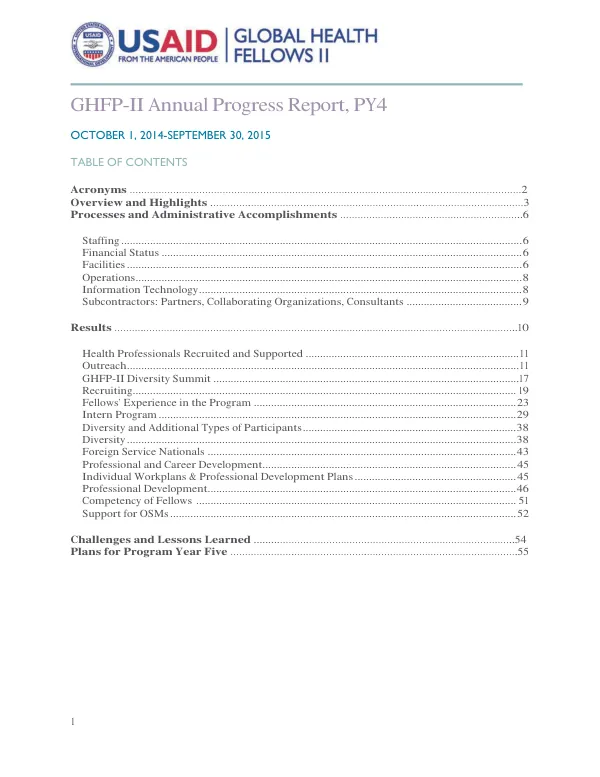
GHFP-II Annual Progress Report, PY4
The Global Health Fellows Program II (GHFP-II) continued to implement activities that support two key mandates in program year four (PY4).
2015 · 56 pages
Sign in to readA free account is required to download.
Abstract
The program aimed to meet USAID's immediate and emerging human capacity needs and help build the next generation of diverse global health professionals. In PY4, GHFP-II supported 137 PHI Fellows and 74 PHI Interns, along with 16 Foreign Service Nationals (FSNs) and additional participants from GHFP-II partners. The program exceeded its end-of-program (EOP) targets for outreach, with more than half a million page views to the website and a significant increase in the number of events and people reached. GHFP-II also met its EOP recruiting targets, with 93 percent of candidates selected as finalists during the first round and an average of 2-3 weeks for recruiting and hiring candidates. The program's direct services were positively described by 97 percent of the 137 Fellows, and 100 percent of eligible Fellows accepted an extension of their Fellowship. Indicator results for professional and career development (PCD) showed mixed improvements, with the greatest gains in the percentage of new Fellows completing baseline job competency assessments and satisfaction with the PCD portion of Washington orientation. Additionally, 90 percent of DC-based On-site Managers (OSMs) were satisfied/very satisfied with GHFP-II assistance. GHFP-II also made significant progress in building the next generation of diverse global health professionals. 100 percent of Fellows rated their overall Fellowship experience as contributing positively to their future career, and 91 percent were continuing in the GH field, above the EOP target of 90 percent. In PY4, 159 Interns participated in the program, with 87 percent satisfied with the overall quality of the Internship and a high percentage planning to pursue work or further education in the field. The program's commitment to diversity was evident in the participation of diverse groups, with 40 percent of GHFP-II participants representing ethnic minorities and those from low socio-economic backgrounds. GHFP-II also organized participation of FSNs, with 100 percent of respondents surveyed satisfied with GHFP-II assistance. Additionally, the program partnered with organizations such as GlobeMed and PYXERA Global to increase diversity and inclusion in the global health field. GHFP-II's partnership with GlobeMed resulted in the creation of nine undergraduate student-run Chapters in Minority Serving Institutions (MSIs), helping to build interest in and efficacy around potential careers in global health. GlobeMed also placed 85 Interns internationally, with 92 percent pursuing the GH field through employment or a graduate program after their Internship. The program's partnership with PYXERA Global resulted in 37 Global Health Champions providing 1,064 person days of technical assistance, and GHCorps supported 10 Level One new Fellows spending one year in Africa. Overall, GHFP-II's efforts in PY4 demonstrated significant progress in meeting USAID's human capacity needs and building the next generation of diverse global health professionals. The program's commitment to diversity and inclusion was evident in its partnerships and outcomes, and its efforts to improve professional and career development were yielding positive results.
Related documents