AGENCIA DE LOS ESTADOS UNIDOS PARA EL DESARROLLO INTERNACIONAL
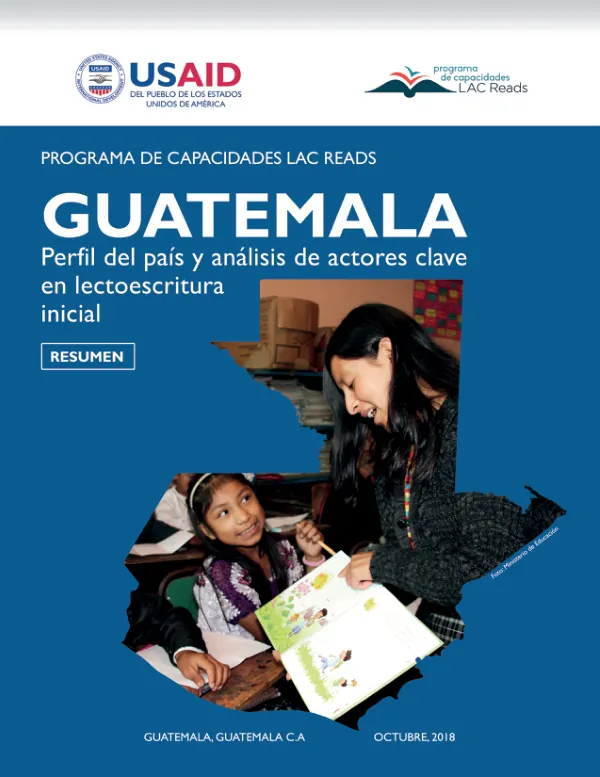
Guatemala Perfil del país y análisis de actores clave en lectoescritura inicial
Guatemala's Profile and Analysis of Key Actors in Initial Literacy Guatemala is a country with a rich cultural heritage and a diverse population.
2018 · 75 pages
Sign in to readA free account is required to download.
Abstract
The country has a long history of struggling with literacy rates, particularly in the initial stages of education. According to the results of the Early Grade Reading Assessment (EGRA), the average reading score for grade 1 students in Guatemala is 44.6%, indicating a significant gap in literacy skills. The country's education system is structured into three levels: primary, secondary, and higher education. The primary education level is divided into two cycles, with the first cycle covering grades 1-3 and the second cycle covering grades 4-6. The education system is managed by the Ministry of Education (Mineduc), which is responsible for setting education policies and standards. The results of the EGRA also indicate that there are significant disparities in literacy rates among different regions and socio-economic groups. The northern region of Guatemala has the highest literacy rate, with 53.4% of grade 1 students able to read at the expected level. In contrast, the southern region has the lowest literacy rate, with only 34.6% of grade 1 students able to read at the expected level. The country has a number of organizations and individuals involved in the development of interventions in initial literacy. These include government agencies, international organizations, non-governmental organizations, academics, and researchers. The relationships between these actors are complex and multifaceted, with some organizations working together to achieve common goals while others may have competing interests. The types of initiatives being implemented in initial literacy in Guatemala are diverse and varied. Some initiatives focus on teacher training and capacity building, while others focus on developing new curricula and instructional materials. The use of technology, such as digital platforms and mobile apps, is also becoming increasingly popular in initial literacy interventions. The evidence base for initial literacy interventions in Guatemala is limited, and there is a need for more research and evaluation to inform policy and practice. The country's education system is also facing significant challenges, including a shortage of qualified teachers and inadequate infrastructure. To improve the literacy skills of grade 1 students in Guatemala, it is recommended that the government and other stakeholders prioritize the development of high-quality instructional materials and teacher training programs. Additionally, there is a need for more research and evaluation to inform policy and practice, and to identify effective interventions that can be scaled up to reach more students. The country's education system is also facing significant challenges, including a shortage of qualified teachers and inadequate infrastructure. To address these challenges, it is recommended that the government invest in teacher training and development programs, and that it prioritize the construction of new schools and the renovation of existing ones. In terms of coordination and synergy, there are opportunities for collaboration between government agencies, international organizations, and non-governmental organizations. For example, the Ministry of Education could work with international organizations such as the World Bank and the Inter-American Development Bank to access funding and technical assistance for initial literacy interventions. Finally, there is a need for greater awareness and understanding of the importance of initial literacy among policymakers and stakeholders. This can be achieved through the development of public awareness campaigns and the dissemination of research findings and best practices in initial literacy. In conclusion, Guatemala's profile and analysis of key actors in initial literacy highlight the need for a comprehensive and coordinated approach to addressing the country's literacy challenges. By prioritizing the development of high-quality instructional materials and teacher training programs, and by investing in research and evaluation, the country can make significant progress in improving the literacy skills of its grade 1 students.