USAID DEC
Head-to-Head Comparison of Soluble vs. Qβ VLP Circumsporozoite Protein Vaccines Reveals Selective Enhancement of NANP Repeat Responses
Sign inUSAID DEC
Head-to-Head Comparison of Soluble vs. Qβ VLP Circumsporozoite Protein Vaccines Reveals Selective Enhancement of NANP Repeat Responses
The circumsporozoite protein (CSP) of Plasmodium falciparum is a promising malaria vaccine target.
2015 · 18 pages
Sign in to readA free account is required to download.
Abstract
The CSP is a complex protein that can be divided into three main regions: a conserved N-terminal region, a NANP-NVDP repeat region, and a cysteine-rich C-terminal region. The most advanced malaria vaccine candidate, RTS,S, consists of the central NANP repeat and carboxy-terminal region of CSP displayed on a hepatitis B virus-like particle (VLP). However, RTS,S contains only a portion of the CSP protein, and recent studies suggest that the N-terminal region may also play a crucial role in the immune response against malaria. To build upon the success of RTS,S, researchers have produced a near full-length Plasmodium falciparum CSP that includes the conserved amino-terminal region of CSP. This soluble CSP, combined with a synthetic Toll-like-receptor-4 (TLR4) agonist in a stable oil-in-water emulsion (GLA/SE), has been shown to induce a potent and protective immune response in mice against transgenic parasite challenge. However, the immunogenicity of soluble CSP can be further augmented by presentation on a VLP. Bacteriophage Qβ VLPs can be readily produced in E. coli and have a diameter of 25 nm. They contain packaged E. coli RNA, which serves as a built-in adjuvant through the activation of TLR7/8. CSP was chemically conjugated to Qβ, and the CSP-Qβ vaccine immunogenicity and efficacy were compared to adjuvanted soluble CSP in the C57Bl/6 mouse model. The results showed that Qβ-CSP induced higher anti-NANP repeat titers, higher levels of cytophilic IgG2b/c antibodies, and a trend towards higher protection against transgenic parasite challenge compared to soluble CSP. The VLP and soluble CSP immunogenicity difference was most pronounced at low antigen dose, and within the CSP molecule, the titers against the NANP repeats were preferentially enhanced by Qβ presentation. While a TLR4 agonist enhanced the immunogenicity of soluble CSP to levels comparable to the VLP vaccine, the TLR4 agonist did not further improve the immunogenicity of the Qβ-CSP vaccine. The data presented here pave the way for further improvement in the Qβ conjugation chemistry and evaluation of both the Qβ-CSP and soluble CSP vaccines in the non-human primate model. The use of VLPs as a carrier to improve the immunogenicity of CSP has several advantages. VLPs can be readily produced in E. coli and have a diameter of 25 nm, which is optimal for uptake and rapid transit to the lymphoid organs. They also contain highly repetitive tertiary structures that are recognized as pathogen-associated molecular patterns by the immune system. The Qβ-VLP platform used in this study has been clinically validated and has been used safely in multiple human trials targeting self- and foreign antigens. The results of this study suggest that Qβ VLP can be used as a carrier to improve the immunogenicity of CSP, particularly the NANP repeat epitope. The Qβ-CSP conjugate vaccine induced a potent and protective immune response against challenge with a transgenic rodent parasite. These findings have important implications for the development of a malaria vaccine and highlight the potential of VLPs as a carrier to improve the immunogenicity of CSP.
Related documents
Documents in this collection
 2016
2016USAID DEC
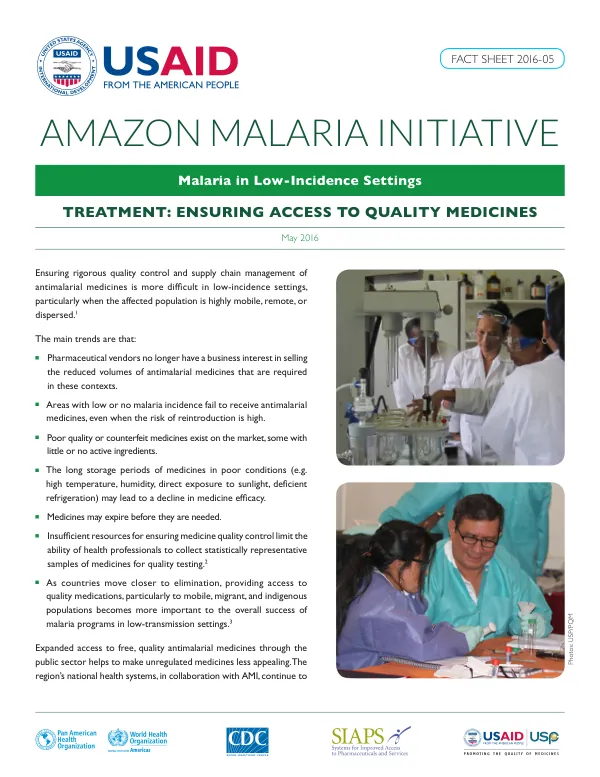
Amazon Malaria Initiative FACT SHEET 2016-05 Ensuring rigorous quality control and supply chain management of antimalarial medicines is more difficult in low-incidence settings, particularly when the affected population is highly mobile, remote, or dispersed
Open record 2015
2015USAID DEC