USAID DEC
Investing in people, investing in the future: Capacity building through the Integrated Pest Management Collaborative Research Support Program
Sign inNATIONAL AGRICULTURE INSTITUTE
Investing in people, investing in the future: Capacity building through the Integrated Pest Management Collaborative Research Support Program
The Integrated Pest Management Collaborative Research Support Program (IPM CRSP) is a research initiative that focuses on promoting sustainable pest management methods in developing countries.
2012 · 2 pages
Sign in to readA free account is required to download.
Abstract
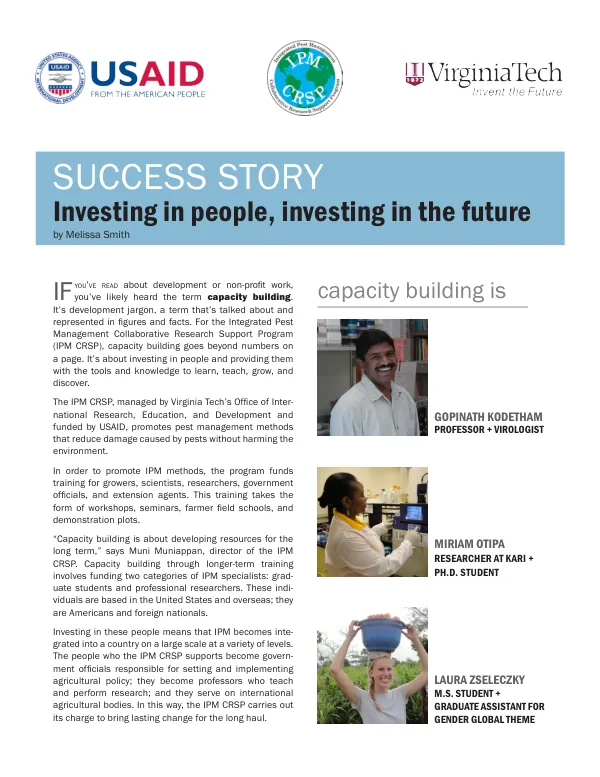
Funded by USAID and managed by Virginia Tech's Office of International Research, Education, and Development (OIRED), the program aims to reduce damage caused by pests without harming the environment. Capacity building is a key component of the IPM CRSP, involving the training of growers, scientists, researchers, government officials, and extension agents in pest management methods. This training takes the form of workshops, seminars, farmer field schools, and demonstration plots. The program funds two categories of IPM specialists: graduate students and professional researchers, who are based in the United States and overseas. One of the program's success stories is Gopinath Kodetham, a virologist from India who received a small grant from the IPM CRSP to identify the most prevalent plant diseases in Andhra Pradesh state. With the funding, Kodetham was able to identify newer, economically-important vegetable viruses that had not yet been reported in India. The IPM CRSP also views Kodetham as a long-term partner, interested in training the next generation of scientists in farmer-friendly IPM approaches to pest management. Another example of the program's impact is Miriam Otipa, a senior research scientist at the Kenya Agricultural Research Institute. Otipa's Ph.D. work on passion fruit viruses is being funded by the IPM CRSP, and she has presented her research to high-profile audiences, including Secretary of State Hillary Clinton and USAID Administrator Rajiv Shah. Otipa's work focuses on finding the causal agent of the virus, with hopes of saving a promising industry that provides a crucial source of income to women. The IPM CRSP also supports graduate students, such as Laura Zseleczky, who is studying for her M.S. in public and international affairs at Virginia Tech. Zseleczky serves as the graduate research assistant for the Gender Global Theme of the IPM CRSP and has gained valuable experience in organizing and participating in IPM CRSP events, including a workshop in Ghana. Her hands-on experience has helped make conceptual thinking in her courses more tangible, and she will be able to apply her knowledge and skills in her future career in international development. The IPM CRSP's efforts have led to significant outcomes, including a $1.5 million award from Indian federal agencies to Kodetham for his work on a serious virus affecting cucurbits. The program's impact extends beyond individual researchers, as it contributes to a faculty who can contribute in turn, not only in agriculture but also in other developing countries. The IPM CRSP's capacity building efforts have created a network of experts who can provide advice and support to neighboring countries, promoting sustainable pest management practices and reducing the environmental impact of pest control methods.
Related documents