USAID DEC
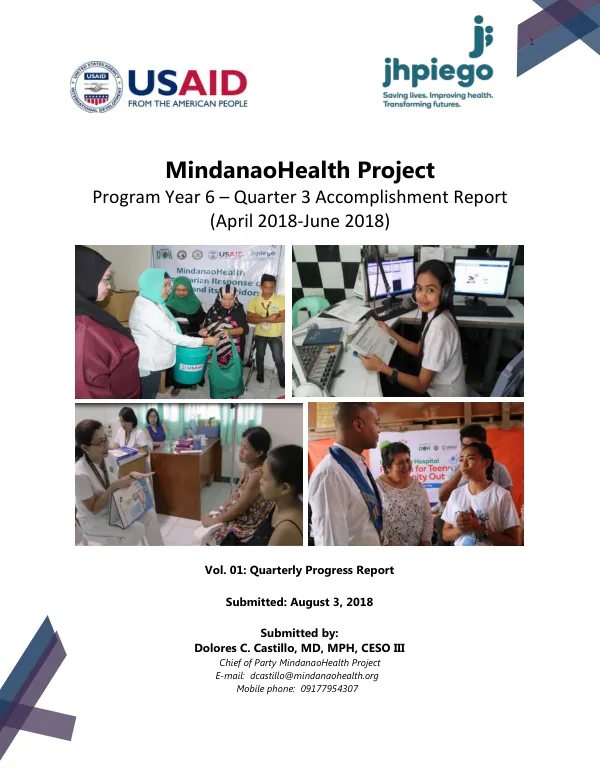
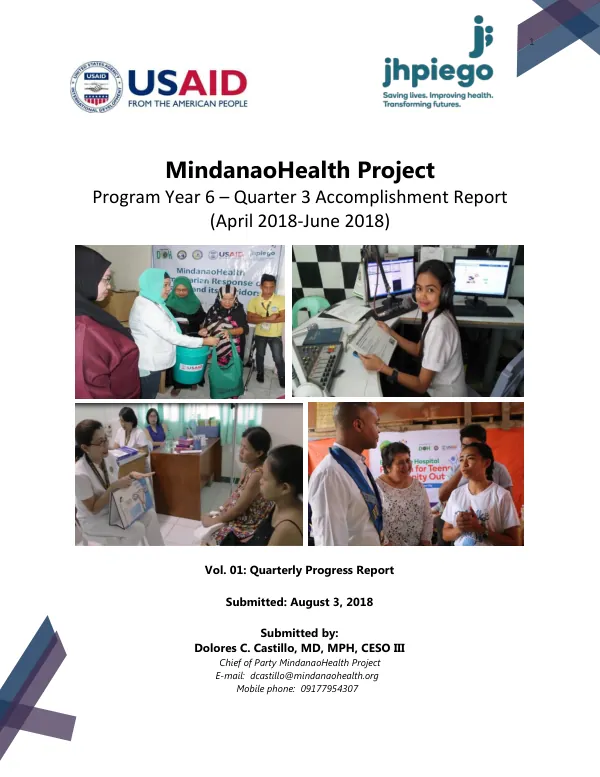
MindanaoHealth Project Program Year 6 – Quarter 3 Accomplishment Report (April 2018-June 2018)
Sign inDEPARTMENT OF HEALTH
MindanaoHealth Project Program Year 6 – Quarter 3 Accomplishment Report (April 2018-June 2018)
The MindanaoHealth Project is a program aimed at improving maternal, neonatal, and child health, as well as family planning services in the Mindanao region of the Philippines.
2018 · 161 pages
Sign in to readA free account is required to download.
Abstract
The program is supported by the United States Agency for International Development (USAID) and is implemented by the Maternal, Neonatal, Child Health/Family Planning (MNCHN/FP) Regional Projects in Luzon, Visayas, and Mindanao. The program's primary focus is on increasing access to family planning services, particularly in conflict-affected areas. To achieve this goal, the program has established a network of family planning service delivery points (SDPs) in various locations throughout the region. These SDPs provide a range of family planning services, including counseling, education, and provision of contraceptive commodities. One of the key achievements of the program is the increase in the number of modern family planning current users in USG-assisted areas. According to the program's data, the number of modern family planning current users has increased by 15% compared to the previous quarter. This is attributed to the program's efforts to increase access to family planning services, particularly in rural areas. The program has also made significant progress in improving the quality of family planning services. The average stock-out rate of contraceptive commodities at SDPs has decreased by 20% compared to the previous quarter. This is a result of the program's efforts to improve supply chain management and ensure that SDPs have adequate stock of contraceptive commodities. In addition to family planning services, the program also focuses on improving maternal and child health. The program has established a network of health outreach teams that provide health education and services to communities in need. The teams have reached over 10,000 clients during the quarter, providing them with essential health services, including antenatal care, delivery, and postpartum care. The program also places a strong emphasis on sustainability and self-reliance. The program has established partnerships with local governments and civil society organizations to ensure that the program's achievements are sustained beyond the project's lifespan. The program has also provided training and capacity-building activities to local health workers and community leaders to enable them to take ownership of the program's achievements. The program's collaboration with other stakeholders is also a key aspect of its success. The program has established partnerships with various organizations, including the Department of Health, local governments, and civil society organizations, to ensure that the program's goals are aligned with the needs of the communities it serves. In terms of management, administrative, and financial issues, the program has made significant progress in ensuring that its activities are implemented in a transparent and accountable manner. The program has established a robust financial management system that ensures that funds are utilized efficiently and effectively. Looking ahead, the program has planned several high-level activities for the next quarter, including the launch of the WHO/USAID/Jhpiego Toolbox on FP/MNCHN and the regional dissemination of the program's achievements. The program also plans to continue its efforts to improve access to family planning services, particularly in conflict-affected areas, and to strengthen its partnerships with local governments and civil society organizations.