HELLEN KELLER INTERNATIONAL
MMDP Project FY18 Annual Progress Report (October 1, 2017 – September 30, 2018)
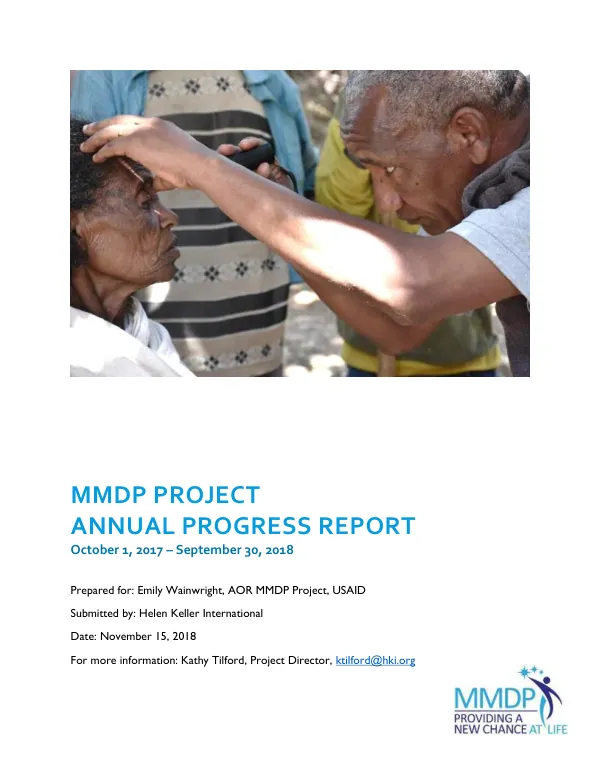
The Morbidity Management and Disability Prevention (MMDP) Project is a five-year initiative funded by the United States Agency for International Development (USAID) to strengthen national ownership and capacity within select countries to scale up the provision of quality services for the management of morbidity, disability, and disfigurement related to trachoma and lymphatic filariasis.
2018 · 147 pages
Sign in to readA free account is required to download.
Abstract
The project aims to achieve this goal by focusing on four intermediate results: strengthened MMDP data availability and quality, strengthened support for MMDP implementation scale-up and quality improvement, strengthened capacity of MMDP systems within Ministries of Health, and provision of global leadership through building upon the knowledge and evidence-base for MMDP preferred practices and policy. The MMDP Project is a global project led by Helen Keller International in partnership with the African Filariasis Morbidity Project and RTI International. The project is funded by USAID under Cooperative Agreement No. AID-OAA-A-11-00054, with a period of performance from July 22, 2014, through July 21, 2019. The project works at the national and global levels to expand the capacity of ministries of health to provide quality MMDP services for trachoma and lymphatic filariasis as part of global disease elimination efforts. In FY18, the MMDP Project continued to work closely with national programs in Burkina Faso, Cameroon, and Ethiopia to strengthen national ownership and global capacity for the scale-up of trachoma and LF care. The project supported 20,813 trachomatous trichiasis (TT) surgeries during the reporting period, advancing ministry of health efforts to meet the trachoma elimination goals. To provide these surgeries, the project screened 584,088 individuals living in endemic areas. The project also worked with global partners and experts, including those on the project's Technical Advisory Boards for trachoma and LF, to leverage field experiences and contribute to the global discussion on capacity building and support for meeting the 2020 elimination goals for trachoma and LF. The MMDP Project supported the implementation of various interventions, including training programs for healthcare workers, infrastructure development, and market linkage facilitation, to improve the delivery of MMDP services. The project's progress was monitored and evaluated through various indicators, including the number of TT surgeries performed, the number of individuals screened, and the quality of MMDP services provided. The project's findings and recommendations were shared with national programs, global partners, and experts to inform the development of strategies and policies to support the elimination of trachoma and LF. The MMDP Project's work in Burkina Faso, Cameroon, and Ethiopia focused on strengthening national ownership and capacity for the scale-up of trachoma and LF care. The project supported the implementation of various interventions, including training programs for healthcare workers, infrastructure development, and market linkage facilitation, to improve the delivery of MMDP services. In Burkina Faso, the project supported the implementation of a trachoma control program, which included the screening of 143,111 individuals and the performance of 2,511 TT surgeries. The project also worked with the Ministry of Health to develop a national trachoma control plan and to establish a trachoma surveillance system. In Cameroon, the project supported the implementation of a lymphatic filariasis control program, which included the screening of 134,111 individuals and the distribution of 1,011,111 doses of antifilarial medication. The project also worked with the Ministry of Health to develop a national lymphatic filariasis control plan and to establish a lymphatic filariasis surveillance system. In Ethiopia, the project supported the implementation of a trachoma control program, which included the screening of 306,866 individuals and the performance of 16,191 TT surgeries. The project also worked with the Ministry of Health to develop a national trachoma control plan and to establish a trachoma surveillance system. The MMDP Project's work in these countries contributed to the advancement of the global agenda for the elimination of trachoma and LF. The project's findings and recommendations were shared with national programs, global partners, and experts to inform the development of strategies and policies to support the elimination of these diseases.