USAID DEC
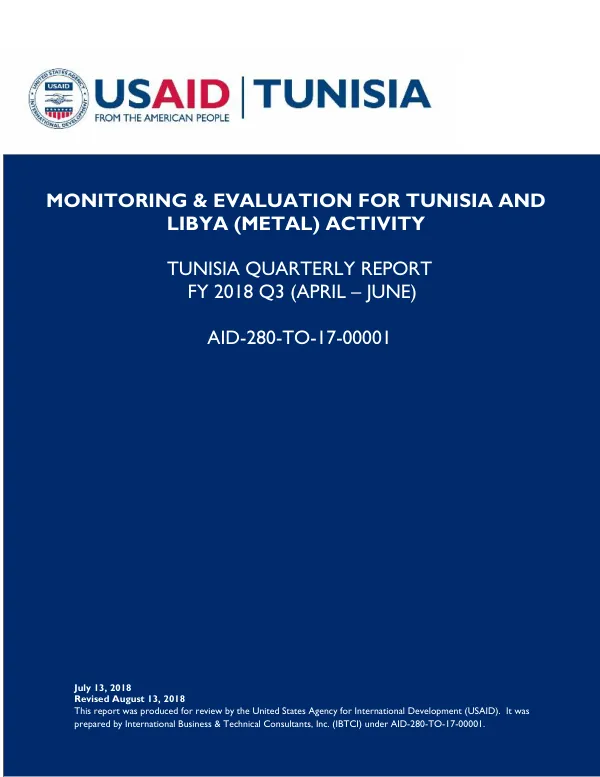
Monitoring and Evaluation for Tunisia and Libya (METAL) Activity, Tunisia Quarterly Report FY2018 Q3
Sign inINTERNATIONAL BUSINESS AND TECHNICAL CONSULTANTS, INC.
Monitoring and Evaluation for Tunisia and Libya (METAL) Activity, Tunisia Quarterly Report FY2018 Q3
The Monitoring and Evaluation for Tunisia and Libya (METAL) Activity is a technical support program for monitoring, evaluation, and learning (MEL) services for USAID/Tunisia and USAID/Libya.
2018 · 12 pages
Sign in to readA free account is required to download.
Abstract
The program aims to provide technical assistance to USAID/Tunisia in achieving its Country Development Cooperation Strategy (CDCS) goal and development objectives (DOs) by assisting in the application of knowledge derived from MEL to inform program and strategy decisions. The METAL Activity has three intermediate results: Improved Access to Relevant and Reliable Evidence for Decision-Making, Adaptive Management Supported, and Improved Institutional M&E Capacity of USAID/Tunisia and USAID/Libya. The first intermediate result focuses on providing monitoring support to USAID/Tunisia, including reviewing project-level MEL plans and implementing partner (IP) activity monitoring, evaluation, and learning plans (AMELPs). During the third quarter of fiscal year 2018, METAL initiated the review of USAID/Tunisia's project-level MEL plans, targeting June 2018. A thorough review of the indicators was conducted during the Middle East Regional Platform (MERP) M&E Advisor's visit in May. METAL is awaiting MERP guidance to finalize the project Activity Monitoring, Evaluation and Learning Plan (AMELP) updates. METAL also reviewed four IP AMELPs, updated based on the new template proposed by METAL and adopted by USAID/Tunisia. Only two IPs, Mashrou3i and CEED, have not submitted their updated AMELPs. METAL is awaiting the CEED Contracting Officer's Representative's (COR) guidance to meet with the team and begin providing support for their AMELP update. The review of the updated AMELPs revealed the efforts deployed by IPs to strengthen and complete their AMELPs in accordance with ADS 201. All submitted AMELPs have complete Performance Indicator Reference Sheets (PIRS) and data collection sections. The main METAL comments on the submitted AMELPs were related to baselines, targets, extensive data limitations sections, and missing methodologies for measurement of specific indicators. The METAL Activity has also made progress in improving institutional M&E capacity of USAID/Tunisia and USAID/Libya. METAL has provided capacity building support to USAID/Tunisia and some of its local partners in monitoring, evaluation, and knowledge management. The activity has also supported the development of a Performance Management Plan (PMP) refinement, which is anticipated by September 2018. In terms of challenges and lessons learned, METAL has faced some challenges in providing technical support to USAID/Tunisia and USAID/Libya. However, the activity has learned valuable lessons from these challenges, including the importance of effective communication and collaboration with IPs and USAID staff. Looking ahead, METAL plans to continue providing technical support to USAID/Tunisia and USAID/Libya in the next quarter. The activity will focus on finalizing the project MEL plans and AMELPs, as well as providing capacity building support to USAID/Tunisia and its local partners. METAL will also continue to work with USAID/Libya to provide third-party monitoring and evaluation services and support in efforts to gain and apply knowledge derived from MEL to inform program and strategy decisions.