USAID DEC
Monthly Progress Report: Tahafuz: “Building Resilience through Community Based Disaster Risk Management in the Sindh Province of Pakistan”
Sign inCONCERN WORLDWIDE INTERNATIONAL
Monthly Progress Report: Tahafuz: “Building Resilience through Community Based Disaster Risk Management in the Sindh Province of Pakistan”
The Tahafuz project, "Building Resilience through Community Based Disaster Risk Management in the Sindh Province of Pakistan," is a project implemented by the Rural Support Programmes Network (RSPN) with funding from the United States Agency for International Development (USAID) Office of Foreign Disaster Assistance (OFDA).
2013 · 8 pages
Sign in to readA free account is required to download.
Abstract
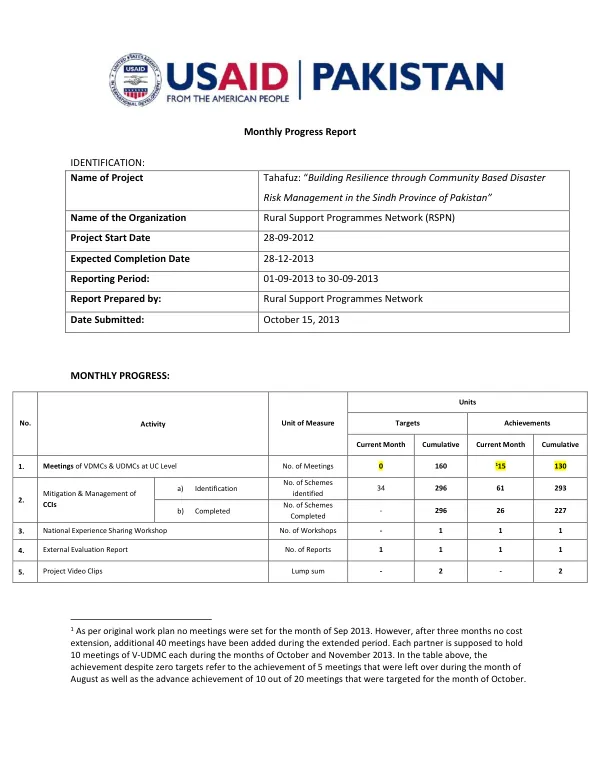
The project aims to build the resilience of communities in the Sindh Province of Pakistan through community-based disaster risk management. The project began on September 28, 2012, and was initially scheduled to end on December 28, 2013. However, due to a no-cost extension approved by the donor, the project period was extended until December 28, 2013. During this extended period, 64 additional Community Critical Infrastructure (CCI) schemes were added to the original plan, bringing the total number of CCIs to 296. The project has made significant progress in its implementation. A total of 232 Village Disaster Management Committees (VDMCs) have been formed, with 1,341 men and 1,331 women participating in these committees. Additionally, 20 Union Disaster Management Committees (UDMCs) have been formed, with 232 men and 232 women participating. The project has also trained 600 men and 570 women in disaster preparedness, management, and mitigation. The project has also made significant progress in the construction of CCIs. A total of 227 CCIs have been completed, with 61 new CCIs identified during the reporting month. The feasibility studies for some of these schemes have been completed, and the project is working to ensure that the schemes are beneficial to the community given local conditions. The project has also held meetings between VDMCs and UDMCs at the Union Council level. A total of 15 meetings were held during the reporting month, with 5 meetings being leftovers from the previous month and 10 meetings being advance achievements for the month of October. The project has also conducted an external evaluation, which has been shared with all stakeholders, including USAID and partners. The evaluation report highlights the achievements of the project and areas where more could have been done. The project has also organized a National Experience Sharing Workshop, which was attended by representatives from various organizations, including communities, USAID OFDA, NDMA, redRUK, Concern Worldwide, Focus, PPAF, NRSP, BRSP, TRDP, RSPN, Oxfam GB, and NDMP. The workshop aimed to share project achievements and field experiences among different stakeholders. The project has also produced a video clip and photographs, which were presented at the National Workshop and appreciated by the participants. The video clips will be shared with USAID in the coming week. One of the success stories of the project is the village of Baheed Khan Khaskheli, which is situated 50 km south of Umerkot town. The village has a population of 400 households and is comprised of Jogi, Khaskheli, Bheel, Bughya, and Kolhi communities. The village faces a lack of water facilities, with men, women, and children fetching water from dug wells that are 3 to 5 kilometers away from their homes. The project has formed a village disaster management committee, which has proposed the construction of a dug well scheme to cater to the DRR needs of the village.
Related documents
Documents in this collection
 2016
2016USAID DEC
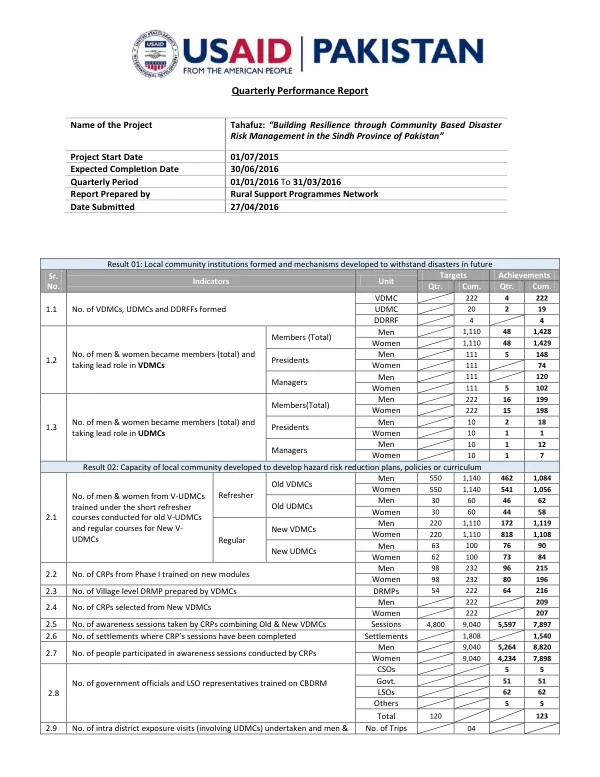
Quarterly Performance Report Tahafuz: Building Resilience through Community Based Disaster Risk Management in the Sindh Province of Pakistan
Open record 2021
2021USAID DEC