USAID DEC
NRT 5-Year Strategic Plan 2013 - 2017: Grazing Management
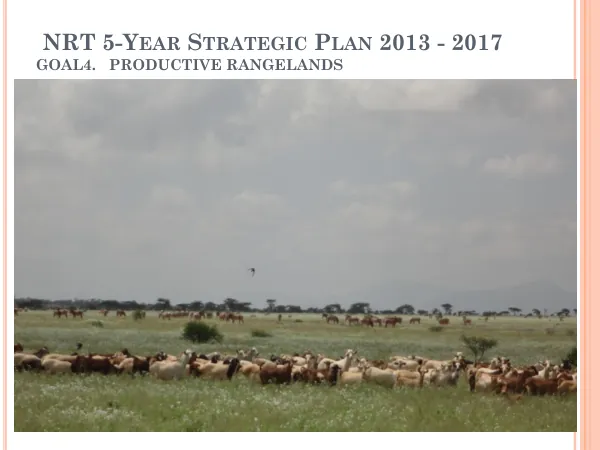
The NRT 5-Year Strategic Plan 2013-2017 focuses on achieving Goal 4: Productive Rangelands.
2013 · 31 pages
Sign in to readA free account is required to download.
Abstract
Escalating conditions of range land degradation, exacerbated by unplanned grazing, poor settlement patterns, and weakening traditional structures of governance, have led to the loss of perennial grasses, spread of invasive plant species, gully erosion, and frequent droughts. The highly degraded former grazing lands, bush encroachment, and gullies spread are major concerns. Holistic planned grazing is a program of action designed by Northern Rangelands Trust (NRT) to secure the best use of rangelands, build resilience, and reduce vulnerability to droughts and its adverse effects. The program aims to support a total of 9 NRT conservancies in 2013 to achieve the goal of improving forage yield, quality, and diversity, enhancing resilience and reducing the effects of droughts, maintaining or improving wildlife habitats, and enhancing effective ecological processes. The program also targets the restoration of highly degraded rangelands and carbon sequestration to mitigate climate change. To achieve the objectives, NRT employs holistic planned grazing, rangeland rehabilitation through bush control and reseeding, gully healing, and animal impacts. Land use plans are implemented to control adverse land use changes, and institutional capacity is built through committees, coordinators, bylaws, and other mechanisms. Measuring and monitoring changes are also essential components of the program. Holistic planned grazing involves getting animals to the right place, at the right time, for the right reasons. Grazing planning falls into two categories: wet season grazing plans, which involve deferred grazing to give plants recovery time, and dry season grazing plans, which aim to efficiently utilize pasture and minimize overgrazing. In wet season grazing plans, livestock are encouraged to graze around settlements and far away from permanent water sources. In dry season grazing plans, livestock are moved to areas with adequate pasture to prevent overgrazing. The program targets the improvement of forage yield, quality, and diversity, as well as the enhancement of resilience and reduction of the effects of droughts. The restoration of highly degraded rangelands and carbon sequestration are also key objectives of the program. By implementing holistic planned grazing, rangeland rehabilitation, and land use planning, NRT aims to achieve its objectives and improve the productivity of rangelands.
Related documents