USAID DEC
Observation Guide for Facilitating Discussions on HIV/AIDS
The observation guide for facilitating discussions on HIV/AIDS is a tool designed to assess the skills and competencies of facilitators in leading discussions on this sensitive topic.
2012 · 3 pages
Sign in to readA free account is required to download.
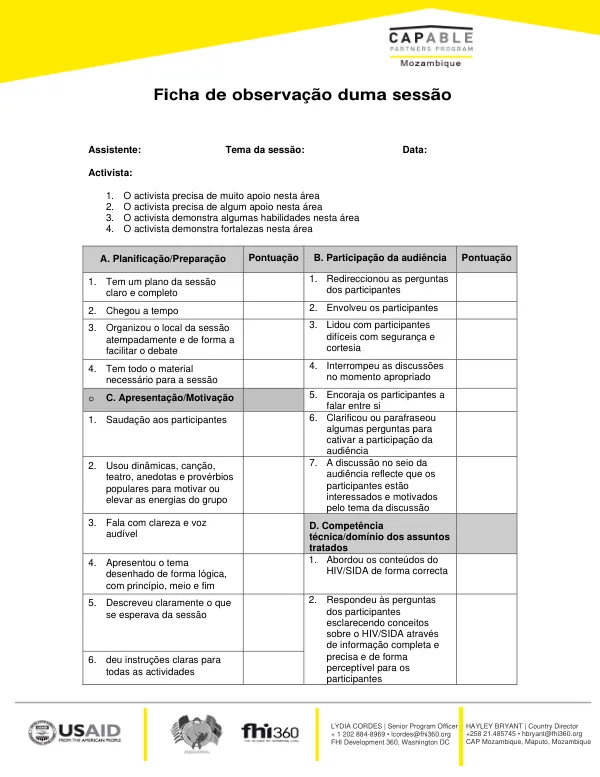
Abstract
The guide is divided into several sections, each evaluating a different aspect of the facilitator's performance. The facilitator's ability to plan and prepare for the session is evaluated under the section "Planificação/Preparação." This includes assessing whether the facilitator has a clear and complete plan for the session, can redirect participant questions, arrives on time, involves participants, and organizes the session location effectively. The facilitator's presentation and motivation skills are evaluated under the section "Apresentação/Motivação." This includes assessing whether the facilitator encourages participants to speak with each other, delivers a clear and audible speech, uses dynamics, music, theater, anecdotes, and proverbs to motivate or energize the group, and clarifies or paraphrases questions to engage the audience. The facilitator's technical competence and ability to address the topic of HIV/AIDS is evaluated under the section "Competência técnica/domínio dos assuntos tratados." This includes assessing whether the facilitator presents the topic in a logical and clear manner, addresses the contents of HIV/AIDS correctly, responds to participant questions, and uses examples and visual aids effectively. The facilitator's ability to facilitate exercises and activities is evaluated under the section "Facilitação de Exercícios." This includes assessing whether the exercises allow participants to practice skills related to the topic, are an effective way for participants to learn about the topic, and involve participants actively. The guide also includes an evaluation of the facilitator's use of visual aids, language, and body language. This includes assessing whether the facilitator uses visual aids effectively, speaks clearly and at a comfortable pace, and uses body language to facilitate communication. The observation guide is used to identify areas where the facilitator may need additional training or support. It is also used to provide feedback to the facilitator on their performance and to suggest ways in which they can improve their skills. The guide is part of a larger program called Strengthening Leading Mozambican NGOs and Networks II, which aims to support Mozambican NGOs and networks in their efforts to address HIV/AIDS and other development issues. The program provides training and technical assistance to facilitators and other stakeholders to help them build their capacity to address these issues effectively.