DEPARTMENT OF AGRICULTURE
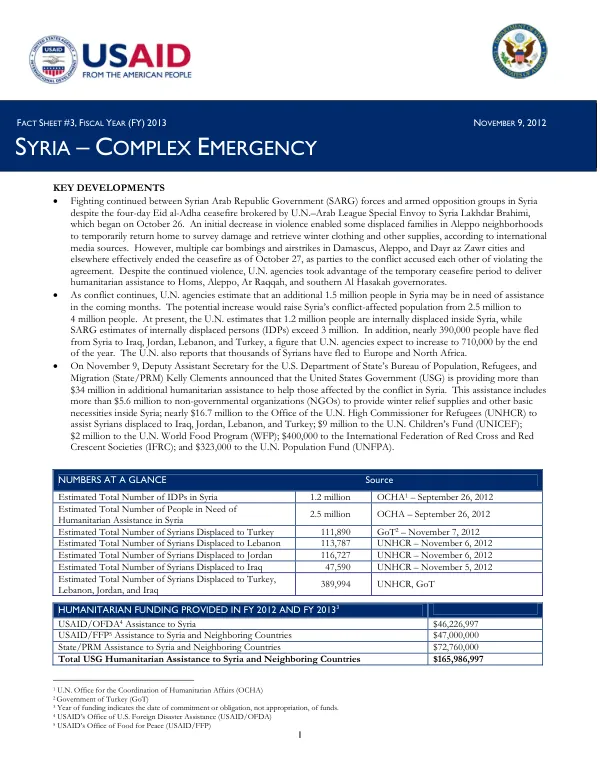
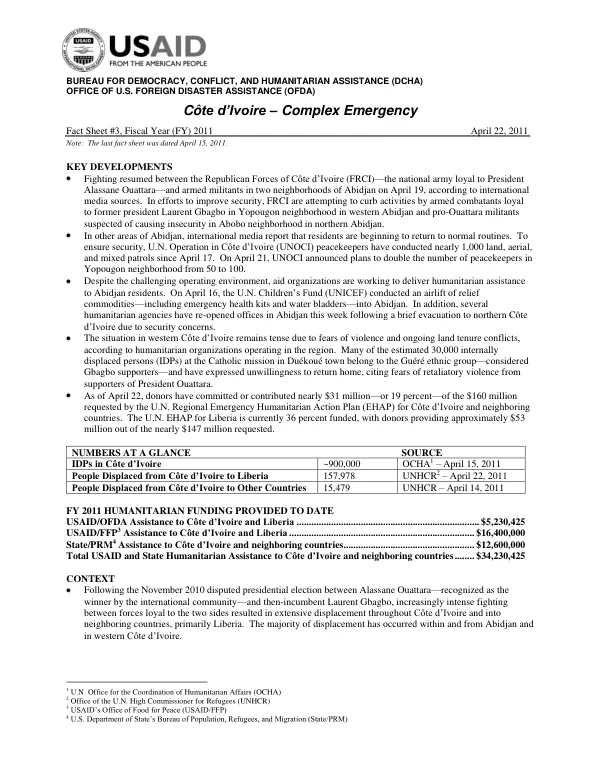
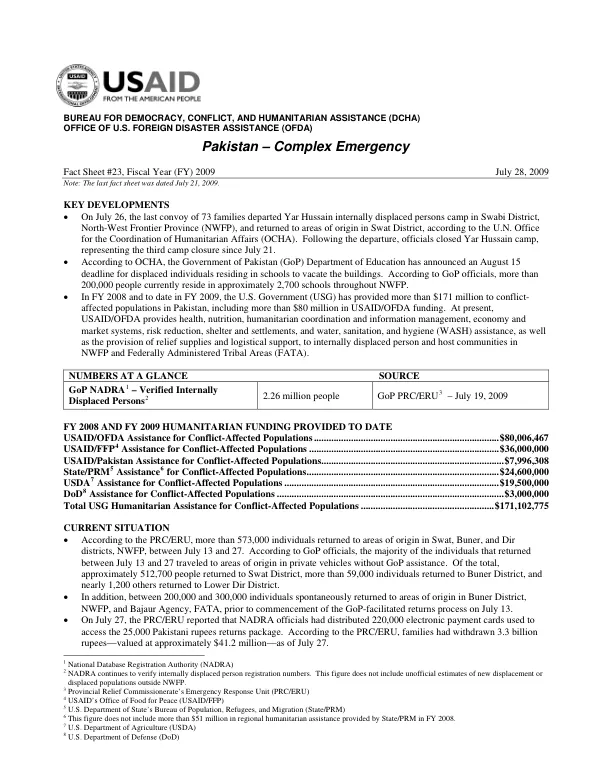
Pakistan Complex Emergency Fact Sheet #23
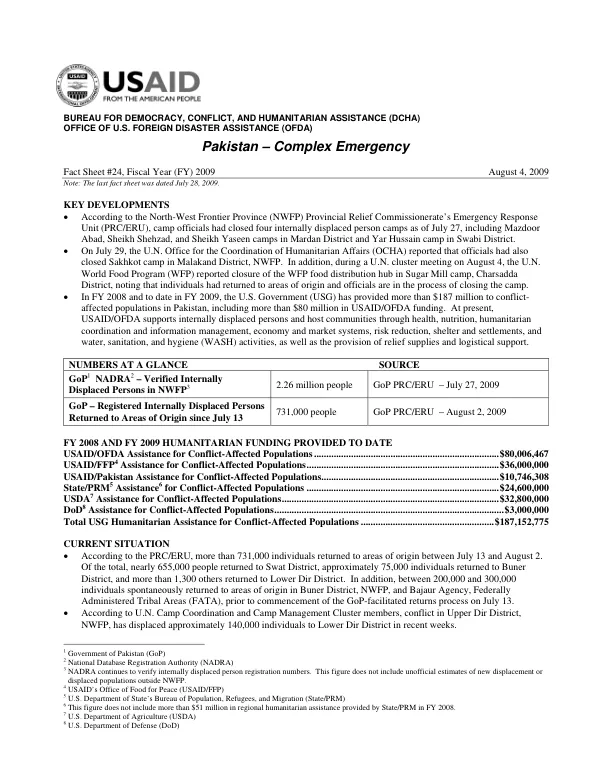
The complex emergency in Pakistan began with ongoing military operations in Upper Dir District, North-West Frontier Province (NWFP), displacing approximately 140,000 individuals to the province's Lower Dir District in recent weeks.
2009 · 4 pages
Sign in to readA free account is required to download.
Abstract
Local government officials report that Government of Pakistan (GoP) operations in South Waziristan Agency, Federally Administered Tribal Areas (FATA), have displaced approximately 60,000 people to date. The majority of displaced individuals from South Waziristan Agency currently reside with host communities in Tank and Dera Ismail Khan districts, NWFP. According to the Provincial Relief Commissionerate's Emergency Response Unit (PRC/ERU), more than 573,000 individuals returned to areas of origin in Swat, Buner, and Dir districts, NWFP, between July 13 and 27. The majority of individuals that returned between July 13 and 27 traveled to areas of origin in private vehicles without GoP assistance. Of the total, approximately 512,700 people returned to Swat District, more than 59,000 individuals returned to Buner District, and nearly 1,200 others returned to Lower Dir District. The U.S. Government (USG) has provided more than $171 million to conflict-affected populations in Pakistan, including more than $80 million in USAID/OFDA funding. USAID/OFDA provides health, nutrition, humanitarian coordination and information management, economy and market systems, risk reduction, shelter and settlements, and water, sanitation, and hygiene (WASH) assistance, as well as the provision of relief supplies and logistical support, to internally displaced person and host communities in NWFP and FATA. Humanitarian agencies continue to express concern regarding the spread of waterborne diseases during the July to September monsoon season. In response, the World Health Organization (WHO) and U.N. WASH Cluster members continue to provide 6.5 million liters of safe drinking water per day to camp populations, benefiting more than 216,000 displaced individuals. In addition, WHO conducts daily water quality tests in all camps. The U.N. Logistics Cluster has imposed security escort requirements on all U.N. staff traveling in Peshawar District since the July 16 incident in Kacha Ghari camp. The U.N. Human Settlements Program (UN HABITAT) assessed the possibility of establishing temporary shelters for individuals returning to Sultanwas town in Buner District, NWFP. The assessment team reported that conflict destroyed the majority of Sultanwas town. The U.N. World Food Program (WFP) distributed nearly 9,300 metric tons of food assistance to more than 1.4 million individuals, including 115,000 people residing in camps and 1.3 million people residing with host communities, between July 15 and 23. The International Committee of the Red Cross (ICRC) distributed approximately 1,000 metric tons of food to more than 60,000 displaced individuals between July 15 and 23.