DEPARTMENT OF AGRICULTURE
USAID-DCHA Pakistan Complex Emergency Fact Sheet #24 8/04/2009
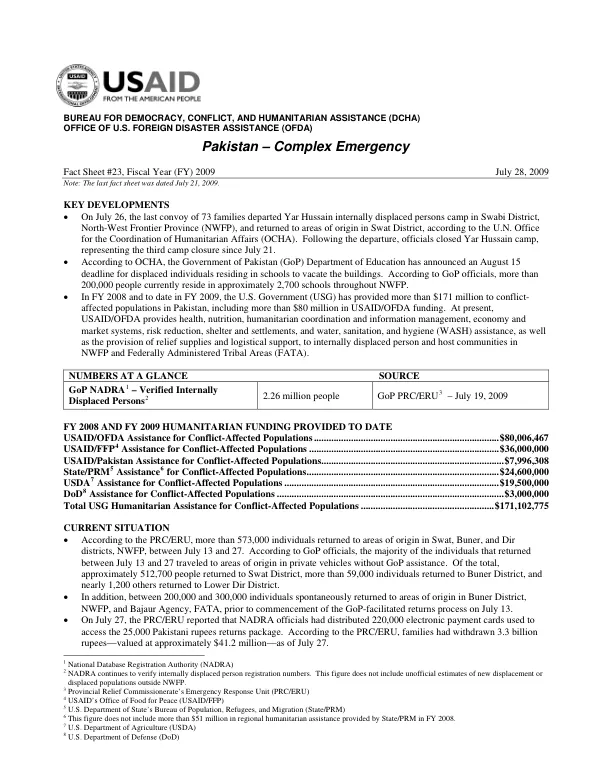
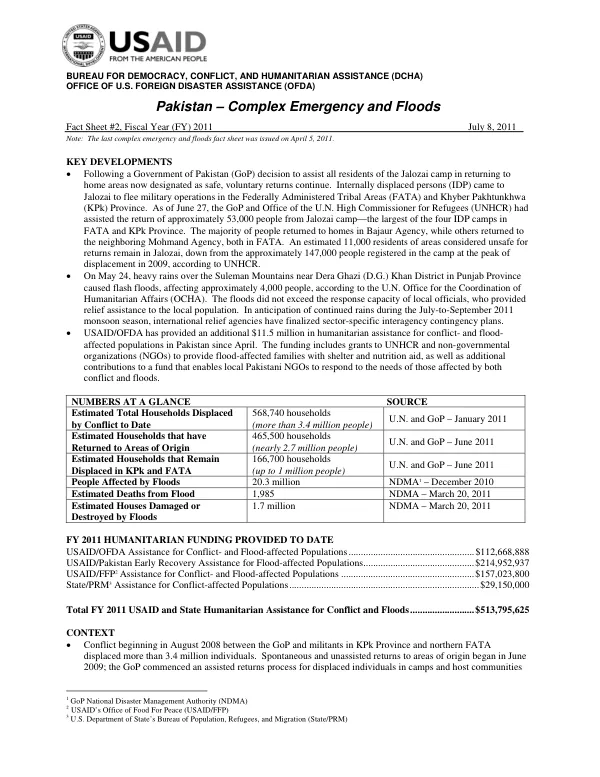
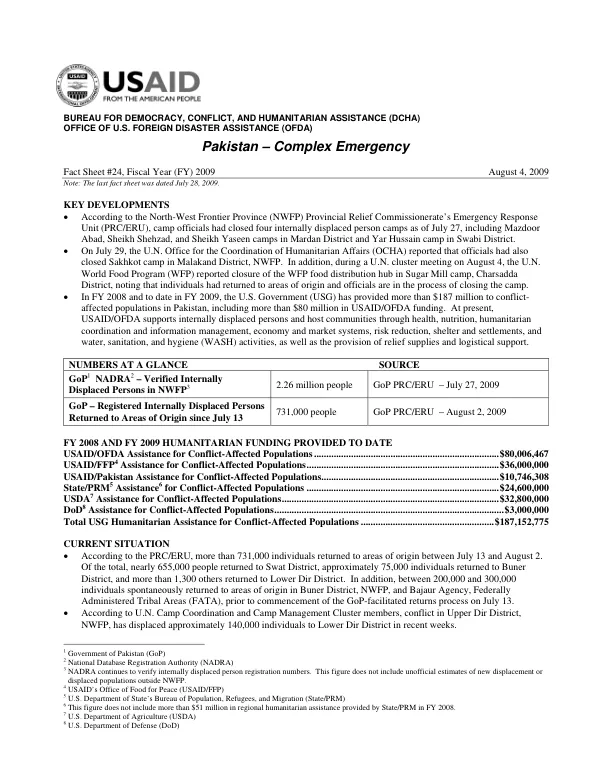
The North-West Frontier Province (NWFP) Provincial Relief Commissionerate's Emergency Response Unit (PRC/ERU) reported that four internally displaced person camps had been closed as of July 27, including Mazdoor Abad, Sheikh Shehzad, and Sheikh Yaseen camps in Mardan District and Yar Hussain camp in Swabi District.
2009 · 4 pages
Sign in to readA free account is required to download.
Abstract
Additionally, the U.N. Office for the Coordination of Humanitarian Affairs (OCHA) reported the closure of Sakhkot camp in Malakand District, NWFP. The U.N. World Food Program (WFP) also reported the closure of the WFP food distribution hub in Sugar Mill camp, Charsadda District. According to the PRC/ERU, more than 731,000 individuals returned to areas of origin between July 13 and August 2. Of the total, nearly 655,000 people returned to Swat District, approximately 75,000 individuals returned to Buner District, and more than 1,300 others returned to Lower Dir District. In addition, between 200,000 and 300,000 individuals spontaneously returned to areas of origin in Buner District, NWFP, and Bajaur Agency, Federally Administered Tribal Areas (FATA), prior to commencement of the GoP-facilitated returns process on July 13. The U.N. Camp Coordination and Camp Management Cluster members reported that conflict in Upper Dir District, NWFP, has displaced approximately 140,000 individuals to Lower Dir District in recent weeks. As of July 29, OCHA reported that nearly 43,400 displaced individuals had vacated 1,167 of the 4,740 occupied school buildings in NWFP. Of the total, an estimated 75 percent—representing approximately 32,550 individuals—returned to Swat District. According to OCHA, the NWFP government expects displaced individuals occupying the remaining school buildings in NWFP to vacate by August 15. Humanitarian assessments conducted by USAID/OFDA implementing partners reported that nearly 100 percent of returnees interviewed during the assessment reported that lack of access to cash remains a primary concern. Secondary needs cited by returnees included electricity restoration, as well as increased access to safe drinking water, food, and agricultural seeds. The assessment team also reported that inability to access fields during the conflict resulted in an 85 percent decline in the apricot, peach, wheat, plum, and onion harvests in the five union councils in southern Swat District. The U.N. Humanitarian Assessments reported that WFP distributed nearly 29,000 metric tons (MT) of food assistance during the month of July to more than 2 million individuals. WFP plans to establish three distribution points in D.I. Khan District and two others in Tank District during the week of August 3 to serve populations displaced from South Waziristan Agency, FATA. With USAID/OFDA support, the U.N. Human Settlements Program (UN HABITAT) has distributed tents, house repair kits, kitchen sets, and floor mats to approximately 22,500 conflict-affected families in Mardan District, NWFP, and more than 8,800 others residing in Swabi District, NWFP. The U.N. Children's Fund (UNICEF) has distributed 8,600 hygiene kits and approximately 270,000 water purification tablets to more than 60,000 individuals departing Sheikh Shehzad and Sheikh Yaseen camps in Mardan District, NWFP, and Yar Hussain camp in Swabi District, NWFP. To date in FY 2009, USAID/OFDA has provided more than $11.4 million to support WASH programs for conflict-affected populations throughout NWFP. U.N. WASH Cluster members continue to support WASH programs, benefiting approximately 150,000 internally displaced individuals residing with host communities, as well as more than 114,000 individuals residing in camps. The U.S. Government has provided more than $187 million to conflict-affected populations in Pakistan, including more than $80 million in USAID/OFDA funding. USAID/OFDA supports internally displaced persons and host communities through health, nutrition, humanitarian coordination and information management, economy and market systems, risk reduction, shelter and settlements, and water, sanitation, and hygiene (WASH) activities, as well as the provision of relief supplies and logistical support.
Related documents