U.N. HIGH COMMISSIONER FOR REFUGEES
Pakistan Floods and Complex Emergency Fact Sheet #1
The complex emergency in Pakistan has resulted in significant humanitarian needs, with millions of people displaced due to conflict and flooding.
2012 · 4 pages
Sign in to readA free account is required to download.
Abstract
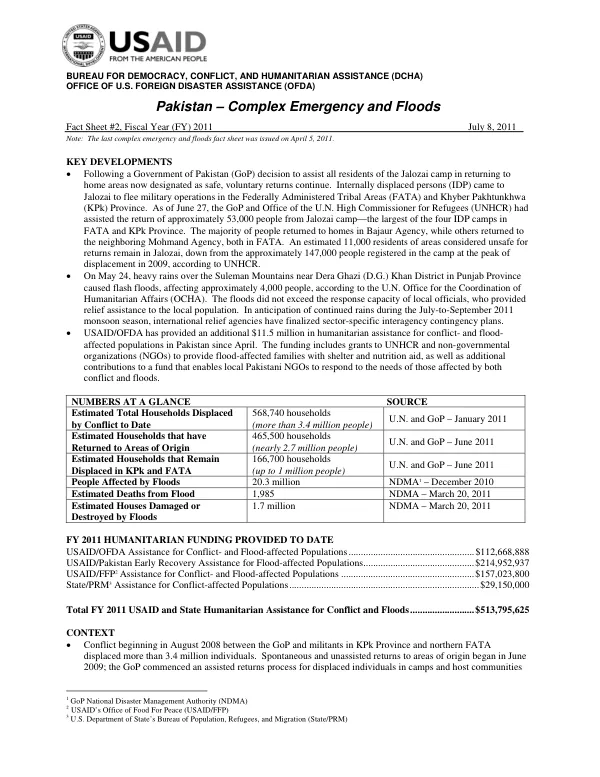
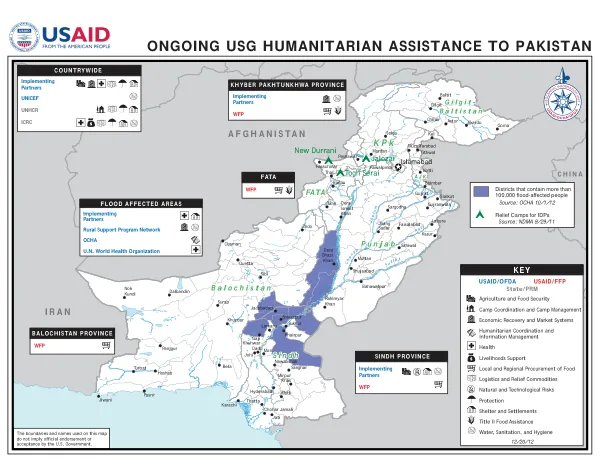
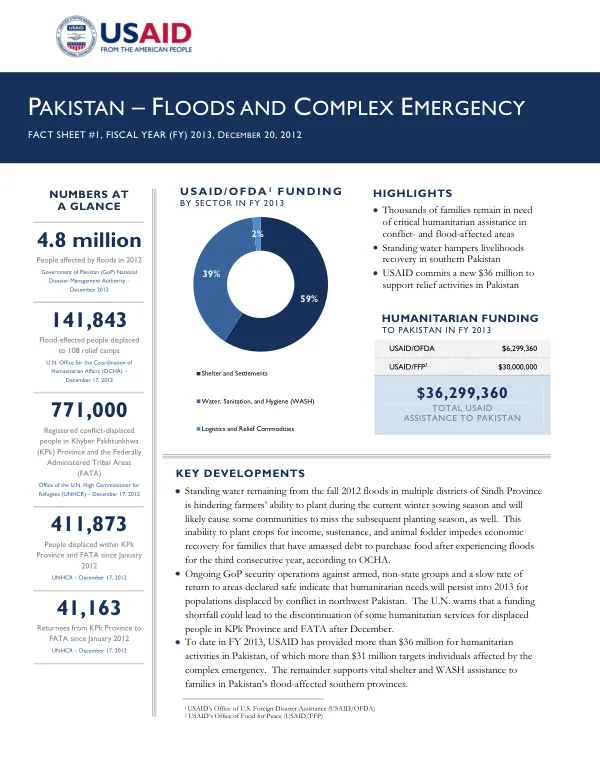
Since August 2008, conflict between the Government of Pakistan (GoP) and militants in the Federally Administered Tribal Areas (FATA) and Khyber Pakhtunkhwa (KPk) Province has led to the internal displacement of millions of Pakistanis. Spontaneous and GoP-assisted returns to areas of origin have occurred each year, but the overall security situation in Pakistan remains volatile and unpredictable. In 2012, heavy seasonal rainfall triggered flooding in Pakistan for a third consecutive year, primarily affecting districts in Balochistan, Punjab, and Sindh provinces. At the height of displacement in early October, approximately 350,000 people were residing in evacuation centers, and returns are currently ongoing. The floods damaged or destroyed up to 465,000 houses, causing affected families to temporarily reside along roadsides, in neighboring villages, and in relief camps or spontaneous settlements. The U.N. Office for the Coordination of Humanitarian Affairs (OCHA) reports that 4.8 million people were affected by the floods in 2012, with 141,843 flood-affected people displaced to 108 relief camps. The U.N. Children's Fund (UNICEF) is assisting vulnerable flood- and conflict-affected populations by increasing access to safe water supply and adequate sanitation, as well as conducting health and hygiene education activities in schools and displacement camps. USAID's Office of U.S. Foreign Disaster Assistance (USAID/OFDA) has provided more than $36 million for humanitarian activities in Pakistan in FY 2013, with over $31 million targeting individuals affected by the complex emergency. The majority of USAID/OFDA's funding supports shelter and water, sanitation, and hygiene (WASH) activities, including the provision of transitional shelters, rehabilitation of hand pumps, and provision of water containers and chlorination kits to treat water procured from the hand pumps. The U.N. World Food Program (WFP) continues to distribute food to conflict-affected people in northwest Pakistan, having reached more than 500,000 beneficiaries through general food distributions as of November 30. WFP has also completed an initial cycle of emergency food distribution under the second phase of its 2012 monsoon flood response, which reached nearly 1.3 million people. USAID's Office of Food for Peace (USAID/FFP) continues to support WFP's Protracted Relief and Recovery Operation (PRRO) for conflict-affected populations in KPk Province and FATA, most recently through a donation of 23,130 metric tons of food commodities valued at $30 million.
Related documents