USAID
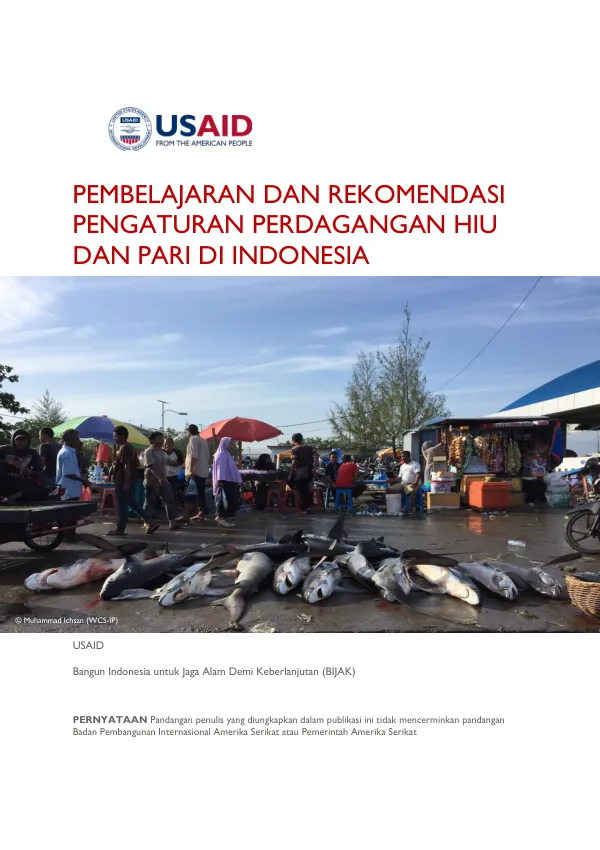
Pembelajaran dan Rekomendasi Pengaturan Perdagangan Hiu dan Pari di Indonesia
The Convention on International Trade in Endangered Species of Wild Fauna and Flora (CITES) has included 46 sharks and rays in Appendix I and II lists as part of the protection of this species.
2021 · 72 pages
Sign in to readA free account is required to download.
Abstract
Indonesia, as the world's top shark producer, has an average of more than 100,000 tonnes per year. The high demand for shark and ray products has led to signs of overexploitation in many countries, including Indonesia. The Management Authority (MA) for CITES-listed species in Indonesia was initiated into 2 (two) with the addition of the Ministry of Marine Affairs and Fisheries (KKP) as the Management Authority for fish species. This move aimed to improve management efficiency. Since the inclusion of sharks and rays in Appendix II CITES, Indonesia has tried to implement management ranging from full protection to manage utilization and trade by developing Non-Detriment Findings (NDF) and setting quotas. The Ministry of Marine Affairs and Fisheries (KKP) plays a crucial role in managing sharks and rays in Indonesia. The KKP has established several units, including the Directorate General of Fisheries Resources Management and the Directorate General of Marine and Coastal Resources Management. These units are responsible for implementing CITES regulations and managing shark and ray resources. The CITES protocol requires Indonesia to apply the principle of sustainable utilization, which includes aspects of legality, traceability, and sustainability. However, Indonesia faces several challenges in implementing CITES regulations, including limited coordination among institutions, limited data, limited regulations, and non-uniform data collection forms for sharks and rays utilization. To address these challenges, the Indonesian government has developed several policies and regulations, including the Standard Operating Procedure (SOP) for issuing Shark and Ray Import and Export Permits. The SOP outlines the procedures for issuing permits, including the requirements for documentation and the process for verifying the authenticity of permits. The Indonesian government has also established a centralized database on sharks and rays utilization, which provides information on the trade and utilization of sharks and rays in Indonesia. However, the database is not yet fully functional, and there are concerns about the accuracy and completeness of the data. In addition to these efforts, the Indonesian government has recommended several measures to improve the management of sharks and rays in Indonesia. These measures include improving the policy and governance levels at the CITES Management Authority (MA) and Scientific Authority (SA) levels, coordinating with the Ministry of Trade for the use of Shark and Ray Import and Export Permits, and developing standardized data collection forms. The private sector also plays a crucial role in the management of sharks and rays in Indonesia. The private sector has been involved in the trade and utilization of sharks and rays, and has a significant impact on the sustainability of shark and ray resources. To address the challenges faced by the private sector, the Indonesian government has recommended that private sectors or traders establish an association to ease the process of quota setting and distribution among traders. Overall, the management of sharks and rays in Indonesia is a complex issue that requires the coordination and cooperation of various stakeholders, including the government, private sector, and civil society. The Indonesian government has made significant efforts to improve the management of sharks and rays, but there are still several challenges that need to be addressed.
Related documents
Documents in this collection
 2021
2021USAID DEC
Pembangunan Kelapa Sawit yang Bertanggung Jawab: Analisis Tren Pemanfaatan Lahan dan Kebijakan Lingkungan pada Industri Kepala Sawit di Indonesia
Open record 2021
2021USAID DEC