USAID DEC
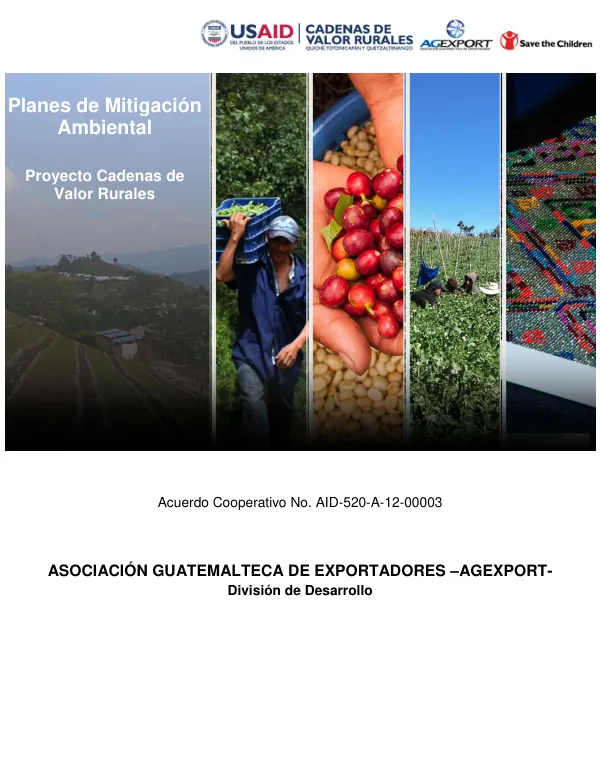
Plan de Mitigación y Monitoreo Ambiental por Cadena de Valor: Cadena de Valor del Café
Sign inUSAID DEC
Plan de Mitigación y Monitoreo Ambiental por Cadena de Valor: Cadena de Valor del Café
The agricultural development initiative in Guatemala focuses on mitigating environmental impacts associated with coffee production.
2016 · 33 pages
Sign in to readA free account is required to download.
Abstract
The project, titled "Cadenas de Valor Rurales," aims to promote sustainable agricultural practices among coffee farmers. The initiative is supported by the USAID-funded Food Security Program. The project's environmental mitigation plan involves several key interventions. Firstly, the project aims to update pesticide and training materials to adhere to the findings of the PERSUAP programmatic evaluation for the Latin America and Caribbean region. This will be implemented by technical staff from ANACAFE, FEDECOCAGUA, and AGEXPORT. The estimated cost of updating the materials is $200 per organization. Secondly, the project will provide annual training on the safe use of agrochemicals, including the use of personal protective equipment (PPE) and integrated pest management (IPM). The training will emphasize the importance of IPM and the identification of permitted pesticides and their uses. The estimated cost of this intervention is $200 per organization. Thirdly, the project will provide farmers with lists of approved pesticides, as per the PERSUAP programmatic evaluation. This will be implemented by technical staff from ANACAFE, FEDECOCAGUA, and AGEXPORT. The estimated cost of this intervention is $25 per organization. Fourthly, the project will train farmers on the use of PPE during pesticide application. When a standard PPE suit is not available, the project will identify alternative materials that can be used for protection. The estimated cost of this intervention is $200 per organization. Fifthly, the project will train associations to promote and communicate the lists of permitted products, established in the PERSUAP program. This will be implemented by technical staff from ANACAFE, FEDECOCAGUA, and AGEXPORT. The estimated cost of this intervention is $0, as it is included in the project's technical assistance. Sixthly, the project will promote the use of manual weeding and "chapeados" (leaving 10 centimeters of plants intact) instead of herbicides. The estimated cost of this intervention is $0, as it is a change in practice. Seventhly, the project will construct demonstration plots and train farmers on the correct and complete construction and use of pesticide mixing zones and biological beds. The estimated cost of this intervention is $200 per organization. Eighthly, the project will train farmers on the practice of cleaning and disposing of empty pesticide containers, according to Guatemalan standards. The estimated cost of this intervention is $0, as it is included in the project's technical assistance. Ninthly, the project will develop practices for solid waste management among farmers or producer groups. This will include coordinating waste collection and disposal services or establishing properly designed pits for inorganic waste disposal within the parcels. The estimated cost of this intervention is $14,000 for the implementation of a pilot program. Tenthly, the project will train farmers to establish native vegetation barriers (such as pastures, trees, or shrubs) where they do not exist, in the middle of coffee crops and riverbanks, to capture chemical and nutrient runoff. The estimated cost of this intervention is $200 per organization. Eleventhly, the project will train promoters and farmers on the design and implementation of soil conservation standards and practices (such as measures and spacings for soil conservation, according to soil type, depth, and terrain). The estimated cost of this intervention is $21,000 for the implementation of demonstration plots.