USAID DEC
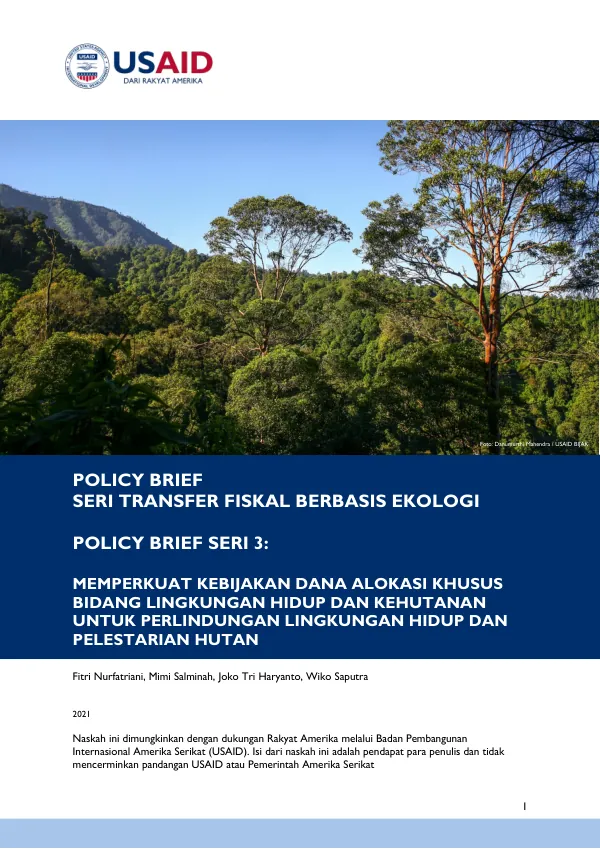
Policy Brief Seri 3: Memperkuat Kebijakan Dana Alokasi Khusus Bidang Lingkungan Hidup dan Kehutanan untuk Perlindungan Lingkungan Hidup dan Pelestarian Hutan
Sign inUSAID DEC
Policy Brief Seri 3: Memperkuat Kebijakan Dana Alokasi Khusus Bidang Lingkungan Hidup dan Kehutanan untuk Perlindungan Lingkungan Hidup dan Pelestarian Hutan
The Dana Alokasi Khusus (DAK) for the environment and forestry sector in Indonesia has not been effective.
2021 · 5 pages
Sign in to readA free account is required to download.
Abstract
The allocation of DAK-LHK is still based on a proposal-based system, which aims to achieve national priority program targets set by the central government. However, the current allocation mechanism has several limitations, including a lack of monitoring and evaluation, inadequate technical criteria, and a top-down approach that does not align with local needs. The allocation of DAK-LHK has been criticized for not supporting ecological sustainability. While the allocation of DAK-LHK has increased in recent years, the programs funded by DAK-LHK have not been effective in promoting ecological sustainability. Most of the programs funded by DAK-LHK are short-term and do not measure the impact of the program on ecological sustainability. The current allocation mechanism of DAK-LHK is based on a formula that does not take into account the ecological function of the forest. The formula only considers the area of forest cover, without considering the quality of the forest or the level of conservation. This has led to a situation where areas with high levels of forest cover receive a higher allocation of DAK-LHK, while areas with low levels of forest cover receive a lower allocation. To address these limitations, the authors recommend several reforms to the DAK-LHK allocation mechanism. First, they recommend that the allocation of DAK-LHK be based on a more comprehensive formula that takes into account the ecological function of the forest. Second, they recommend that the allocation of DAK-LHK be increased to support more effective programs that promote ecological sustainability. Third, they recommend that the allocation of DAK-LHK be made more transparent and accountable, with clear criteria and indicators for evaluating the effectiveness of the programs funded by DAK-LHK.