USAID DEC
Positive Youth Development (PYD) Approach for Adolescent and Youth Reproductive Health (AYRH) Programs
Sign inUSAID
Positive Youth Development (PYD) Approach for Adolescent and Youth Reproductive Health (AYRH) Programs
Positive Youth Development (PYD) is a broad approach that aims to build the competencies, skills, and abilities of youth needed to grow and flourish throughout life.
2019 · 8 pages
Sign in to readA free account is required to download.
Abstract
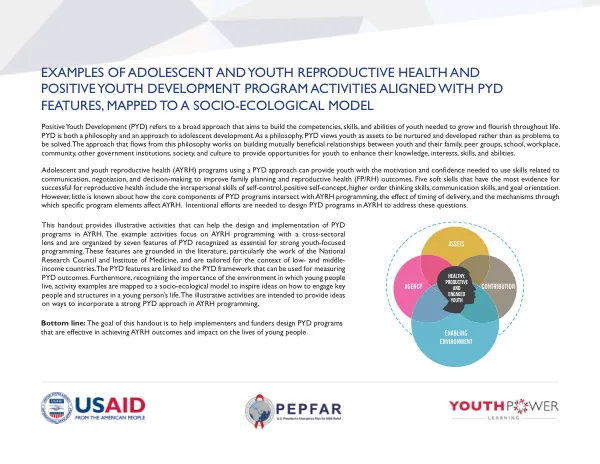
This approach views youth as assets to be nurtured and developed rather than as problems to be solved. PYD works on building mutually beneficial relationships between youth and their family, peer groups, school, workplace, community, other government institutions, society, and culture to provide opportunities for youth to enhance their knowledge, interests, skills, and abilities. Adolescent and youth reproductive health (AYRH) programs using a PYD approach can provide youth with the motivation and confidence needed to use skills related to communication, negotiation, and decision-making to improve family planning and reproductive health (FP/RH) outcomes. Five soft skills that have the most evidence for successful reproductive health include the intrapersonal skills of self-control, positive self-concept, higher order thinking skills, communication skills, and goal orientation. PYD programs in AYRH focus on building soft and life skills through skill-building activities within individual, family, peer, and community settings. These programs provide comprehensive reproductive health and family planning education, including contraception effectiveness, benefits, and side effects. They also train youth in soft and life skills, such as decision-making, communication, and interpersonal skills, and provide opportunities for youth to reinforce skills through role-playing, games, and video. The PYD approach emphasizes the importance of healthy relationships and bonding between youth and their family, peers, and community. This includes identifying and linking youth to positive adult role models, mentors, coaches, teachers, healthcare providers, and community leaders. PYD programs also provide youth with opportunities for positive adult and peer communication about reproductive health and rights, consent, and socio-cultural influences on health. In addition, PYD programs focus on creating an enabling environment that fosters positive relationships, belonging, and membership among youth. This includes providing opportunities for social interaction, creating structures that foster positive peer interaction, and tailoring interventions for marginalized and vulnerable populations. PYD programs also aim to promote cross-cultural awareness, address contraceptive stigma and gender discrimination, and provide comprehensive life-skills training for adolescent boys and young men. The PYD approach recognizes the importance of the environment in which young people live and aims to engage key people and structures in a young person's life. This includes working with government ministries, community leaders, and healthcare providers to advocate for comprehensive reproductive health education in schools, policies, and funding that encourage access to family planning services.