GOVERNMENT OF BANGLADESH
Pounds of Prevention Bangladesh
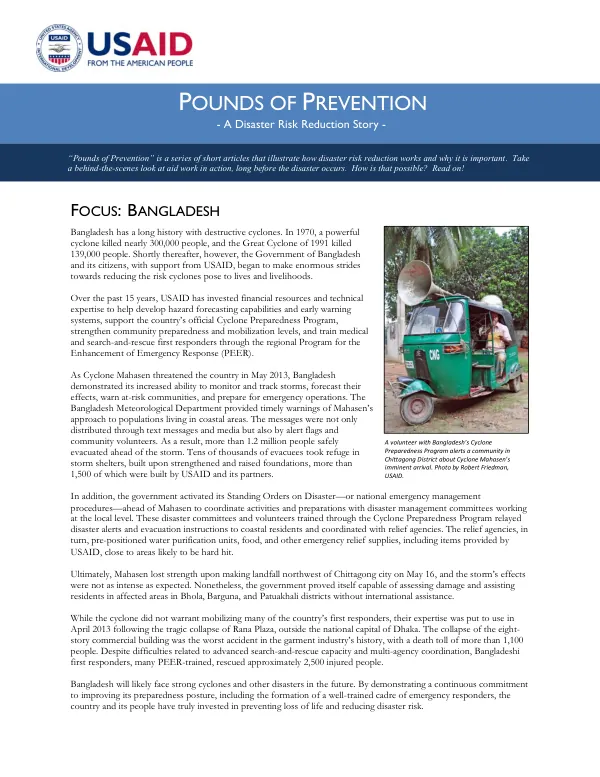
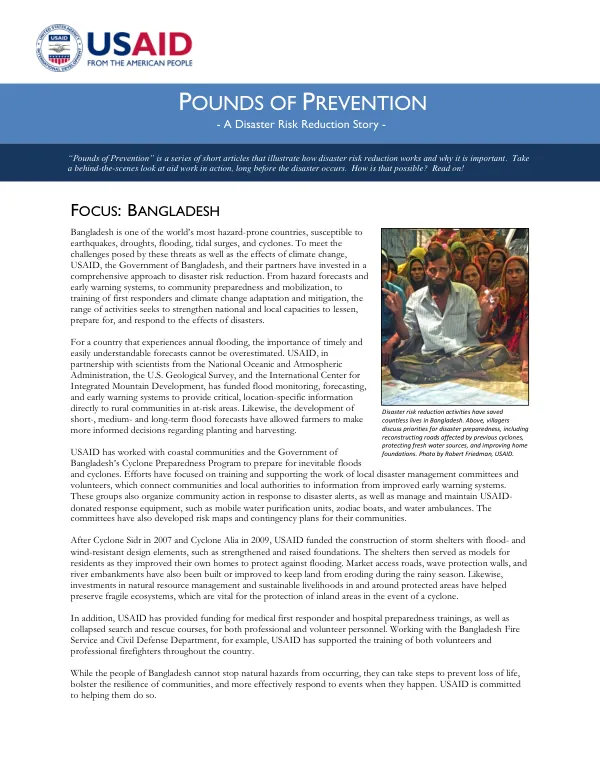
Bangladesh is one of the world's most hazard-prone countries, susceptible to earthquakes, droughts, flooding, tidal surges, and cyclones.
2013 · 1 pages
Sign in to readA free account is required to download.
Abstract
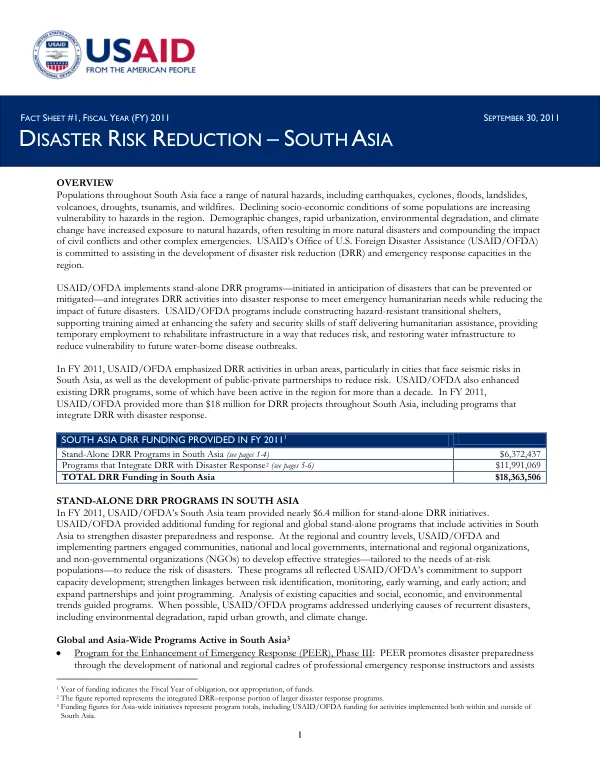
To meet the challenges posed by these threats as well as the effects of climate change, USAID, the Government of Bangladesh, and their partners have invested in a comprehensive approach to disaster risk reduction. This approach includes hazard forecasts and early warning systems, community preparedness and mobilization, training of first responders, and climate change adaptation and mitigation. For a country that experiences annual flooding, timely and easily understandable forecasts are critical. USAID, in partnership with scientists from the National Oceanic and Atmospheric Administration, the U.S. Geological Survey, and the International Center for Integrated Mountain Development, has funded flood monitoring, forecasting, and early warning systems to provide location-specific information directly to rural communities in at-risk areas. These systems have allowed farmers to make more informed decisions regarding planting and harvesting, and have enabled communities to prepare for inevitable floods and cyclones. USAID has worked with coastal communities and the Government of Bangladesh's Cyclone Preparedness Program to prepare for disasters. Efforts have focused on training and supporting local disaster management committees and volunteers, which connect communities and local authorities to information from improved early warning systems. These groups have also organized community action in response to disaster alerts, managed and maintained USAID-donated response equipment, and developed risk maps and contingency plans for their communities. The construction of storm shelters with flood- and wind-resistant design elements has been a key component of disaster risk reduction efforts in Bangladesh. USAID-funded shelters have served as models for residents as they improved their own homes to protect against flooding. Market access roads, wave protection walls, and river embankments have also been built or improved to keep land from eroding during the rainy season. Investments in natural resource management and sustainable livelihoods in and around protected areas have helped preserve fragile ecosystems, which are vital for the protection of inland areas in the event of a cyclone. In addition to these efforts, USAID has provided funding for medical first responder and hospital preparedness trainings, as well as collapsed search and rescue courses, for both professional and volunteer personnel. Working with the Bangladesh Fire Service and Civil Defense Department, USAID has supported the training of both volunteers and professional firefighters throughout the country. By investing in disaster risk reduction, USAID aims to help the people of Bangladesh prevent loss of life, bolster the resilience of communities, and more effectively respond to events when they happen.