USAID DEC
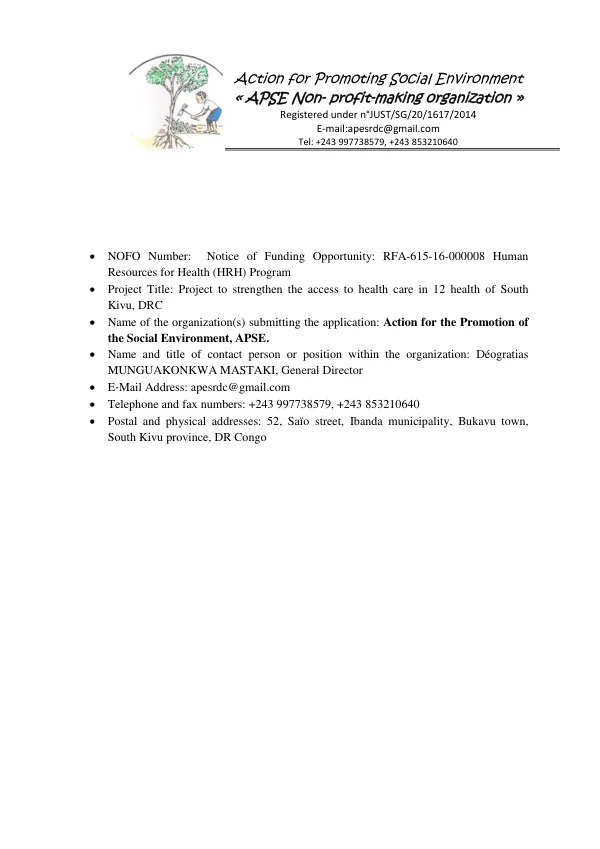
Project to strengthen the access to health care in 12 health zones of South Kivu, DRC
Sign inUSAID DEC
Project to strengthen the access to health care in 12 health zones of South Kivu, DRC
The Human Resources for Health (HRH) Program in South Kivu, Democratic Republic of Congo (DRC), aims to strengthen access to healthcare in 12 health zones.
2016 · 22 pages
Sign in to readA free account is required to download.
Abstract
The program is implemented by Action for the Promotion of the Social Environment (APSE), a non-profit organization registered in the DRC. The project's lifespan is three years, from September 1, 2016, to August 30, 2019, with an approximate budget of USD 2.350.000. The South Kivu province has experienced significant challenges, including political instability, economic decline, and a lack of access to basic social services such as healthcare, clean water, and education. The population of South Kivu is estimated at 4.538,706 inhabitants, with an average density of 69 inhabitants per square kilometer. A significant proportion of the population lives under extreme poverty, with an annual income below USD 1 per day. The health system in the DRC is based on hospitals and health centers supported by mobile teams to combat endemic diseases. However, many hospitals and health centers lack equipment, and the supply chain of drugs has broken down between the central level and the ground. The South Kivu province has experienced a difficult economic situation, with a fall in the formal economy and a decline in agricultural and mining production. The health care infrastructure in South Kivu is inadequate, with many health centers and hospitals functioning poorly or not at all due to insecurity, dilapidation of buildings, and a lack of medical facilities. The health expenditures per person and per year are on average USD 5.69 for the poorest and USD 20.75 for the wealthiest, representing 13% of the annual budget for the poorest and 7% for the middle class. APSE has established various strategies to address the challenges in the health care system, including capacity building for health staff, infrastructure development, and market linkage facilitation. The project aims to improve the technical efficiency and cost-efficiency relationship of the health care system, reduce recurrent charges, and increase the participation of beneficiaries in funding health services. The project will be implemented in 12 health zones in South Kivu, with a focus on capacity building, infrastructure development, and market linkage facilitation. The project's expected outcomes include improved access to healthcare, increased participation of beneficiaries in funding health services, and enhanced technical efficiency and cost-efficiency relationship of the health care system. The project's technical approach will be based on a comprehensive understanding of the HRH context and proposed approaches to achieve objectives. The project will be implemented by a team of experienced professionals, including health staff, infrastructure developers, and market linkage facilitators. The project's management structure will be based on a clear organizational chart, with defined roles and responsibilities. The project's budget will be approximately USD 2.350.000, with funding from various sources, including international donors and local stakeholders. The project's timeline will be three years, from September 1, 2016, to August 30, 2019, with regular monitoring and evaluation to ensure the project's progress and outcomes.
Related documents
Documents in this collection
 2021
2021USAID DEC
SEAD FY21 Annual Report (Final Program Report)
Open record 2020
2020USAID DEC
Ebola Virus Disease Infection Prevention and Control and the Provision of Primary Health Care and Water, Sanitation and Hygiene Infrastructure Semi-annual Report, October 30th, 2020, Agreement No: 720FDA20CA00005
Open record