USAID DEC
Promoting Respectful Maternity Care Through the Maternity Open Day Approach: Lessons Learned
Sign inPALLADIUM INTERNATIONAL, LLC
Promoting Respectful Maternity Care Through the Maternity Open Day Approach: Lessons Learned
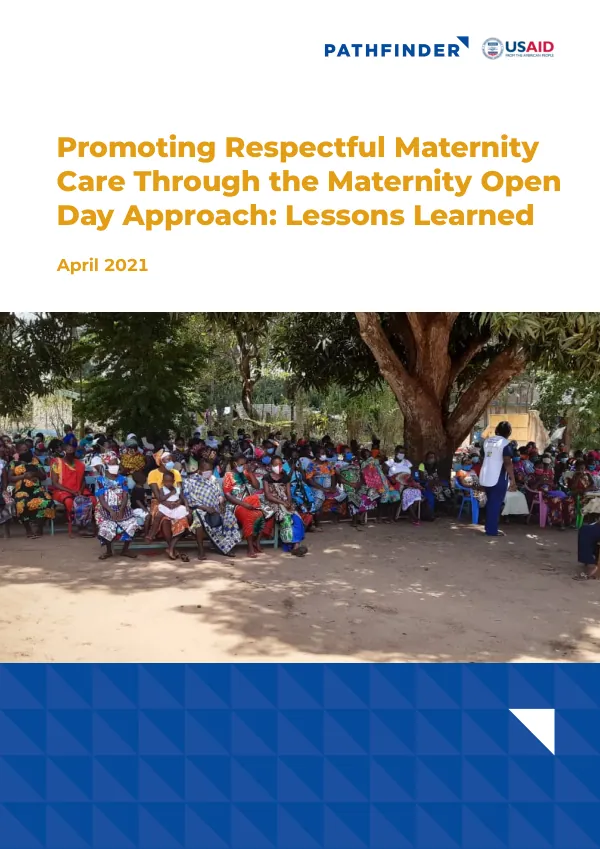
The Maternity Open Day approach was implemented in Kilifi County, Kenya, to promote respectful maternity care and improve maternal and child health outcomes.
2021 · 7 pages
Sign in to readA free account is required to download.
Abstract
The approach was part of the USAID Afya Pwani project, which aimed to improve access to and utilization of quality health services in Kenya. The project was implemented from June 2016 to December 2020 by Pathfinder International, with Palladium and Plan International as sub-recipients. Kenya has made significant progress in reducing maternal mortality, with a 51.6% reduction from 2000 to 2017. However, the reduction is below the recommended 6.4% yearly reduction rate, and regional disparities persist. Kilifi County has a high burden of maternal deaths, with a Maternal Mortality Ratio (MMR) of 250/100,000 compared to the national MMR of 362/100,000. The county also has low skilled birth attendance (SBA) and postnatal care (PNC) coverage. The Maternity Open Day approach was designed to address disrespect and abuse in maternity care, which is a critical deterrent for women seeking facility-based deliveries. The approach involves mobilizing pregnant women and their families to interact with healthcare providers and visit the maternity unit to demystify birthing practices and mitigate fears regarding childbirth in a facility. The approach also provides an opportunity for healthcare providers to gather information from women about facility-based services, identify weaknesses and strengths, and improve services to be more responsive to clients' needs. The implementation of the Maternity Open Day approach involved several steps, including performance review of MNCH indicators at the facility level, first planning meeting, community mobilization, final planning meeting, and the Maternity Open Day itself. The approach was designed to be rights-based and client-oriented, efficient (COPE), and to address the systems approach to improve maternal and newborn health outcomes. The Maternity Open Day approach was implemented in a phased approach, with the first step being performance review of MNCH indicators at the facility level. This involved setting up a performance review team to identify performance gaps in ANC, SBA, and other MNCH indicators. The team then formed the basis of targeted mobilization for the MOD. The second step involved a first planning meeting, where a MOD planning committee was constituted to plan the MOD. The committee consisted of a Public Health Officer (PHO), Community Health Extension Worker (CHEW), and a healthcare provider drawn from the MNCH department. The committee set a suitable date to conduct the MOD, developed a detailed patient flow plan, and assigned roles for healthcare providers and community health volunteers (CHVs). The third step involved community mobilization, where the PHO and CHEW informed community leaders and gatekeepers of the door-to-door mobilization of pregnant women for the MOD. The PHOs and CHEWs engaged CHVs to conduct an extensive community mobilization for pregnant women who had not started antenatal clinics through existing community information systems. The fourth step involved a final planning meeting, where the planning committee checked the availability of essential elemental requirements for a MOD and confirmed the status of mobilization for participants of the MOD. The Maternity Open Day itself involved several steps, including dialogue and maternity tour sessions led by the facility-in-charge. The sessions were conducted in smaller groups of clients to enhance understanding and promote intimate discussions. The Maternity Open Day approach was designed to improve maternal and child health outcomes in Kilifi County, Kenya. The approach involved mobilizing pregnant women and their families to interact with healthcare providers and visit the maternity unit to demystify birthing practices and mitigate fears regarding childbirth in a facility. The approach also provided an opportunity for healthcare providers to gather information from women about facility-based services, identify weaknesses and strengths, and improve services to be more responsive to clients' needs.