PALLADIUM INTERNATIONAL, LLC
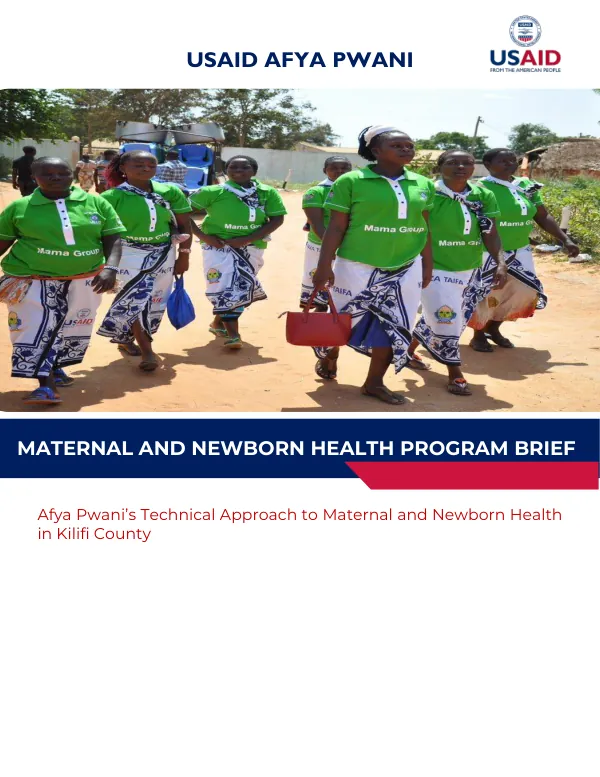
USAID Afya Pwani Maternal and Newborn Health Program Brief
The maternal and newborn health program in Kilifi County, Kenya, aimed to improve access to and use of quality health services.
2021 · 8 pages
Sign in to readA free account is required to download.
Abstract
At project inception, Kilifi county's maternal and neonatal mortality rates were among the highest in Kenya, with 250 deaths per 100,000 live births and 29 deaths per 1,000 live births, respectively. The 2014 Kenya Demographic and Health Survey showed low uptake of antenatal care (ANC) services (65%), skilled delivery (52%), and postnatal care services (38%) in the county. The leading causes of maternal mortality were postpartum hemorrhage, eclampsia, and sepsis, while newborn asphyxia, prematurity, and sepsis were the leading causes of neonatal mortality. Both demand- and supply-side barriers contributed to suboptimal access to and use of maternal health services. Demand-side barriers included retrogressive social-cultural beliefs, long distances between health facilities, poor road networks, disrespectful treatment by health care workers, and high cost of ANC and skilled delivery services. The USAID Afya Pwani project, implemented from 2016 to 2021, aimed to improve access to and use of quality health services in Kenya through strengthened service delivery and institutional capacity of county health systems. The project adopted an adaptive, county-led, systems approach to increase demand and strengthen the delivery of quality maternal and newborn health (MNH) services. The project implemented an SBCC framework using grassroots advocacy, behavior change communication, and community education to influence both individual and societal change. Afya Pwani supported local community gatekeepers, including Kaya leaders, local administrators, and religious leaders, to dispel social-cultural barriers to MNH and improve health outcomes. The project also empowered the Magarini Cultural Centre, a confluence of Kaya leaders, to influence communities' social norms and behavior in the Magarini subcounty. This led to a significant improvement in the use of MNH services. The project transformed 400 traditional birth attendants (TBAs) into birth companions and referral agents for ANC and skilled delivery. Conscious of fathers' critical part as health decision makers in Kilifi, the project involved men as partners and galvanized their support for ANC attendance and institutional delivery. The project engaged 400 male champions and used a paternity open day approach. Afya Pwani also introduced appointment and defaulter management in 100 facilities to enhance retention in the MNCH cascade. The project strengthened the referral system and linkages at all levels, enhancing client, expert, and specimen referral through co-design and rollout of seven subcounty decentralized obstetric, high-risk clinics. The project also supported the county in expanding comprehensive laboratory services for antenatal care from 20 facilities to 78 facilities. The project scaled up Linda mama services through facility sensitization and increased community awareness from 18 facilities to 126 facilities. The project documented 100% registration of clients for Linda mama during open maternity days. Scale up of Linda mama, along with SBCC, respectful maternity care, improved provider emergency obstetric and newborn care (EmONC) knowledge and skills, supportive supervision, and strengthened access to equipment and commodities, helped to increase the skilled birth attendance rate from 66% at baseline to 79% as at the end of Year 4. The postnatal care rate also increased from 14.5% at baseline to 62.6% at the end of Year 4. This was the result of a multipronged approach that included strengthening provider capacity, improving reporting and documentation, increasing access to equipment, advocating for increased 24-hour maternity coverage, and using social media to reduce missed opportunities.