FHI 360
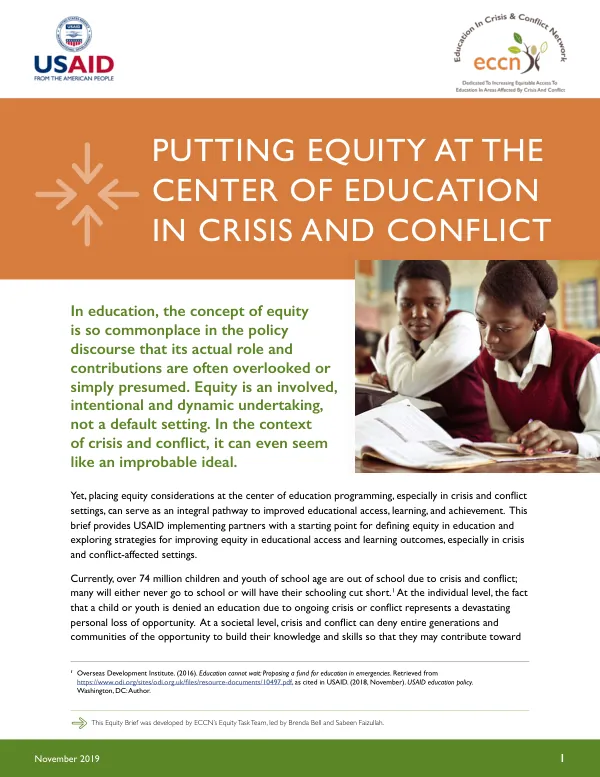
Putting Equity at the Center of Education in Crisis and Conflict
The concept of equity in education is often overlooked in policy discourse, despite its critical role in improving educational access, learning, and achievement, particularly in crisis and conflict settings.
2019 · 9 pages
Sign in to readA free account is required to download.
Abstract
Over 74 million children and youth of school age are out of school due to crisis and conflict, with many never attending school or having their schooling cut short. This represents a devastating personal loss of opportunity for individuals and a societal loss of potential for entire generations and communities. The USAID Education Policy emphasizes the importance of equity and inclusion, with Principle 6 stating that education programs should be accessible, inclusive, and culturally and conflict-sensitive. The policy also prioritizes country-focus and ownership, focusing on measurably and sustainably improving learning and educational outcomes. In crisis and conflict contexts, equity in education serves as a practical and strategic necessity to breaking cycles of poverty, discrimination, and further inequality that threaten the stability and security of societies. The U.S. Government Strategy on International Basic Education outlines a clear commitment to providing the most marginalized and vulnerable populations with access to a safe, equitable, and quality education. The USAID Education Policy is even more explicit in putting equity front and center, both as one of the six principles that guide the strategy and in its four policy priorities. Priority 1 states that children and youth, particularly the most marginalized and vulnerable, have increased access to quality education that is safe, relevant, and promotes social well-being. Equity and inclusion are critical to ensuring that all children and youth have a strong foundation in reading, math, and social and emotional skills. Equitable and inclusive teaching and learning approaches are essential to achieving learning outcomes, and youth gain the skills they need to lead productive lives, gain employment, and positively contribute to society. Higher education institutions have the capacity to be central actors in development by conducting and applying research, delivering quality education, and engaging with communities. Defining equity involves a two-fold process of reducing existing barriers (social, cultural, economic) in a fair manner and increasing opportunities through inclusion. Ensuring equity in education means ensuring that the most marginalized and vulnerable children and young people have an equal opportunity to access, learn, and complete safe, quality, relevant education. This commitment involves a process of reducing barriers and increasing opportunities to achieve greater equality. The commitment to equity in education is critical to achieving improved educational access, learning, and achievement, particularly in crisis and conflict settings. By prioritizing equity and inclusion, education programs can ensure that all children and youth have a strong foundation in reading, math, and social and emotional skills, and gain the skills they need to lead productive lives, gain employment, and positively contribute to society.
Related documents
Documents in this collection
 2015
2015USAID DEC
USAID E3/ED Building Evidence and Capacity to Increase Equitable Access to Education in Crisis and Conflict-Affected Environments Quarterly Report: January 2015 – March 2015
Open record 2015
2015USAID DEC