ELIZABETH GLASER PEDIATRIC AIDS FOUNDATION
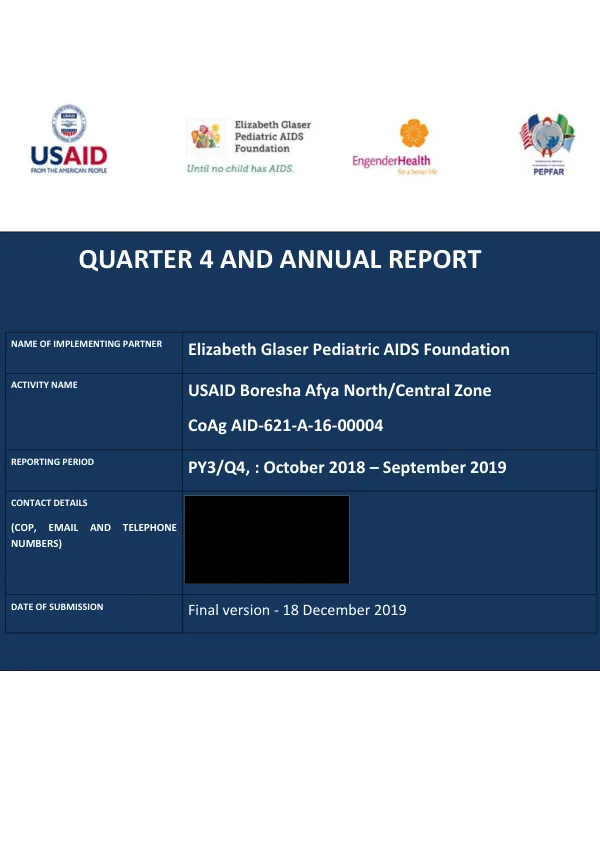
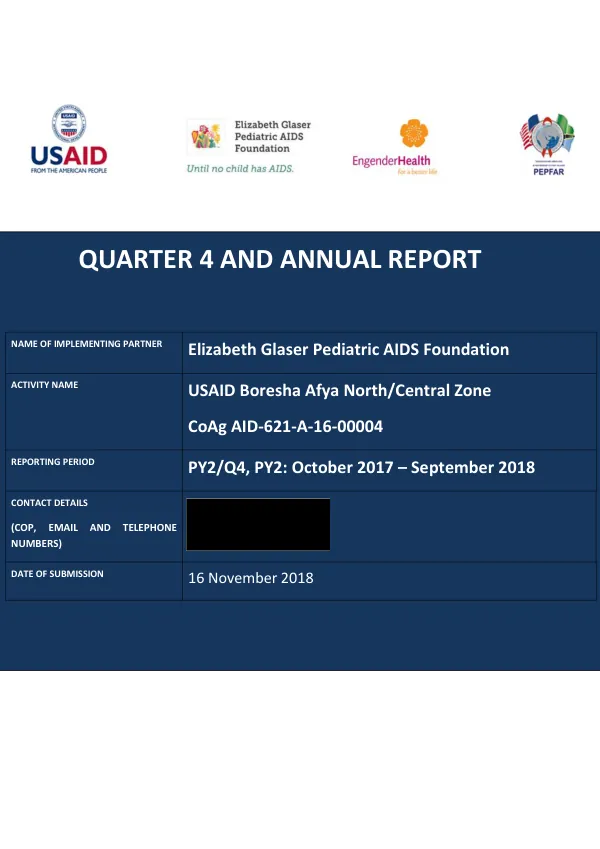
Quarter 4 and Annual Report: USAID Boresha Afya North/Central Zone
The USAID Boresha Afya North/Central Zone activity is a health project implemented by the Elizabeth Glaser Pediatric AIDS Foundation (EGPAF) in Tanzania.
2018 · 125 pages
Sign in to readA free account is required to download.
Abstract
The project aims to improve the health status of Tanzanians by increasing access to quality, integrated health services, particularly in reproductive, maternal, neonatal, child, and adolescent health. The project is implemented from October 1, 2016, to September 30, 2021, and is funded by the United States Agency for International Development (USAID) through the CoAg AID-621-A-16-00004 agreement. The project focuses on three main result areas: Improved Enabling Environment for Health Service Provision, Improved Availability of Quality, Integrated Health Services at the Facility Level, and Increased Access to Health Services at the Community Level. To achieve these results, the project uses five cross-cutting strategic approaches, including optimizing EGPAF's district-focused approach, promoting integrated, client-centered approaches, and implementing proven and enhanced community approaches. In the Improved Enabling Environment for Health Service Provision result area, the project provides technical assistance to the Government of Tanzania to develop, communicate, and execute national plans. This includes developing policies, guidelines, and protocols to enable the provision of integrated, quality health services at facilities with links to communities. In the Improved Availability of Quality, Integrated Health Services at the Facility Level result area, the project increases the provision of quality, integrated services, supports districts and regions for increased accountability and responsiveness in service delivery, and strengthens client-provider interactions to promote respectful, informed care. In the Increased Access to Health Services at the Community Level result area, the project strengthens connections between households and facilities through preventative, curative, and health promotion activities by community health workers (CHWs) and improves access to health services through community outreach for underserved populations. The project also focuses on gender mainstreaming, monitoring, evaluation, and learning, and has made significant progress towards its targets in the first two years of implementation. The project has trained over 2,500 CHWs and has reached over 100,000 individuals with health services. The project has also established 15 demonstration plots to promote sustainable agriculture practices and has provided technical assistance to the Government of Tanzania to develop national plans. The project has also identified several challenges, including equipment costs and limited resources, and has developed plans to overcome these challenges. The project has also documented several best practices and success stories, including the use of community-based HIV services and the promotion of respectful, informed care. Overall, the USAID Boresha Afya North/Central Zone activity is making significant progress towards its goals and has the potential to improve the health status of Tanzanians, particularly in reproductive, maternal, neonatal, child, and adolescent health.
Related documents