ACTION CONTRE LA FAIM
Quarterly Report Apri - Jun 2019
The agricultural development initiative in the Democratic Republic of the Congo began in 2018 with funding from USAID's Food Security Program.
2024 · 8 pages
Sign in to readA free account is required to download.
Abstract
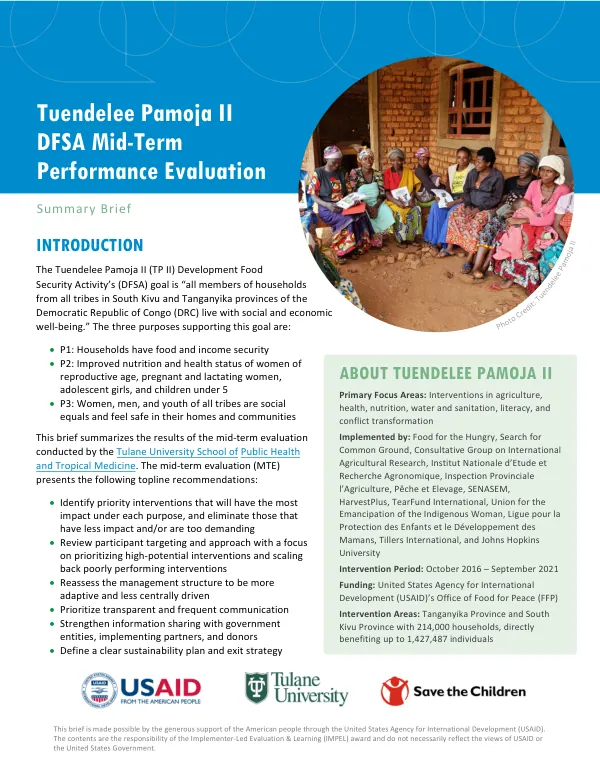
The initiative, known as Tudienzele, aims to sustainably improve food, nutrition, and economic security among vulnerable households in Kasai and Kamonia regions. Tudienzele is implemented by a consortium led by ADRA International, with sub-awardees including Action Contre la Faim (ACF), Adam Smith International (ASI), Johns Hopkins University-CCP, and a local gender partner. The program focuses on two main purposes: strengthened livelihoods and increased incomes, and improved utilization of quality among vulnerable people. Under the first purpose, the program aims to improve usage of credit and capital, increase profitable and diverse enterprises and income-generating activities, and increase agricultural production. Under the second purpose, the program aims to improve maternal, infant, and young child behaviors and improve water, sanitation, and hygiene behaviors. The program has a geographic focus on Kasai and Kamonia regions, with a target of 244,452 participant households. The program is implemented by a consortium of organizations, including ADRA, ACF, ASI, and Johns Hopkins University-CCP. The program also plans to partner with the Ecole de Sante Publique Kinshasa and other collaborating partners. During the reporting period, the program conducted a post-award orientation meeting with USAID's BHA on October 18, 2023. The meeting aimed to ensure that ADRA understood the requirements of the award and the procedures to be followed during award administration. The program also began planning and foundational steps to launch activities during the 12-month refine and implement period. The program's cross-cutting elements include food commodity management, gender, youth, social inclusion, and patterns of power, governance, and climate adaptation. The program also has a theory of change, which outlines the expected outcomes and impact of the program. The program's monitoring, evaluation, and learning (MEAL) activities are led by ADRA, with support from the consortium partners. The program's adaptive management approach allows for flexibility and adjustments to be made as needed to ensure the program's effectiveness and efficiency. The program's quarterly report highlights the progress made during the reporting period, including the post-award orientation meeting and the beginning of planning and foundational steps to launch activities. The report also outlines the program's goals, objectives, and expected outcomes. The program's implementation quality is ensured through strong consortium management, quality control, and quality control and strong M&E and adaptive management. The program's governance structure includes a chief of party, a country director, and a local gender partner. The program's climate adaptation component aims to improve the resilience of vulnerable households to climate-related shocks and stresses. The program's food commodity management component aims to improve the availability and accessibility of food for vulnerable households. The program's gender, youth, social inclusion, and patterns of power component aims to promote gender equality and social inclusion among vulnerable households. The program's governance component aims to ensure that the program is implemented in a transparent and accountable manner. The program's climate adaptation component aims to improve the resilience of vulnerable