USAID DEC
Quarterly Political Economy Analysis: The Perspectives of Migrant Fulani Herders on Violent Conflict with Farmers in LGA's of Adamawa and Yobe States
Sign inCREATIVE ASSOCIATES INTERNATIONAL INC.
Quarterly Political Economy Analysis: The Perspectives of Migrant Fulani Herders on Violent Conflict with Farmers in LGA's of Adamawa and Yobe States
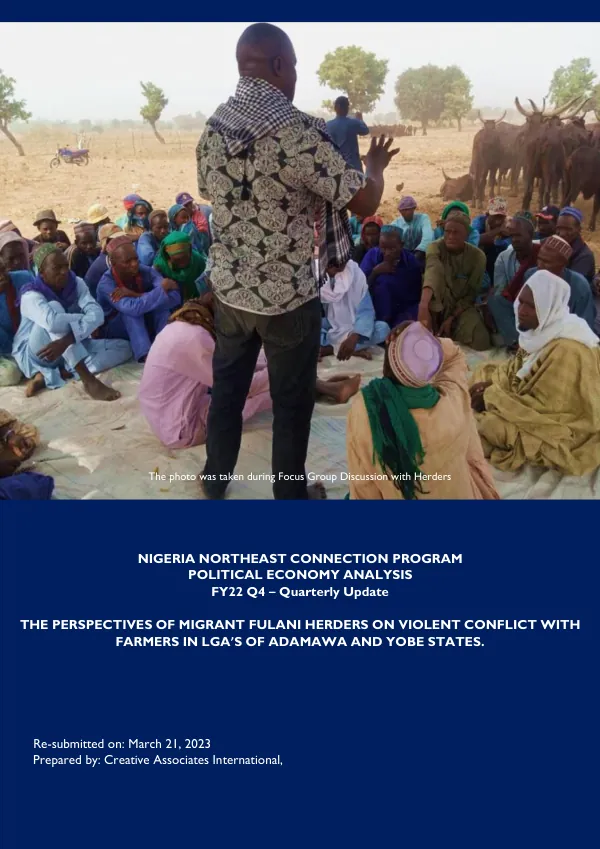
The Nigeria Northeast Connection Program Political Economy Analysis FY22 Q4 Quarterly Update focuses on the perspectives of migrant Fulani herders on violent conflict with farmers in Local Government Areas (LGAs) of Adamawa and Yobe States.
2023 · 22 pages
Sign in to readA free account is required to download.
Abstract
The study aimed to understand the issues, context, and dynamics of the conflict from the herders' perspective, which is often underrepresented in studies on farmer-herder conflicts. Research identified several key factors contributing to the farmer-herder conflict, including farmers' intrusion into herders' grazing routes, lack of access to water points for herds, local authorities' partisanship against herders, unfair distribution of basic social amenities, youth drug addiction, and extortion of herders. Herders have mixed perceptions of their relationship with host communities, with some LGAs experiencing a cordial relationship and others experiencing increased hate, hostility, enmity, and distrust. Herders perceived that the government does not treat them well, reinforcing the sentiment of distrust and injustice. The government's reluctance to apprehend and punish cattle rustlers, failure to investigate attacks on cattle and herders, and grazing route encroachers, and extortion on herders have exacerbated the conflict. Violence between herders and farmers has increased suspicion and animosity between both parties, leading to herders taking longer routes to avoid violent interactions and farmers avoiding cultivating in some areas out of fear of attacks. Findings did not establish a direct link between migrant herders and Violent Extremist Organizations (VEOs), but some respondents admitted to paying zakat to unknown groups/individuals in the forest. Herders who go deep into the bushes around Borno State admit to paying zakat to Boko Haram members, who often force them to pay by taking one cow out of every 30 cows. Local legislation, traditional leaders' standing, and local conflict resolution committees have been identified as potential conflict resolution mechanisms. In Lamurde, a bylaw stipulates that herders should leave farming communities by June and return by January 15 of the following year. Traditional leaders, such as Ardos, Jauros, district heads, and Emirs, and associations, such as the Miyetti Allah Cattle Breeders Association of Nigeria (MACBAN) and Tabbittal Pulako, have a significant influence on migrant herders and can leverage their influence to engage with the herders in resolving conflicts with farmers. The Traditional Peace Arbitration Committee (TPAC) was established in Lamurde to mitigate and manage conflicts between herders and farmers. The committee meets regularly to examine and address the conflict between herders and farmers. The study highlights the need for long-term solutions to the farmer-herder conflict, including addressing the root causes of the conflict, improving access to water points and grazing routes, and promoting community engagement and dialogue. The study was conducted in four LGAs: Demsa, Numan, Lamurde in Adamawa, and Fune in Yobe State. The research involved 24 key informants' interviews and 20 focus group discussions with 240 discussants across the four LGAs. The study used academic journals and other relevant peer-reviewed publications to gather secondary data to compare with findings from the field research. The findings of the study have implications for policymakers and practitioners working to address the farmer-herder conflict in Northeast Nigeria. The study highlights the need for a more nuanced understanding of the conflict, including the perspectives of migrant Fulani herders, and the importance of addressing the root causes of the conflict. The study also highlights the potential of local legislation, traditional leaders' standing, and local conflict resolution committees as conflict resolution mechanisms.
Related documents