BAHIR DAR UNIVERSITY
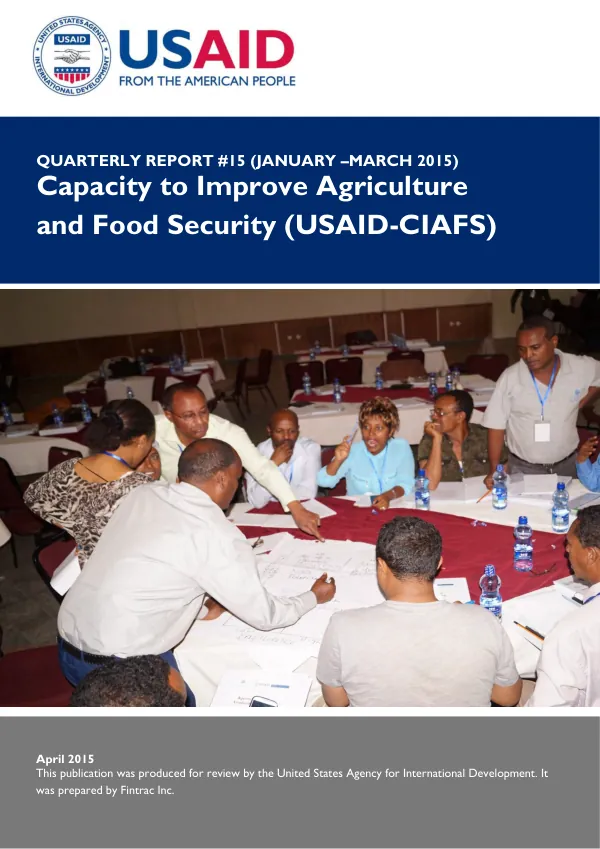
Quarterly Report: Capacity to Improve Agriculture and Food Security (USAID-CIAFS)
Capacity to Improve Agriculture and Food Security (USAID-CIAFS) is an important component of USAID/Ethiopia's multi-year strategy under the Feed the Future (FTF) initiative.
2015 · 8 pages
Sign in to readA free account is required to download.
Abstract
The project's objectives include increasing agricultural productivity, preserving natural resources, improving agricultural marketing, increasing the purchasing power of households, and maximizing food security. USAID-CIAFS supports the Ministry of Agriculture (MOA) and regional Bureaus of Agriculture (BOA) to build their human capital and institutional capacity for decision making and resource use to achieve the Growth and Transformation Plan (GTP) and Agricultural Transformation Plan (ATP) objectives. The project is implemented in the primary regions of Tigray, Amhara, Oromiya, and Southern Nations, Nationalities, and Peoples' Region (SNNPR). Afar and Somali pastoralists are also targeted by CIAFS. The project's first quarterly performance report of 2015 covers January 1 to March 30. Key achievements this quarter included organizing the first regional level leadership training for SNNPR with 60 senior officials from various directorates of the regional bureau participating. The training was well-received, with participants stating that they had become one family, sharing the same objective. The next priority is to scale up and further disseminate the training to district levels in all four regions. USAID-CIAFS also hired local experts to customize the leadership curriculum for district level leaders. The curriculum was piloted in Oromiya region in a training program organized for 60 district leaders selected from the Agriculture Growth Program (AGP) districts. The purpose of the pilot training was to test the relevance and application of the curriculum for eventual roll out to all regions. Informed by comments from participants, the project conducted an extensive consultation process with regional bureaus of all four regions and implemented a training of trainers program. USAID-CIAFS identified 37 lead trainers carefully selected from regional bureaus, allied organizations, and local NGOs. The selected trainers received instruction in the revised leadership curriculum, which included sessions on communication and facilitation. Ten of the participants were from two major civil societies - ORDA and SEPDA - as they have district level agricultural transformation programs. Each of the trainers had previously participated in USAID-CIAFS leadership training and specializes in at least one of the core topics of the curriculum. Participants developed regional level action plans and selected focal persons to interface with regional bureaus to support dissemination of the trainings to district levels. USAID-CIAFS also collaborated with Haramaya University to prepare a tertiary curriculum on climate change to train graduates to support adaptation and the Climate Resilient Green Economy (CRGE) program. The curriculum was presented to and critiqued by subject matter experts. Additionally, the project compiled and published an abridged version of proceedings of the international conference on harnessing biotechnology for agriculture transformation and food security in Ethiopia held last August. The project also edited and prepared for publication 28 research papers on the linkages between climate change and food security prepared in collaboration with Haramaya, Mekelle, and Bahir Dar Universities.
Related documents