USAID DEC
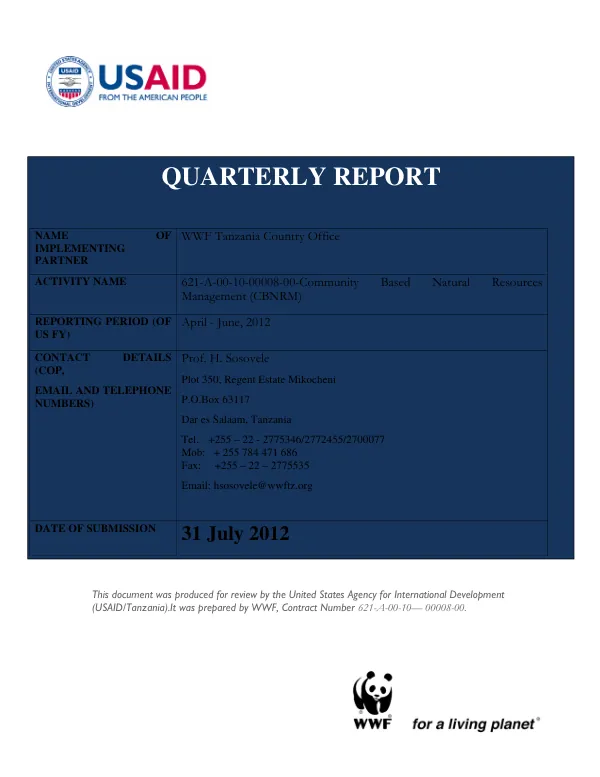
Quarterly Report: Community Based Natural Resources Management (CBNRM) Policy Implementation
Sign inWILDLIFE CONSERVATION SOCIETY
Quarterly Report: Community Based Natural Resources Management (CBNRM) Policy Implementation
The Community Based Natural Resources Management (CBNRM) Policy program in Tanzania began in January 2010 with funding from USAID.
2012 · 19 pages
Sign in to readA free account is required to download.
Abstract
The program's primary goal is to enhance community participation in wildlife conservation through the establishment and management of Wildlife Management Areas (WMA) on village land. By doing so, communities are expected to benefit from sustainable use of natural resources in a WMA and improve their livelihoods. The program also supports the operationalization of the Environmental Management Act (EMA), 2004. The program has also made progress in developing policies and laws that integrate conservation and development. Draft guidelines to address climate change issues were completed and discussed in a stakeholder's consultative workshop during the reporting period. The revised WMA Regulations have been approved, and translation will be commissioned in July-September 2012. The Regulations on Integrated Management of Coastal Zones and Regulations on Management of Protected Wetlands have been drafted and await wider stakeholders' workshop. The program has engaged the Ecosystems and Renewable Resources Consulting Group (ERR) of Kigali, Rwanda to prepare the WMA Biennial Status report. The ERR team is collecting data and visiting all 17 WMAs currently. The WMA status report will provide information on the status of the WMA process highlighting successes, challenges, and policy issues. The draft report is expected by mid-August 2012. The program's target areas include national coverage on policy issues, with a specific focus on the Selous, Ruaha-Rungwa, Tarangire-Manyara Ecosystem, and Rukwa-Katavi Ecosystems. The program has a budget of $10,395,000.00, with an obligated amount of $3,795,000. The program's principal target beneficiaries include local communities in 14 WMAs, local and central government, and the AA consortium. Major counterpart organizations include the Ministry of Natural Resources and Tourism-Wildlife Division and the Vice President's Office-Division of Environment. The program's results performance indicators include the number of hectares of biological significance and/or natural resources under improved natural resource management, the number of person hours of training in natural resources management and/or biodiversity conservation, and the number of people with increased economic benefits derived from sustainable natural resource management and conservation. The program's progress has been largely off track during the reporting period, but extra efforts will be required to implement activities by December 2013.
Related documents