CHEMONICS
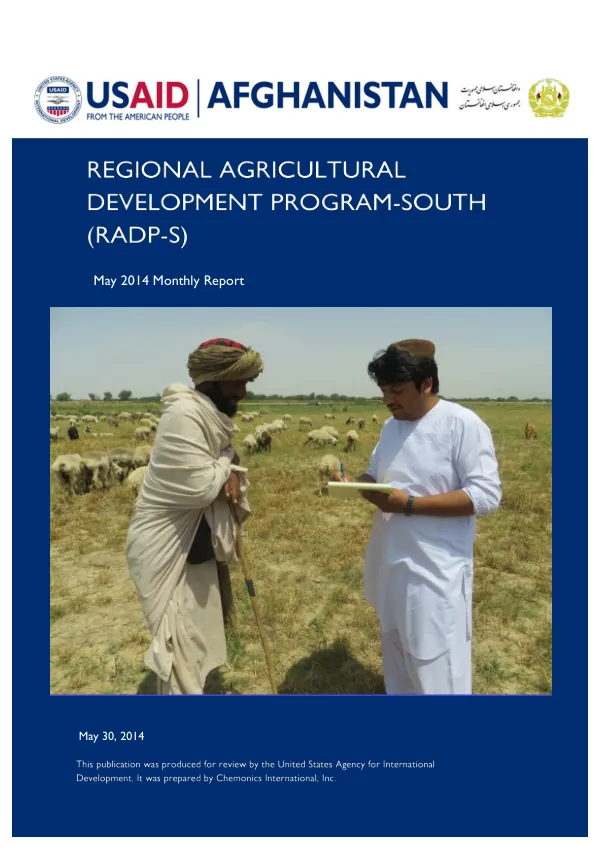
Regional Agricultural Development Program-South May 2014 Monthly Report
The Regional Agricultural Development Program-South (RADP-S) aims to improve food and economic security for rural Afghans in the provinces of Kandahar, Helmand, Zabul, and Uruzgan.
2014 · 13 pages
Sign in to readA free account is required to download.
Abstract
To accomplish this goal, RADP-S focuses on improving the productivity and profitability of the wheat, high value crops, and livestock value chains, while addressing policy, legal, and regulatory constraints affecting value chain development. The program supports the consolidation of licit economies to fuel sustainable long-term economic growth, including providing alternatives to poppy cultivation. RADP-S implementation approach dovetails with Afghan and U.S. government strategies in its focus on advancing food security, regenerating agribusiness, and increasing agriculture sector jobs and incomes. RADP-S aims to strengthen the capacity of producers, associations, traders, and agribusinesses to respond to market demands; facilitate lasting market linkages between value chain actors; and support an enabling environment that allows the private sector to thrive. The program places the Afghan private sector at the forefront of agricultural development, with a focus on increasing the competitiveness and productivity of the agricultural sector. Key Implementing Partners (KIPs) play a crucial role in the implementation of RADP-S. KIPs are responsible for managing and administering the program, including providing technical assistance, training, and capacity building to farmers, producers, and agribusinesses. KIPs also facilitate market linkages between value chain actors and support the development of an enabling environment that allows the private sector to thrive. The Production, Productivity and Training Unit is responsible for implementing the program's production and productivity interventions, including the development of demonstration plots, training of farmers, and provision of inputs and services to farmers. The unit also focuses on improving the productivity and profitability of wheat, high value crops, and livestock value chains. The Enabling Environment Unit works to address policy, legal, and regulatory constraints affecting value chain development. The unit provides technical assistance and support to the government of Afghanistan to develop and implement policies and regulations that support the development of the agricultural sector. The Value Chain Facilitation Unit facilitates market linkages between value chain actors, including farmers, producers, traders, and agribusinesses. The unit provides training and capacity building to value chain actors, facilitates market linkages, and supports the development of an enabling environment that allows the private sector to thrive. The Gender Unit works to promote gender equality and women's empowerment in the agricultural sector. The unit provides training and capacity building to women farmers, producers, and agribusinesses, and supports the development of policies and regulations that promote gender equality and women's empowerment. The Communications and Outreach Unit is responsible for communicating the program's achievements and impact to stakeholders, including the government of Afghanistan, the private sector, and the international community. The unit also provides outreach and engagement services to stakeholders, including farmers, producers, and agribusinesses. The Monitoring and Evaluation Unit is responsible for monitoring and evaluating the program's progress and impact. The unit collects and analyzes data on the program's achievements and impact, and provides recommendations for improvement to the program management team. The Collaboration with Partners and Stakeholders Unit works to build partnerships and collaborations with stakeholders, including the government of Afghanistan, the private sector, and the international community. The unit provides technical assistance and support to partners and stakeholders, and facilitates collaboration and coordination among stakeholders. The Implementation Challenges Unit identifies and addresses implementation challenges facing the program. The unit provides technical assistance and support to the program management team, and facilitates collaboration and coordination among stakeholders to address implementation challenges.