CHEMONICS
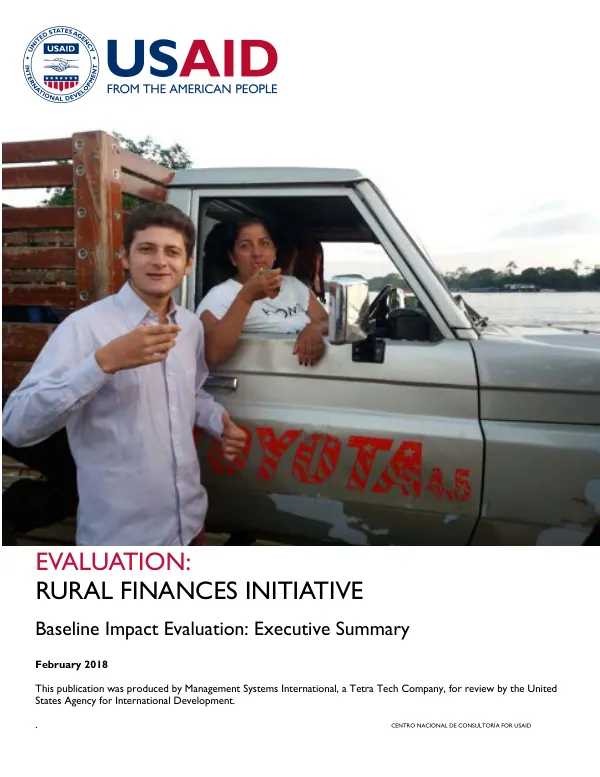
Rural Finances Initiative Baseline Impact Evaluation: Executive Summary
The Rural Finance Initiative (RFI) aims to improve financial services in 197 municipalities affected by the armed conflict in Colombia.
2018 · 12 pages
Sign in to readA free account is required to download.
Abstract
The initiative is implemented by Chemonics International and aims to improve the quality of financial services, increase access to financial services for the rural and vulnerable population, reduce the costs of financial services, and improve the efficiency and effectiveness of financial services. The baseline evaluation of the RFI was conducted by Management Systems International, a Tetra Tech Company, for USAID/Colombia Evaluation and Analysis for Learning (EVAL). The evaluation aimed to measure the impact of the RFI program in the areas of intervention and the performance of the indicators of success defined at the outset of the intervention. The evaluation team selected five municipalities for the treatment group and five control municipalities for the baseline evaluation. The treatment municipalities were selected based on the RFI's intervention, while the control municipalities were selected based on a matching model using relevant variables. The control municipalities were chosen to serve as a comparison to isolate the impact of the RFI on the selected dimensions. A total of 3,047 surveys were conducted, with 1,519 surveys in treatment municipalities and 1,528 surveys in control municipalities. The surveys were conducted in both rural areas and municipal centers, with 41% of the surveys conducted in rural areas and 59% conducted in municipal centers. The study also had a qualitative component, with 56 in-depth interviews conducted with micro-entrepreneur inhabitants, municipal authorities, officials of the RFI's partner financial institutions, and key RFI personnel. The results of the baseline analysis indicate that the efficiency and effectiveness of financial services are linked to the regulation and control system implemented by the Financial Superintendence. The effectiveness of the provision of financial services is conditioned on financial institutions applying regulations in a rigorous manner, which creates barriers that affect access to and reduce the efficiency of bank portfolios in areas that are difficult to access or in which the population is highly dispersed. The evaluation also found that 45% of the population in treatment municipalities have financial products, while 25% have access to cell phone and internet signals. There is a high level of ignorance about the existence and operation of financial products, and the requirements for obtaining bank loans, such as guarantees and co-signers, have a negative relationship with the use of financial products. The population uses services in the informal financial sector, such as "gota a gota" ("drop by drop"), because they are more flexible than services in the formal sector. Cooperatives serve a larger percentage of the rural population and micro-entrepreneurs because they are more flexible. Cash is the most used means of payment for cultural reasons, and because most merchants do not accept other means of payment. The evaluation also found that women's level of savings is similar to men's, but they use a greater proportion of traditional forms of saving. Women receive smaller loan amounts than men, although they report less default on their loans. Transfer and remittance products are common, and are offered mainly by companies that specialize in transfers. The cost of travel from rural areas to financial institutions is high, with $29,375 in treatment municipalities. For more than 45% of rural inhabitants in treatment municipalities, it takes more than one hour to travel to the nearest financial institution. Based on the results of the baseline analysis, the evaluation team recommends that the RFI work with partner banks to improve financial education programs, articulate its strategy for the use of information technologies in performing electronic transactions, take advantage of the flexibility of cooperatives to facilitate the entry of financial services in rural areas, and promote greater use of financial services by women with more manageable savings accounts, shorter travel times, and less risky loan products.
Related documents