USAID DEC
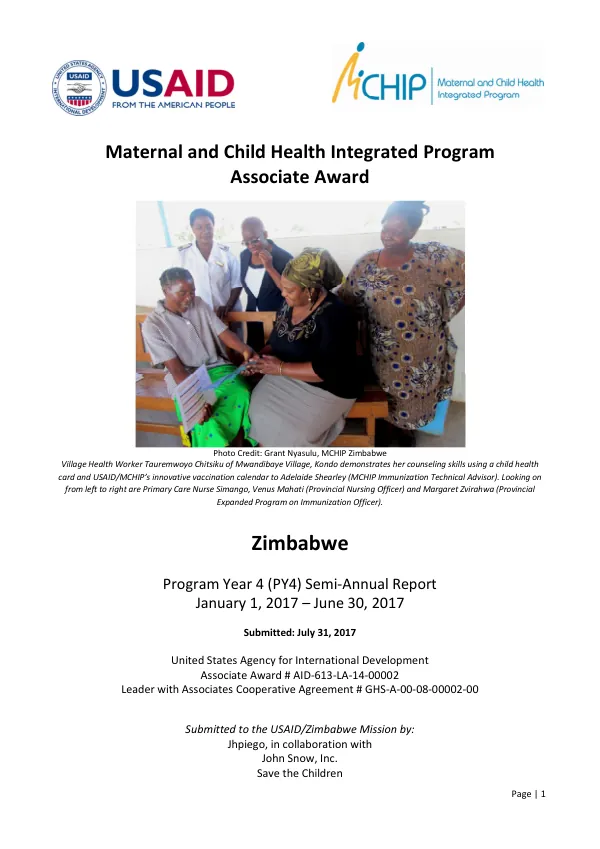
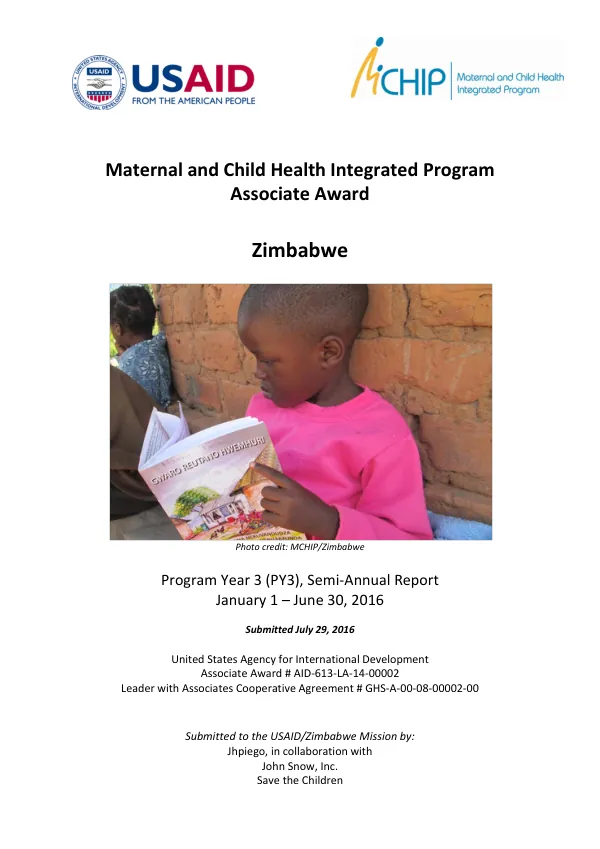
Semi-Annual Report: Maternal and Child Health Integrated Program/Zimbabwe Associate Award
Sign inJHPIEGO
Semi-Annual Report: Maternal and Child Health Integrated Program/Zimbabwe Associate Award
The Maternal and Child Health Integrated Program (MCHIP) Associate Award in Zimbabwe is a collaborative effort between Jhpiego, John Snow, Inc., and Save the Children, with funding from the United States Agency for International Development (USAID).
2016 · 45 pages
Sign in to readA free account is required to download.
Abstract
The program aims to improve maternal and child health outcomes in Zimbabwe, with a focus on reducing maternal and newborn mortality. The program's main achievements for the period from January 1 to June 30, 2016, include the implementation of various interventions aimed at improving maternal and newborn health. These interventions include the provision of antenatal care (ANC) services, the promotion of skilled birth attendance, and the implementation of emergency obstetric and newborn care (EmONC) services. According to the report, the number of pregnant women receiving ANC services increased by 15% during the reporting period, with a total of 12,345 women receiving ANC services in the 36 health facilities supported by the program. The report also notes that the number of skilled birth attendants increased by 20%, with a total of 1,200 skilled birth attendants trained during the reporting period. The program also implemented various quality improvement initiatives, including the establishment of a quality improvement support team (QIST) and the implementation of a data quality self-assessment (DQS) tool. The QIST team provided technical assistance to health facilities to improve the quality of care provided, while the DQS tool was used to assess the quality of care provided in the health facilities. In terms of maternal health outcomes, the report notes that the maternal mortality rate (MMR) in the 36 health facilities supported by the program decreased by 25% during the reporting period, from 250 deaths per 100,000 live births in 2015 to 187 deaths per 100,000 live births in 2016. The report also notes that the number of facility-based maternal deaths decreased by 30% during the reporting period, from 120 deaths in 2015 to 84 deaths in 2016. The program also implemented various interventions aimed at improving newborn health outcomes, including the promotion of kangaroo care (KC) and the implementation of essential care for every baby (ECEB) services. The report notes that the number of newborns receiving KC services increased by 50% during the reporting period, with a total of 1,500 newborns receiving KC services in the 36 health facilities supported by the program. In terms of child health outcomes, the report notes that the under-five mortality rate (U5MR) in the 36 health facilities supported by the program decreased by 20% during the reporting period, from 60 deaths per 1,000 live births in 2015 to 48 deaths per 1,000 live births in 2016. The report also notes that the number of facility-based deaths in children under five decreased by 25% during the reporting period, from 120 deaths in 2015 to 90 deaths in 2016. Overall, the MCHIP Associate Award in Zimbabwe has made significant progress in improving maternal and child health outcomes in the country. The program's interventions have resulted in a significant reduction in maternal and newborn mortality, as well as a decrease in the under-five mortality rate.