NORC AT THE UNIVERSITY OF CHICAGO
Small Grants Programs for Raising Awareness of Vicarious Trauma
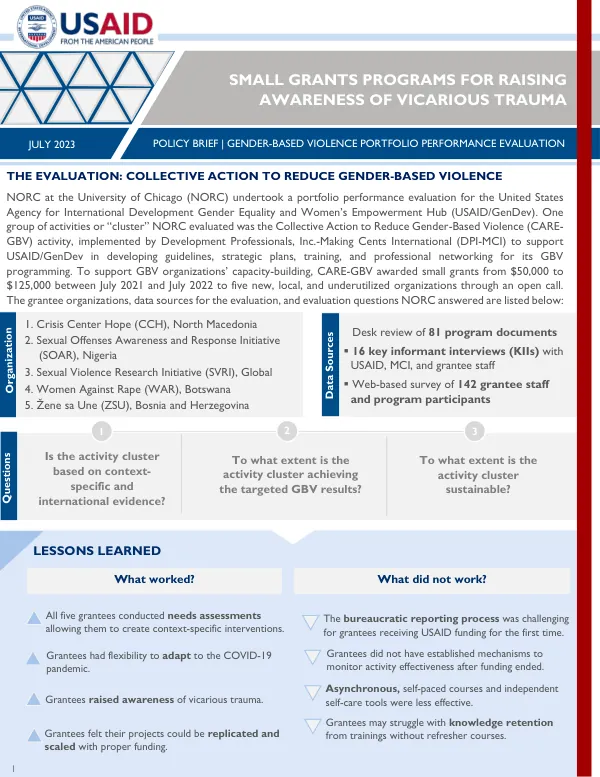
The Collective Action to Reduce Gender-Based Violence (CARE-GBV) activity, implemented by Development Professionals, Inc.-Making Cents International (DPI-MCI), aimed to support the United States Agency for International Development Gender Equality and Women’s Empowerment Hub (USAID/GenDev) in developing guidelines, strategic plans, training, and professional networking for its GBV programming.
2023 · 4 pages
Sign in to readA free account is required to download.
Abstract
The activity awarded small grants from $50,000 to $125,000 between July 2021 and July 2022 to five new, local, and underutilized organizations through an open call. The grantees, which included Crisis Center Hope (CCH) from North Macedonia, Sexual Offenses Awareness and Response Initiative (SOAR) from Nigeria, Sexual Violence Research Initiative (SVRI) from Global, Women Against Rape (WAR) from Botswana, and Žene sa Une (ZSU) from Bosnia and Herzegovina, conducted needs assessments to create context-specific interventions. The assessments allowed grantees to identify local services and establish connections with other GBV organizations, local government officials, and community-based support services. The evaluation found that grantees had flexibility to adapt to the COVID-19 pandemic and that training manuals met the needs of GBV responders to a great extent. However, grantees struggled with knowledge retention from trainings without refresher courses and faced challenges with bureaucratic reporting processes. The evaluation also found that grantees may want to consider joining forces with other GBV organizations to address staff burnout and deliver vicarious trauma interventions. The evaluation recommended that future grantees should be encouraged to leverage the needs assessment phase to identify locally relevant support services. Additionally, stakeholder engagement efforts should be expanded to include a diverse group of partners to better address vicarious trauma within an organization and in the GBV field. The evaluation also suggested that future programs should consider the preferred learning styles of participants and how to best deliver the content, including incorporating synchronous learning methods. The evaluation found that the most effective mechanisms for delivering training were those that provided psychosocial support, self-care, and wellness. Grantees reported that courses which incorporated a diversity of learning aides, such as videos, exercises, and other visual aides, were helpful in keeping them engaged. However, some grantees struggled with making time in their busy schedules to complete asynchronous courses. The evaluation recommended that organizations should institutionalize practices around staff wellness and care by recognizing that staff wellness and care should be a core component of these organizations. Additionally, consideration should be given to additional research and programming to understand how self-care trainings can be customized to support male GBV responders, who may require different approaches to self-care than women. The evaluation concluded that USAID should continue funding programs that address vicarious trauma among GBV responders, but consider greater funding, longer project lengths, or alternative contracting mechanisms. The evaluation also suggested that grantees could consider engaging an established network of GBV service providers, local and international subject matter experts, traditional healers and leaders, government agencies, and CSOs/NGOs to better address vicarious trauma within an organization and in the GBV field.