ABT ASSOCIATES
Sources of Family Planning: Liberia
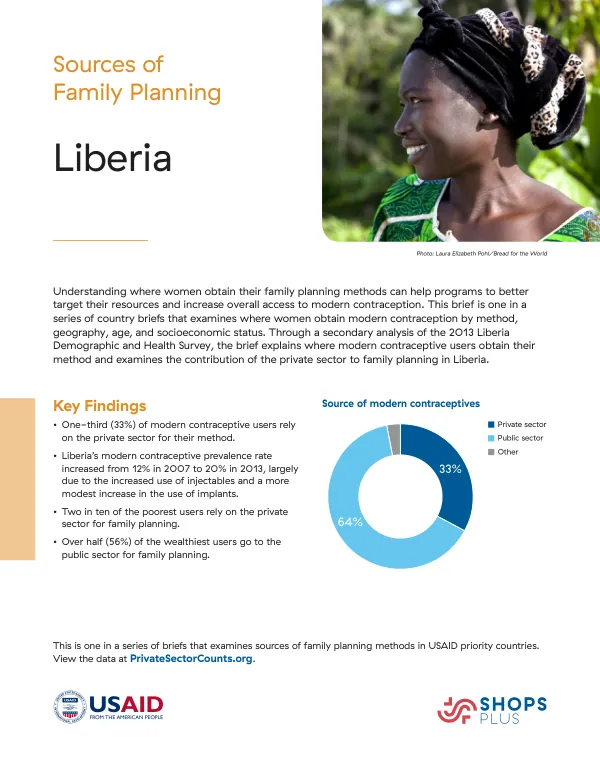
The private sector plays a significant role in providing modern contraceptive methods in Liberia, with one-third of users relying on private sector sources.
2019 · 4 pages
Sign in to readA free account is required to download.
Abstract
The public sector is the primary source of modern contraceptives, accounting for 64% of users. The private sector's contribution to the growth of modern contraceptive prevalence rate (mCPR) in Liberia is substantial, with a three-fold increase in injectables and a rise in the use of implants. The mCPR in Liberia increased from 12% in 2007 to 20% in 2013, largely due to the increased use of injectables and a more modest increase in the use of implants. The use of both short-acting methods (SAMs) and long-acting reversible contraceptives and permanent methods (LARCs and PMs) increased from 2007 to 2013. SAMs increased despite a three-fold decrease in condom use. The private sector's contribution to the method mix is significant, with both the public and private sectors substantially contributing to SAM growth among Liberian women between 2007 and 2013. The use of public sources for implants also increased from less than 1% to 2%. Among users of Liberia's leading method, injectables, 65% use public sources and 34% use private sources. Private sector reliance is higher in urban than rural areas, with 36% of urban users relying on the private sector compared to 26% of rural users. Younger users are slightly more likely to obtain their method from the private sector, with 36% of users under 25 relying on private sources compared to 31% of users 25 and older. The private sector is an important source for contraception, particularly for SAM users, youth, and urban populations. Understanding barriers to private sector provision of pills and injectables would help improve private sector participation and programming. Improving access to injectables in the private sector could allow women who are able to pay to access this method, freeing up government services for poorer women. The government could focus its resources on providing LARCs, while simultaneously working to address policy and regulatory barriers to increase the private sector's capacity to provide a range of contraceptive commodities and services. The wealthiest users rely on the private sector more for SAMs than they do for LARCs and PMs, with 43% of wealthiest users relying on private sources for SAMs compared to 26% for LARCs and PMs. In Liberia, the poorest women are less likely to use a modern contraceptive method than the wealthiest women, with 15% of poorest users relying on private sources compared to 24% of wealthiest users. The private sector's contribution to the growth of mCPR in Liberia is substantial, and understanding the barriers to private sector provision of pills and injectables would help improve private sector participation and programming. The private sector's role in providing modern contraceptive methods in Liberia is significant, with one-third of users relying on private sector sources. The public sector is the primary source of modern contraceptives, accounting for 64% of users. The private sector's contribution to the growth of mCPR in Liberia is substantial, and understanding the barriers to private sector provision of pills and injectables would help improve private sector participation and programming. The government could focus its resources on providing LARCs, while simultaneously working to address policy and regulatory barriers to increase the private sector's capacity to provide a range of contraceptive commodities and services. The private sector's contribution to the method mix is significant, with both the public and private sectors substantially contributing to SAM growth among Liberian women between 2007 and 2013.
Related documents