INTERNATIONAL COMMITTEE FOR THE RED CROSS
Sri Lanka Complex Emergency – Fact Sheet #10, Fiscal Year (FY) 2009
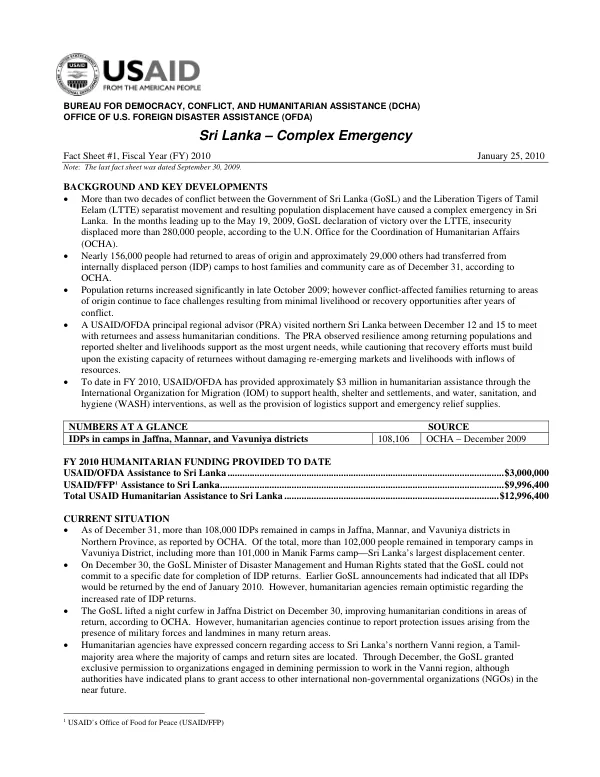
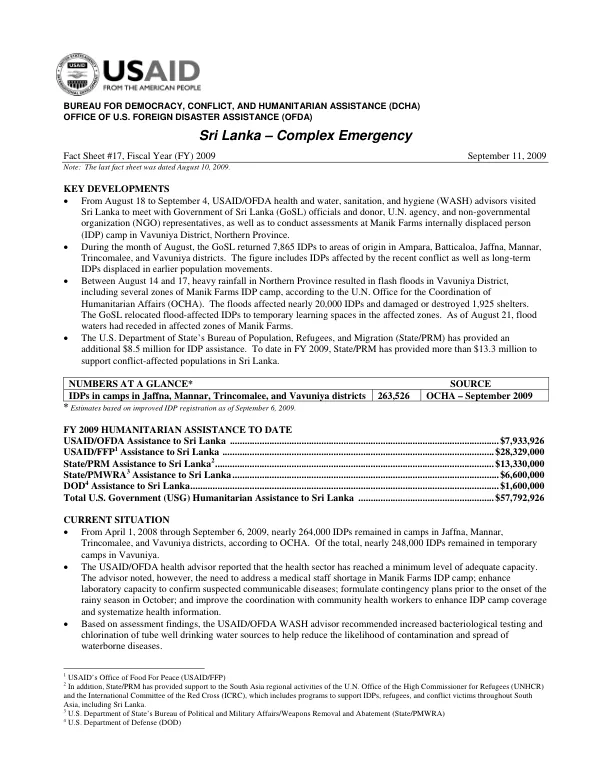
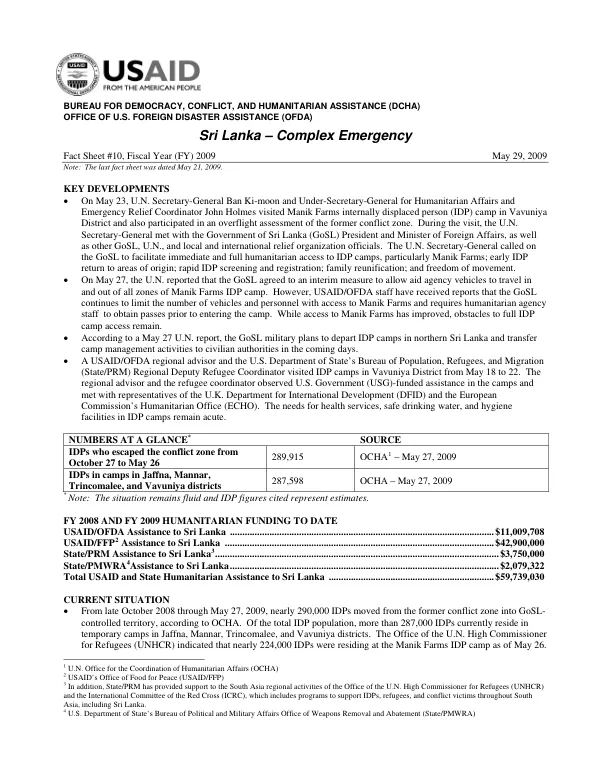
The Sri Lanka Complex Emergency began in late October 2008, with nearly 290,000 internally displaced persons (IDPs) moving from the former conflict zone into Government of Sri Lanka (GoSL)-controlled territory.
2009 · 4 pages
Sign in to readA free account is required to download.
Abstract
As of May 27, 2009, more than 287,000 IDPs resided in temporary camps in Jaffna, Mannar, Trincomalee, and Vavuniya districts. The Office of the U.N. High Commissioner for Refugees (UNHCR) reported that nearly 224,000 IDPs were residing at the Manik Farms IDP camp as of May 26. Humanitarian activities in the IDP camps remained limited, with shelter and sanitation projects and food distributions being the primary focus. According to the U.N., humanitarian organizations continued to provide approximately 900,000 meals per day to IDPs in northern Sri Lanka as of May 27. However, a shortage of staff at the GoSL hospital in Mannar District to treat new admissions, including more than 1,500 injured IDPs arriving from the former conflict zone, was reported by OCHA on May 26. Medical staff shortages exist throughout IDP camps in northern Sri Lanka. The U.N. Human Rights Council (UNHRC) resolution passed on May 27 urged the GoSL to protect minority ethnic groups. However, human rights organizations reported that the failure of the adopted resolution to include calls by European nations to investigate war crimes during the 26-year civil war with the Liberation Tigers of Tamil Eelam (LTTE) ignores claims of abuse by both the GoSL military and LTTE rebels. USAID/OFDA staff are monitoring potential effects the resolution may have on access to IDPs currently residing in temporary camps, including Manik Farms. Humanitarian demining efforts are underway in Mannar District, with the Swiss Foundation for Mine Action (FSD) planning to begin initial demining surveys in late May. The Mine Action Group (MAG) began demining operations in Mannar District in May and estimates that demining each village area will require up to three months. FSD and MAG noted challenges with the demining assessment process, including a lack of first-hand knowledge of GoSL Army and LTTE minefields. The agencies plan to interview IDPs who previously lived in the area to facilitate initial assessments. USAID/OFDA has provided more than $6 million to assist IDPs and returnees in FY 2009, including support for health, logistics, protection, disaster risk reduction, agriculture and food security, economy and market systems, shelter and settlements, humanitarian coordination and information management, and Water, Sanitation, and Hygiene (WASH) programs. USAID/FFP has provided 19,490 metric tons (MT) of P.L. 480 Title II emergency food assistance, valued at $14.3 million, to the World Food Programme (WFP). State/PRM has provided $1.76 million to the International Committee of the Red Cross (ICRC) to support conflict-affected Sri Lankans.